Here is the pattern I see more than any other when a B2B founder tells me their SEO investment is not working. They hired a specialist six months ago. The specialist produced a thorough audit, a keyword research deck, and a technical recommendations document. Three articles were published. Traffic has not moved. The founder wonders if SEO is even the right channel.
The problem is almost never the specialist. It is a mismatch between what the role actually requires and what the company thought it was buying. Most job descriptions for a B2B SEO specialist are written by marketing teams who have never managed one. The hiring criteria are borrowed from generic SEO job posts. The performance expectations are set without a baseline. The result is six months of strategy decks and no compounding traffic.
After building AI Workforces for 50+ businesses across B2B SaaS, services, and tech categories, I have evaluated dozens of B2B SEO specialist hires and seen both outcomes. This article gives you the framework I use: what a B2B SEO specialist actually does, what they cost when you calculate it fully, how to screen candidates properly, and when deploying an AI SEO Workforce makes more commercial sense than a hire.
What a B2B SEO Specialist Actually Does
A B2B SEO specialist is not a content writer and not a technical developer. The role sits between strategy and execution, covering five core functions.
Keyword and cluster architecture. A B2B SEO specialist maps the full keyword universe for a given ICP and organizes it into pillar-and-cluster structures. One hub article supported by 8 to 12 spoke articles per cluster. This is what builds topical authority. Without it, you are publishing articles, not an SEO programme.
Competitive SERP analysis. The specialist identifies who ranks for your target keywords, what content format wins for each intent, what gaps exist, and where your domain can realistically compete given its current authority. This is the foundation every content brief should rest on.
Content brief creation. The specialist translates SERP analysis into briefs that a writer can execute: target keyword, secondary keywords, recommended structure, competitor gaps to address, E-E-A-T signals to include, word count, and internal linking targets.
On-page and technical SEO oversight. Title tags, meta descriptions, schema markup, internal link architecture, site speed, crawlability. Not deep development work, but enough technical fluency to identify and resolve the issues blocking indexation and ranking.
Pipeline attribution reporting. A B2B SEO specialist tracks the full journey from search to closed deal. First-touch organic attribution in the CRM. MQL and SQL sourced from organic. Cost per organic lead. Without this, your CFO will cut the SEO budget the first time quarterly numbers disappoint.
In 2025, a sixth function has become non-negotiable: GEO (Generative Engine Optimization). Google AI Overviews appear on 13% of all queries. B2B buyers use ChatGPT and Perplexity to research vendors before ever visiting a website. A B2B SEO specialist who cannot structure content for AI citation is optimizing for a distribution channel that is shrinking relative to where buyers now search.
The True Cost of a B2B SEO Specialist Hire
The number most companies use when budgeting is the base salary. That is the wrong number.
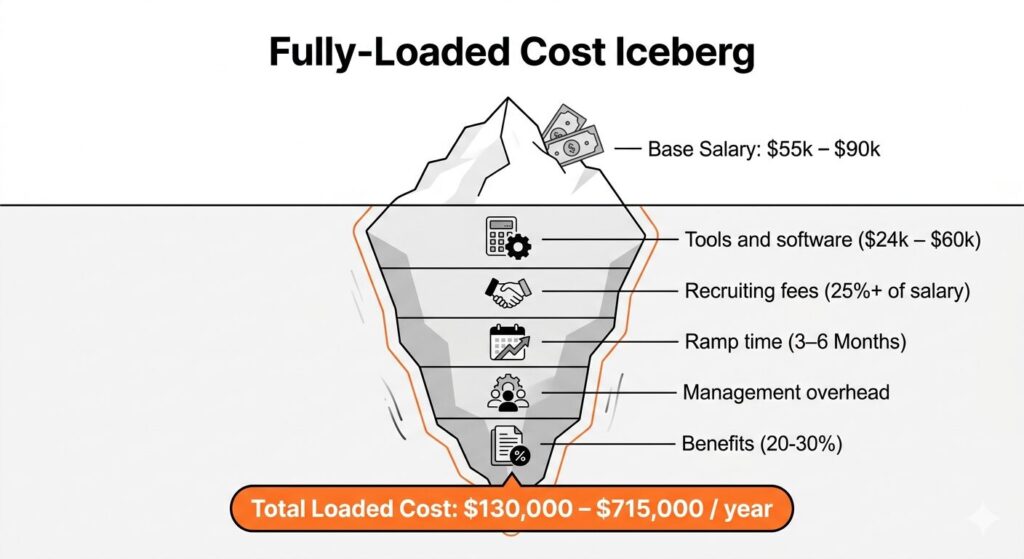
Base salary for a B2B SEO specialist in the US runs $55,000 to $90,000 annually, depending on experience and market. But that is only the starting point.
Add benefits at 20 to 30% of base. Add the tools budget ($24,000 to $60,000 per year for Ahrefs or Semrush, Surfer SEO or Clearscope, plus CRM attribution tooling). Add recruiting fees if you use an agency (25 to 35% of first-year salary for senior roles). Add 3 to 6 months of ramp time during which output is partial. Add management overhead. The fully-loaded cost of a single B2B SEO specialist hire runs $130,000 to $715,000 per year.
| Cost Component | Low Estimate | High Estimate |
| Base salary | $55,000 | $90,000 |
| Benefits (20-30%) | $11,000 | $27,000 |
| Tools and software | $24,000 | $60,000 |
| Recruiting fees | $14,000 | $32,000 |
| Ramp time cost | $14,000 | $23,000 |
| Management overhead | $12,000 | $483,000 |
| Total loaded cost | $130,000 | $715,000 |
The same $130,000 buys 27 months of the AI SEO Workforce Business Plan ($199/month) at 8 to 10 articles per month. The same $715,000 covers the Scale Plan ($399/month) for nearly 15 years.
This is not an argument against hiring. It is an argument for calculating the real number before you decide.
Core Screening Criteria for a B2B SEO Specialist
Generic SEO skill lists do not help you evaluate a B2B specialist. These are the five criteria that actually predict performance in a B2B SaaS or B2B services context.
Cluster architecture experience. Ask them to walk you through a pillar-and-cluster structure they built. If they cannot name the pillar keyword, the number of supporting articles, and the internal link structure, they have not built one. They have published content and called it SEO.
Pipeline attribution fluency. Ask how they track organic pipeline in a CRM. If they answer with Google Analytics traffic dashboards and stop there, they are measuring the wrong metric for B2B. You need someone who can set up first-touch organic attribution and connect it to MQL data.
B2B-specific case studies. Ask for a client example with traffic growth numbers, ranking movement on specific keywords, and pipeline or revenue impact. Generic portfolio sites showing traffic graphs without commercial outcomes are insufficient for B2B evaluation.
GEO and AI search literacy. Ask what they are doing to optimize for AI Overviews and LLM-driven search. If they have no answer, their skill set is 18 months behind the current search landscape.
Red flags to screen out: promising results in under 90 days, inability to define the cluster structure they built for a previous client, no attribution model beyond session counts, and portfolio work that is B2C or ecommerce-focused presented as transferable to B2B.
The 90-Day Accountability Framework
Most B2B SEO specialists are not held to concrete deliverables in the first 90 days. That is why the “they produced audits but no results” outcome is so common. Use this framework to set accountability before day one.
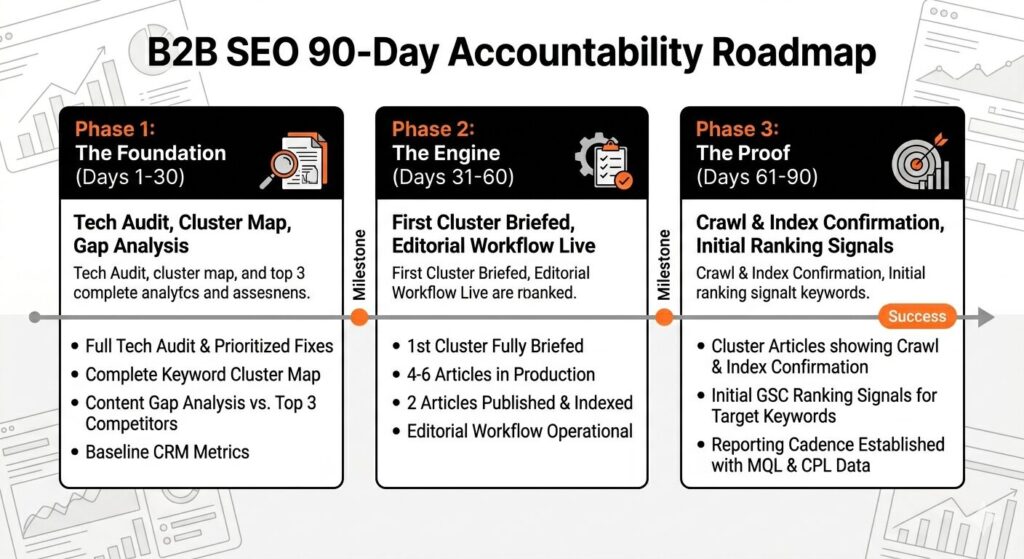
Days 1 to 30. Full technical audit with prioritized fix list. Complete keyword cluster map covering the primary ICP. Content gap analysis against the top 3 competitors for each cluster. Baseline metrics documented in the CRM attribution model.
Days 31 to 60. First cluster fully briefed, with 4 to 6 articles in production. At least 2 articles published and indexed. Editorial workflow agreed and operating. Attribution reporting live in the CRM with first organic session data flowing.
Days 61 to 90. First cluster articles showing crawl and index confirmation. Initial ranking signals visible in Google Search Console for target keywords. Reporting cadence established with clear KPIs: organic sessions, keyword positions tracked, organic MQLs, and CPL versus paid channels.
If these milestones are not met, the engagement needs an honest conversation at day 90, not month 12. A B2B SEO specialist who cannot commit to this framework before starting is telling you something important about how they work. Document these milestones in the offer letter or engagement contract.
B2B SEO Specialist vs. AI SEO Workforce: The Decision Framework
Hiring a B2B SEO specialist is the right move in some situations. It is not the right move in every situation. Use these four variables to decide.
| Variable | Hire a Specialist | AI SEO Workforce |
| Monthly budget | $10,000+ | Under $8,000 |
| Publishing velocity needed | 3 to 5 articles/month | 8 to 28 articles/month |
| Technical SEO complexity | High (complex site architecture) | Standard (content-led growth) |
| Internal editorial oversight | Dedicated editor in place | 2 to 4 hours/week available |
A specialist hire makes sense when your domain has significant technical SEO debt (crawl issues, site architecture problems, international hreflang complexity) that requires hands-on development coordination. It also makes sense when you have an editor already in-house and need a strategist to direct an existing team rather than replace one.
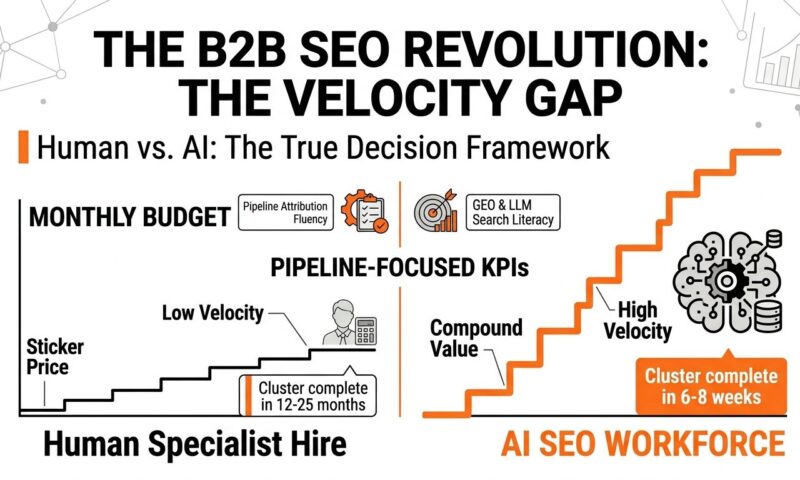
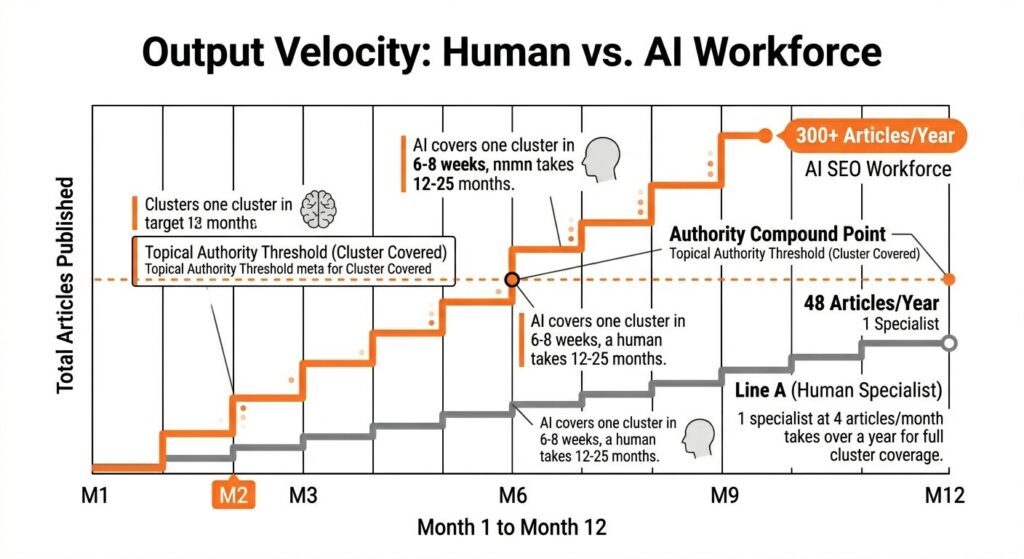
The AI SEO Workforce makes more sense when your primary constraint is content velocity and you need to compound a cluster architecture across 50 to 100 target keywords faster than a single specialist hire can produce output. A specialist writing 4 articles per month takes 12 to 25 months to cover a single cluster. The AI SEO Workforce covers the same cluster in 6 to 8 weeks.
For a full breakdown of solution categories and cost comparisons, the B2B SEO solutions guide covers the decision framework across all four options.
What the AI SEO Workforce Delivers: Proof
I built the AI SEO Workforce because I kept seeing the same outcome: B2B companies with real products and real buyers unable to compound organic growth because content production was the bottleneck. A single specialist could not produce at the velocity the cluster architecture required.
EasyOps, a B2B SaaS inventory management platform, deployed the AI SEO Workforce at 24 to 25 articles per month. CEO Rajiv Mehta described the starting position: “We were invisible in the market. Our paid ads brought some traffic, but the costs were unsustainable.” In 8 months: organic traffic from 4,200 to 30,500 monthly visitors (626%). MRR from $50,000 to $200,000. Cost per qualified lead from $127 to $43. At month 14, Unicommerce acquired EasyOps for $21.6 million.
ReachInbox, a B2B email outreach platform 180 days from shutdown, deployed the AI SEO Workforce at 25 to 28 articles per month. CEO Anup Sharma: “We went from 2,000 visitors to 17,000, and our conversion rates more than doubled.” In 12 months: traffic from 2,000 to 17,000 monthly visitors (750%). Runway extended from 6 months to 24 months. MRR from $65,000 to $150,000.
Neither outcome was achievable with a single specialist at 3 to 4 articles per month. Velocity was the variable that made the compounding possible. The full methodology behind both engagements is documented in theB2B SEO case studies guide.
For the underlying strategy framework, the B2B SEO pillar covers cluster architecture, ICP content mapping, and attribution setup from the ground up.
Frequently Asked Questions
What is the difference between a B2B SEO specialist and a general SEO specialist?
A general SEO specialist is optimized for traffic volume. A B2B SEO specialist is optimized for pipeline. The difference shows up in keyword selection (long-tail, high-intent commercial terms over head-terms with broad traffic), content structure (ICP-mapped buying stages rather than generic informational content), and reporting (pipeline attribution rather than session counts). Most general SEO specialists can produce traffic. Few can connect that traffic to revenue in a B2B context.
How much does a B2B SEO specialist cost per month?
Base salary runs $4,600 to $7,500 per month. Fully loaded with benefits, tools, recruiting, and ramp time, the true monthly cost is $10,800 to $59,600. Agency retainers covering equivalent specialist-level output run $2,500 to $10,000 per month. The AI SEO Workforce covers the same content execution functions for $199 to $399 per month.
Should I hire a B2B SEO specialist or use an SEO agency?
Hire a specialist if you need dedicated strategic ownership, existing internal execution capacity to direct, and a long-term team-building goal. Use an agency if you need faster ramp time, multi-specialist capacity, and no recruiting overhead. For companies under $500K ARR or those needing 8+ articles per month at sustainable unit economics, the AI SEO Workforce is typically the higher-ROI option at that stage. The B2B SEO agency guide covers the agency evaluation framework in full.
What KPIs should a B2B SEO specialist be accountable to?
At 90 days: number of cluster articles published, keyword positions tracked in Search Console, organic session baseline. At 6 months: organic MQLs sourced, organic CPL versus paid CPL, cluster coverage percentage. At 12 months: organic revenue contribution, pipeline attributed to organic, domain authority trend. Any specialist who reports only on traffic without connecting to pipeline is measuring the wrong outcomes for B2B.
Can AI replace a B2B SEO specialist?
For content operations, yes. The AI SEO Workforce covers SERP research, gap analysis, keyword clustering, brief creation, drafting, QA, and optimisation at significantly higher velocity and lower cost than a single hire.
What it does not replace is deep technical SEO consulting for complex site architecture issues or senior strategic oversight in organizations with existing large content teams. For most B2B SaaS companies under $15M ARR, the AI SEO Workforce covers the functions they actually need from a specialist without the fully-loaded hiring cost.