B2B SEO trends are the measurable shifts in how search engines, AI tools, and B2B buyers discover, evaluate, and engage with content. Not every shift requires a strategic response. Most trend lists treat 10 shifts as equally urgent. After building AI Workforces for 50+ businesses across B2B SaaS, services, and tech categories, I have learned that 3 trends require immediate action, 2 are worth monitoring, and 2 keep appearing on trend lists despite delivering minimal pipeline ROI in B2B SaaS contexts.
This article gives you the priority stack, not the full list.
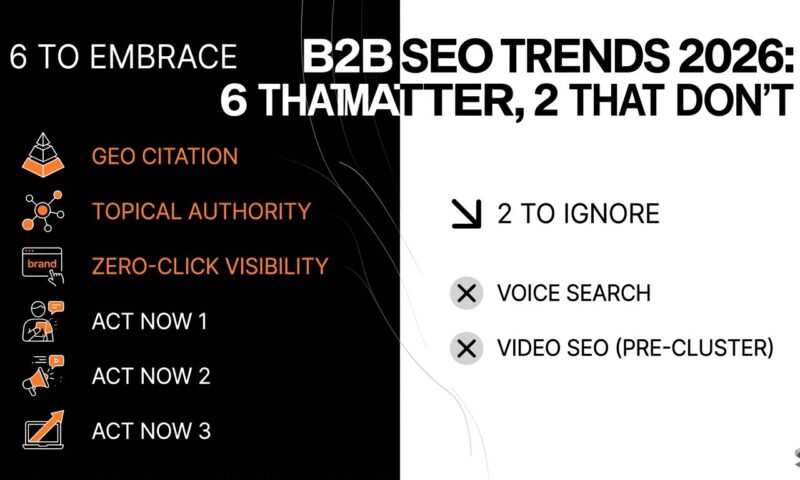
The 3-Tier B2B SEO Trend Priority Stack: Act Now (pipeline impact within 90 days), Watch (significant but 12 to 24 months from mainstream B2B impact), Deprioritize (recurring hype with low B2B pipeline ROI).
Why Most B2B SEO Trends Articles Are Useless
Most B2B SEO trends articles list 8 to 10 shifts and treat every one as equally critical. The result for the B2B marketing team reading it: everything feels urgent, nothing gets prioritised, and the team enters Q1 with a list of “strategic priorities” too long to execute.
The problem is structural. Trend lists are optimised for pageviews, not decisions. Every entry needs to feel important or the reader feels cheated. But a B2B marketing team has capacity for 2 to 3 strategic changes per quarter. An article that tells you everything is urgent tells you nothing.
Three shifts are happening right now and will affect organic pipeline within 90 days if you do not respond. Two are on an 18 to 24 month horizon and will matter, but not yet enough to redirect budget and capacity today. Two have appeared on SEO trend lists for years and have not driven meaningful B2B pipeline results despite the recurring attention.
The framework that follows separates them.
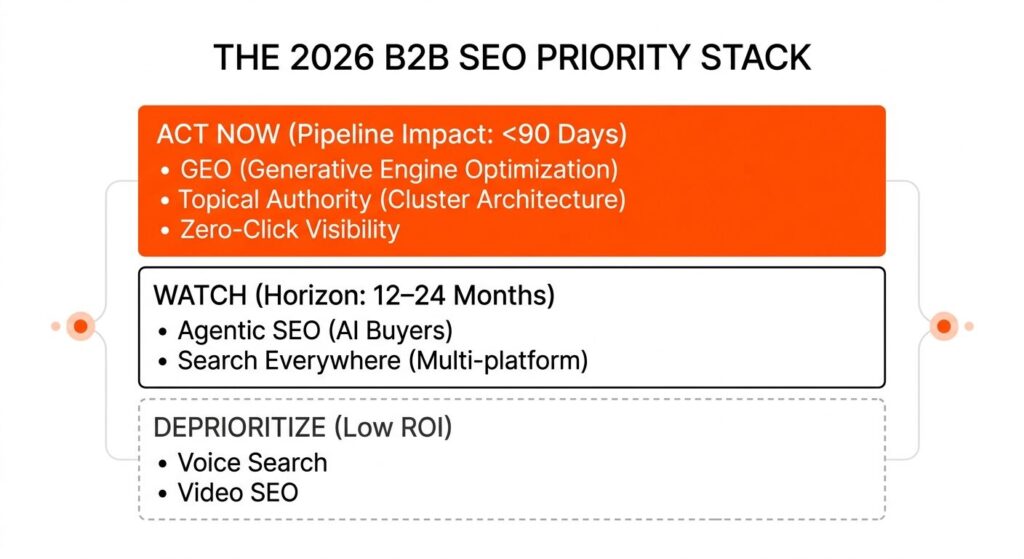
Act Now, Trend 1: GEO Is Replacing Traffic as the B2B SEO Success Metric
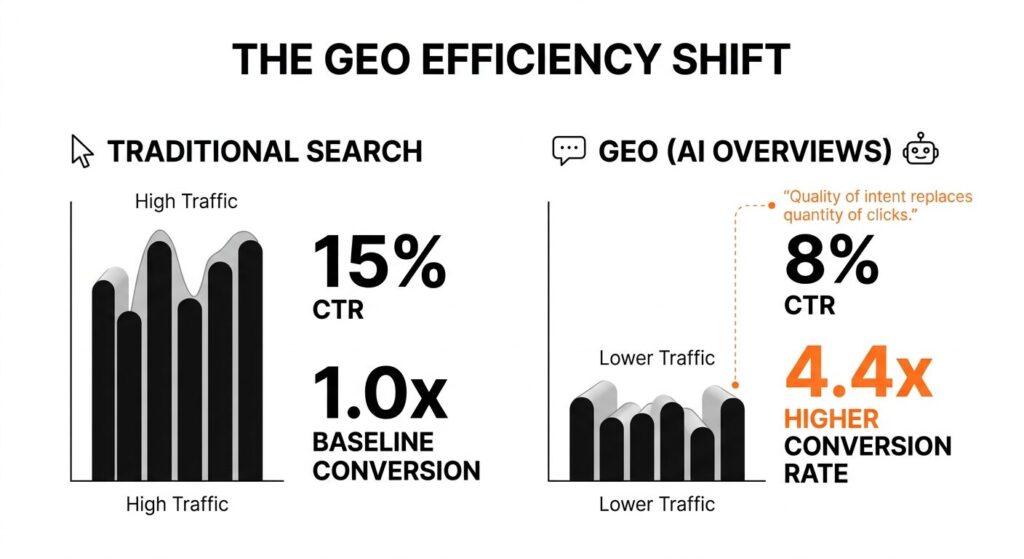
GEO (Generative Engine Optimization) is the practice of structuring content so AI-powered search tools cite your brand when answering buyer questions. Google AI Overviews now appear on 13.14% of all queries, more than doubling from 6.49% in January 2025 (Semrush 2025). When AI Overviews appear, click-through rates drop to 8% versus 15% for standard search results.
For B2B specifically, the implication is positive despite the traffic reduction. AI search visitors convert 4.4 times better than traditional organic visitors (BrightEdge 2025). 80% of B2B technology buyers now trust generative AI as much as traditional search when researching suppliers (Responsive “Buyer Intelligence 2025”). A B2B buyer who encounters your brand cited across 3 separate AI search sessions arrives at a demo call with prebuilt trust.
The metric shift: traffic is no longer the primary B2B SEO success indicator. Brand citation frequency in AI results is.
Implementation step: Add a direct-answer first sentence to every H2 in your content. Structure every FAQ with exact-match question formatting. Include statistics with inline source context, not just footnote citations. These three structural changes make your content extractable by AI systems. Run this audit on your top 10 existing articles before publishing any new content.
Act Now, Trend 2: Topical Authority Is Now the Primary Ranking Signal
Topical authority is the degree to which a domain demonstrates deep, consistent expertise across a related cluster of content. Google and AI systems in 2025 reward domains that own a topic cluster completely, not domains that publish high-quality individual articles on disconnected subjects.
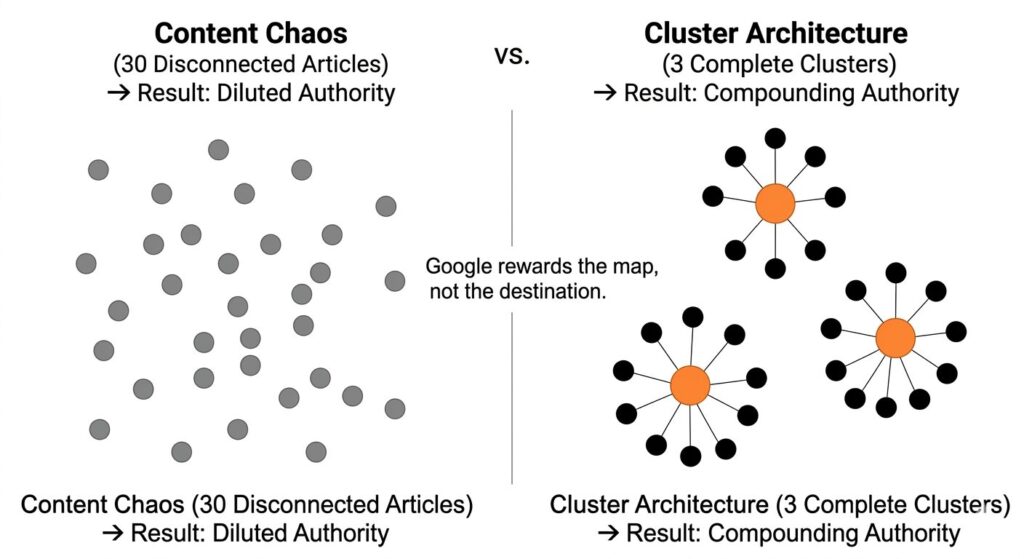
Publishing 3 articles per month across unrelated topics does not build topical authority. Publishing a pillar article supported by 8 to 12 cluster articles on related buyer intent does. The ranking signal is not article quality in isolation. It is cluster completeness.
For B2B pipeline, this means companies that build topical authority in their ICP’s primary problem cluster rank for the full buyer journey, capturing the buying committee at awareness, consideration, and decision stages simultaneously. A single-article SEO approach captures one stage and misses the rest.
Implementation step: Audit all published content. Group articles into clusters by shared topic. Identify clusters with a pillar and 6 or more supporting articles. Prioritise completing those clusters before starting new topics. An incomplete cluster produces partial topical authority. A complete cluster produces compounding authority across all related search queries. Three complete clusters will outperform 30 disconnected articles every time.
Act Now, Trend 3: Zero-Click Means Brand Visibility Beats Ranking Position
60% of Google searches in 2025 ended without a click (SparkToro 2025). When AI Overviews are present, 83% of users get their answer directly within the search interface without visiting any site (Semrush 2025). The traditional value proposition of ranking position 1 (guaranteed traffic) no longer holds in the same way.
What position 1 does guarantee is brand exposure during a high-intent research session. In B2B, where a buying cycle involves 11 stakeholders consuming 27 pieces of content before a decision, being the brand cited repeatedly across those research sessions matters more than any single click.
Zero-click is not the death of B2B SEO. It is a shift from traffic-as-outcome to brand-citation-as-outcome. The B2B companies that respond to this shift by building citation-worthy content will see branded search volume rise even as raw organic traffic numbers flatten or decline.
Implementation step: Add branded search volume as a standalone KPI in your reporting dashboard, separate from organic sessions. Rising branded search against flat organic traffic is a positive signal that zero-click brand building is working. Set up a Google Search Console filtered view for branded versus non-branded query performance. If you are not tracking brand citation frequency in AI tools alongside organic traffic, your reporting framework is measuring the wrong outcomes for 2025 and beyond.
Watch, Trend 4: Agentic SEO (Timeline: 18-24 Months)
Agentic SEO is optimizing content for AI agents that search, compare, shortlist, and potentially purchase on behalf of B2B buyers. Gartner predicts 90% of B2B purchasing will run through AI agents by 2028. When this happens, the agent your buyer uses to evaluate vendors will need to extract, compare, and cite your product’s positioning without any human browsing your website.
This is real and significant. It is not, however, an immediate action item for most B2B SaaS companies in 2025.
Watch because: the content structures that win traditional organic rankings and GEO citations today are exactly the structures that will be retrieved by AI agents. Building for GEO now is simultaneously building for agentic SEO. There is no separate initiative required yet.
Do not reprioritise budget for agentic SEO specifically because: no clear implementation standard exists for B2B SaaS agentic optimisation. The major B2B AI purchasing agent platforms are not yet mainstream. Investing in speculative structural changes now carries high cost and low confidence of return. Monitor, but do not redirect execution capacity from the Act Now priorities.
Watch, Trend 5: Search Everywhere Optimisation (Timeline: 12-18 Months)
Search Everywhere Optimisation is the practice of building brand visibility across every platform where B2B buyers research, not only Google. LinkedIn content, Reddit threads, YouTube, industry forums, and AI tools are all discovery channels your ICP uses before visiting your website.
AI platform visits grew 357% year-on-year in June 2025 (Similarweb). ChatGPT handles approximately 1 in 10 of the search-related activities Google processes daily. The distribution shift is real and accelerating.
Watch because: for B2B SaaS companies under $5M ARR, website organic search still generates the majority of pipeline. The cluster architecture on your domain is the foundation everything else distributes from.
Start partial implementation now: repurpose your cluster articles into LinkedIn long-form content, Reddit posts in relevant communities, and structured answers in industry forums. Do not create net-new content for these channels at the expense of organic cluster development. Distribute content you have already produced. This costs minimal additional time and begins building multi-platform brand citation ahead of the full platform shift.
Deprioritise: The 2 Trends That Keep Appearing and Should Not
Two recurring trends dominate B2B SEO priority lists without delivering pipeline results: voice search and video SEO. Here is why both can be safely deprioritised.
Voice search. Voice search has appeared in the top 5 SEO trends lists for 8 consecutive years. The predicted explosion of B2B voice search behaviour has not materialised in pipeline data for any engagement I have run. B2B decision-makers do not dictate “compare enterprise inventory management software pricing” into a smart speaker during a buying evaluation. Voice search is a B2C convenience behaviour driven by consumer queries. Optimising for it in a B2B SaaS context costs time that produces measurably more return if redirected to GEO and topical authority work.
Video SEO. Video is valuable. For most B2B SaaS companies, however, video production cost-per-MQL is significantly higher than written cluster content at equivalent intent levels. Video SEO belongs in your strategy after your written cluster architecture is built, complete, and producing compounding organic pipeline. Building video before your written cluster foundation is established optimises a secondary channel before the primary one is operational.
What the Right Trend Priorities Produce: Proof
The Act Now priorities, applied consistently, produce compound organic growth. The key is execution velocity across a complete cluster architecture.
EasyOps, a B2B SaaS inventory management platform, deployed the AI SEO Workforce at 24 to 25 articles per month across a defined cluster architecture. CEO Rajiv Mehta: “We were invisible in the market. Our paid ads brought some traffic, but the costs were unsustainable.” In 8 months: organic traffic from 4,200 to 30,500 monthly visitors (626%), MRR from $50,000 to $200,000, CPL from $127 to $43. Unicommerce acquired EasyOps for $21.6 million at month 14. Content was built for topical authority and structured for AI citation from day one.
ReachInbox, a B2B email outreach platform 180 days from shutdown, deployed the AI SEO Workforce at 25 to 28 articles per month. CEO Anup Sharma: “We went from 2,000 visitors to 17,000, and our conversion rates more than doubled.” In 12 months: traffic from 2,000 to 17,000 monthly visitors (750%), runway from 6 to 24 months, MRR from $65,000 to $150,000.
Both results were built on Act Now priorities, not on voice search optimisation or video SEO. The full cluster methodology behind both engagements is in the B2B SEO case studies article. For the strategic framework behind the cluster architecture, the B2B SEO pillar covers the full methodology. For execution options at your current stage, the B2B SEO solutions guide covers the decision framework and cost comparison. For how B2B SEO fits into your broader channel mix, the B2B SEO marketing guide covers channel integration and business case building.
Frequently Asked Questions
What are the most important B2B SEO trends for 2025?
The three trends with immediate pipeline impact are GEO (Generative Engine Optimization), topical authority as the primary ranking signal, and zero-click brand visibility. GEO requires restructuring content so AI search tools can cite your brand. Topical authority requires completing full pillar-and-cluster architectures rather than publishing disconnected articles. Zero-click means tracking brand citation frequency alongside organic traffic as a primary KPI. These three shifts are happening now and will affect organic pipeline within 90 days if not addressed.
How is AI changing B2B SEO in 2025?
AI is changing B2B SEO in two concurrent ways. First, AI Overviews appear on 13% of all queries, reducing click-through rates but increasing the conversion quality of visitors who do click. Second, 80% of B2B tech buyers now use generative AI tools to research vendors, making brand citation in AI results a new priority metric alongside traditional organic rankings. The B2B companies adapting their content structure for AI extraction are building a brand visibility advantage that compounds differently from traditional keyword rankings.
Is B2B SEO still worth investing in with zero-click search rising?
Yes. The channel economics of B2B SEO have not changed: organic leads close at 14.6% versus 1.7% for outbound, and organic search generates 44.6% of all B2B revenue. What has changed is the success metric. Traffic is no longer the primary indicator. Brand citation frequency, branded search volume growth, and organic MQL rate are the metrics that matter in a zero-click environment. Companies that optimise for citation rather than clicks are seeing branded search grow even as raw traffic numbers flatten.
What is GEO and why does it matter for B2B?
GEO (Generative Engine Optimization) is the practice of structuring content so AI-powered search platforms retrieve, cite, and recommend your brand when answering buyer questions. Unlike traditional SEO, which optimises for ranking position in a list of links, GEO optimises for whether your brand is referenced in an AI-generated answer. For B2B, where buyers now research on ChatGPT and Perplexity before visiting vendor websites, GEO determines whether your brand exists in the research phase of the buying cycle.
Which B2B SEO trends should I prioritise first?
Start with GEO structural changes: add direct-answer first sentences to every H2, format FAQs with exact-match question headings, include statistics with inline source context. Simultaneously audit your cluster architecture and prioritise completing any cluster that has a pillar but fewer than 6 supporting articles. Add branded search tracking to your reporting dashboard. These three actions address all three Act Now priorities and can be implemented within a single sprint without requiring new budget or tools.