| Client | Apex Ecom |
| Industry | Digital Marketing Agency / Premium Beauty Brands |
| Client Type | Agency (serving D2C beauty brand clients) |
| SuperteamAI Product Used | Custom AI Agent built via DFY consultation |
| Engagement Duration | 12 months |
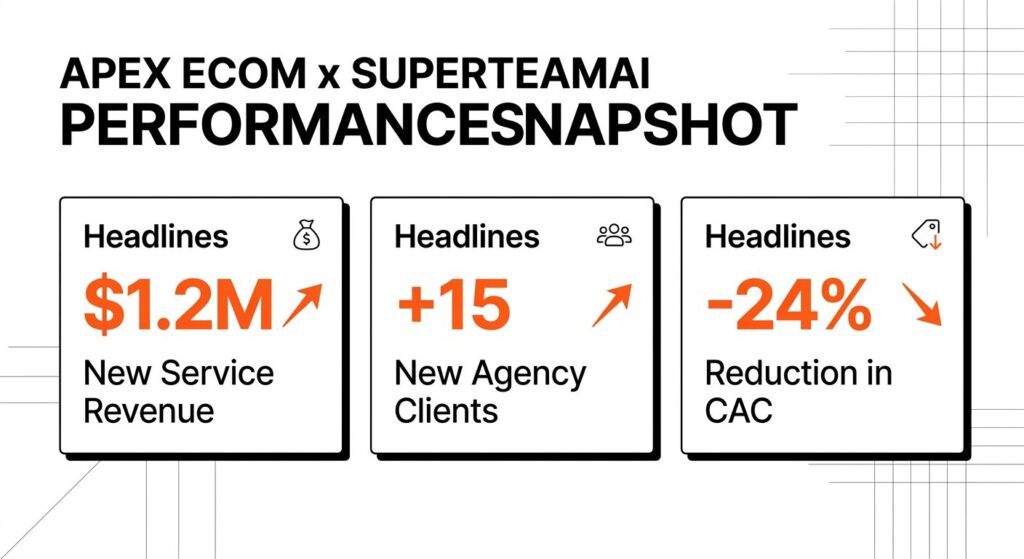
| AI-Referred Traffic | +39% across 6 pilot beauty brand clients |
| AI-Referred Conversion Rate | 2.6% vs. 2.0% for organic (+31%) |
| AI-Referred CAC | $42 vs. $55 traditionally acquired (-24%) |
| AI Revenue Share | 3.4% to 7.8% of total client revenue |
| New Agency Clients | 15 acquired on the strength of this capability |
| New Service Revenue | $1.2M over the 12-month period |
SECTION 1: THE STARTING POINT
Apex Ecom had been running digital marketing for premium beauty brands for six years. By 2024 the agency had 18 staff, 14 active beauty brand clients, and a strong reputation built on SEO, paid performance, and content programs that consistently moved the metrics their clients cared about. They were good at the work. The problem was that the work was quietly becoming less effective, and it took them a while to understand why.
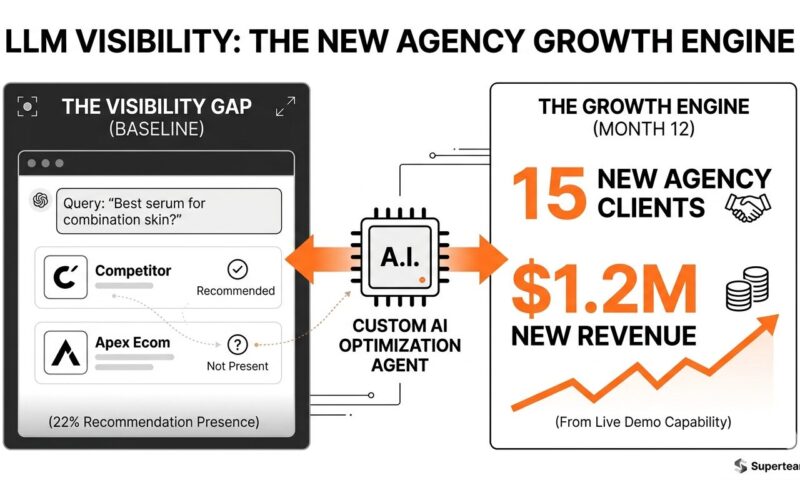
Client analytics were showing softening organic traffic on accounts where rankings had barely moved. Demo request rates from search were declining. A few clients had started asking the same question in different ways: “We’re ranking on Google, but are we showing up when someone asks ChatGPT which serum to buy for combination skin?”
For most of Apex Ecom’s clients, the answer was no.
The behavioral shift was traceable in referral data. Traffic arriving from AI platform referrals, ChatGPT, Gemini, Claude, and Perplexity, was beginning to register as a distinct and growing channel in analytics. But the clients not being recommended on those platforms were losing that traffic entirely. A consumer asking an AI assistant “what should I use for sensitive skin with breakouts” received a direct, synthesized answer with specific product names. If your brand wasn’t in that answer, that consumer never saw you. They didn’t bounce to your paid ad. They didn’t click your organic result. They just bought someone else’s recommendation.
Apex Ecom had no way to monitor this problem, measure how large it was for each client, or address it systematically. None of their existing tools were built for it. They brought the brief to SuperteamAI’s DFY team: build a system that tracks how our clients are being recommended across AI platforms, identifies the gaps, and helps close them.
Rachel Okonkwo, Founder and CEO of Apex Ecom, described what prompted the conversation: “We could see in the data that something was shifting but couldn’t explain it with our existing tools. We knew our clients were losing ground in AI recommendations and we had nothing to offer them. We needed infrastructure, not a workaround.”
SECTION 2: WHAT WAS BUILT
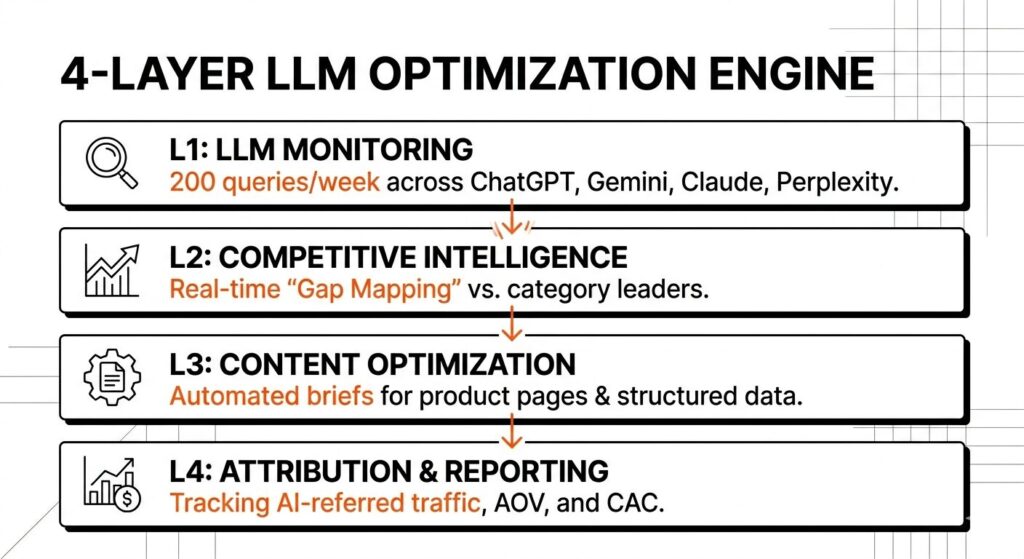
SuperteamAI’s DFY team designed and built the AI Brand Visibility and LLM Optimization Agent over a three-month build phase. The system operates across four layers, each handling a specific function in the monitoring and optimization pipeline.
Layer 1: LLM Monitoring
Every week, the system runs 200 standardized queries per client across ChatGPT, Gemini, Claude, and Perplexity. The queries are structured across four types: skin concern questions (“what should I use for dry, sensitive skin that reacts to fragrance”), ingredient-led searches (“best products with niacinamide for hyperpigmentation”), category searches (“clean beauty foundations for dark skin tones”), and comparison questions (“is X better than Y for anti-aging”). For every query, the system captures whether the client’s brand was mentioned, its position within the recommendation, and the sentiment and specificity of the language used to describe it. This produces a weekly recommendation presence score for each client across each platform.
Before the engagement, Apex Ecom’s six pilot clients were appearing in an average of 22% of their monitored queries. By month 12, that figure had reached 40%, an 82% increase in recommendation presence.
Layer 2: Competitive Intelligence
Every client’s recommendation data runs against their four to six primary competitors in real time. The system tracks where a competitor is gaining recommendation mentions, what product attributes or content signals appear in the language AI platforms use when recommending them, and where a client is absent from a category their competitor is actively winning. This produces a weekly gap map showing exactly which categories and query types need optimization attention.
Layer 3: Content Optimization Engine
The system generates specific recommendations for closing the identified gaps. LLM platforms pull from a content layer when forming recommendations: product descriptions, structured data, ingredient explanation depth, evidence-based efficacy claims, and the presence of third-party citations from authoritative sources. The optimization engine identifies which of these signals are strongest for each category and produces prioritized content briefs for Apex Ecom’s team to implement across client product pages, blog content, and structured data markup.
Layer 4: Attribution and Reporting
AI-referred traffic is tracked as a distinct channel in each client’s analytics, separated from organic search, paid, and direct. Conversion behavior, average order value, and CAC for this segment are reported separately, giving Apex Ecom a clean performance layer to show clients what the optimization work is producing in commercial terms. Each client receives a weekly alert summary and a monthly performance report through the system’s client interface layer.
The full architecture, covering data collection, beauty-specific product intelligence, competitive benchmarking, recommendation analytics, and client reporting layers, connects to Apex Ecom’s CRM and to each client’s e-commerce stack via n8n automation, with integrations into Shopify, Google Analytics, and Klaviyo for the majority of the pilot group.
SECTION 3: THE EXECUTION TIMELINE
Months 1 to 3: Build and Baseline
The build phase ran for three months. SuperteamAI’s team worked directly with Apex Ecom to define the query sets, map the monitoring categories to each pilot client’s product portfolio, and build the beauty-specific product intelligence components that allow the system to understand ingredient efficacy and skin concern terminology at the depth required to evaluate recommendation quality. Connecting the attribution layer to six separate client analytics and e-commerce setups consumed most of month three.
When the monitoring system went live at the end of month three, the baseline data confirmed what Apex Ecom suspected. Across the six pilot clients, average recommendation presence was 22% of monitored queries. For four of the six clients, that figure was below 18%. Competitors in each category were appearing consistently in the 30% to 40% range.
Months 3 to 6: First Optimization Cycle
With baseline data established, the content optimization engine began producing prioritized gap reports. Apex Ecom’s team implemented the highest-priority recommendations first: deepening ingredient and efficacy explanations on product pages, restructuring product descriptions to address skin concern queries more specifically, adding structured data, and building out category content that addressed the conversational question formats the monitoring layer had identified as high-frequency.
By month five, AI-referred traffic for the pilot group had started growing measurably. More importantly, Apex Ecom’s sales team had a live demonstration tool. In prospect meetings, they could run a live query, show exactly how a prospective client’s products were absent from an AI recommendation where a competitor appeared prominently, and show the same query after optimization on a pilot client’s account. That demonstration changed the nature of new business conversations immediately.
Months 6 to 12: Scale and Pipeline
From month six onward, Apex Ecom was running the AI optimization service as a formal new offering at an average monthly retainer of $8,000 per client. The demonstration-led sales process shortened the average sales cycle from 52 days to 35 days, a 33% reduction, because prospects arrived at the first meeting already aware of their LLM visibility problem from the live proof-of-concept run during outreach. The average new client retainer was $7,600 per month, 28% higher than Apex Ecom’s previous average engagement size of $5,900, reflecting the perceived and demonstrated premium value of the new capability.
Fifteen new clients were acquired over the 12-month period on the strength of this service. The total new service revenue generated from these clients during the engagement period reached approximately $1.2M, based on an average of nine months of billing per client at the $8,000 monthly average rate.
SECTION 4: THE RESULTS
For the six pilot beauty brand clients:
Recommendation presence across monitored queries grew from an average of 22% to 40% by month 12. That 82% increase represents a meaningful shift in discovery exposure: for every 200 relevant beauty queries asked on major AI platforms per week, these clients went from appearing in 44 to appearing in 80.
When clients appeared in recommendations, the proportion of those appearances in the top three positions grew from 41% to 70%, a 71% improvement in recommendation positioning. The language AI platforms used to describe these clients shifted from neutral and generic to more specific and favorable, with positive or strongly positive sentiment rising from 52% of appearances to 76%, a 47% improvement in recommendation sentiment.
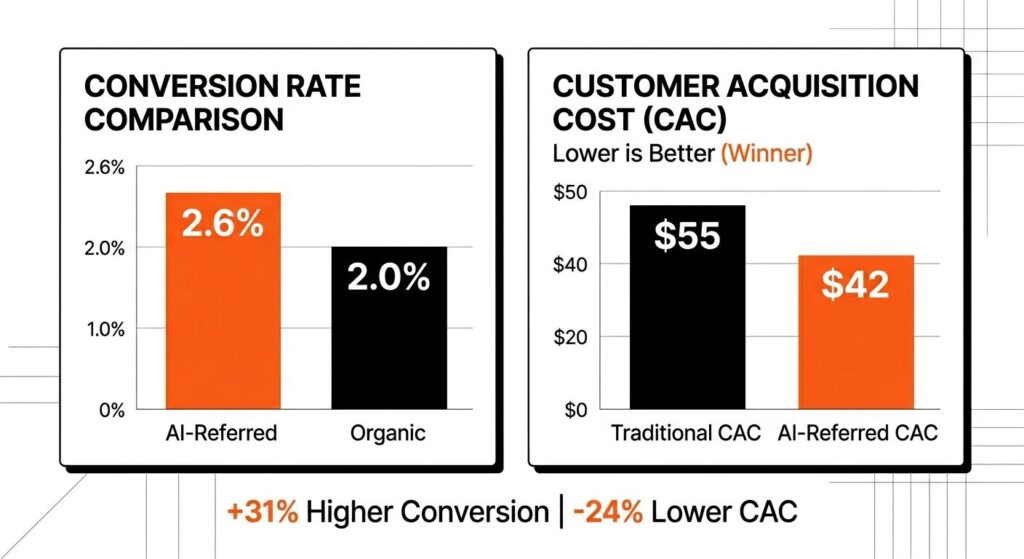
The commercial outcome of improved LLM recommendation presence showed up in analytics as a trackable channel. AI-referred traffic to pilot client product pages grew 39% across the group. That traffic converted at 2.6% on average, against 2.0% for organic traffic, a 31% higher conversion rate, reflecting the higher intent of a visitor who received a specific recommendation before arriving. Customer acquisition cost for AI-referred customers averaged $42 against $55 for traditionally acquired customers, a 24% reduction.
The AI-referred channel grew from representing an average of 3.4% of pilot clients’ total revenue at baseline to 7.8% by month 12, more than doubling its contribution to the revenue mix as both recommendation presence and traffic quality improved together.
For Apex Ecom as an agency:
Fifteen new clients acquired in 12 months specifically for the AI optimization service. Average monthly retainer of $8,000 against a previous agency average of $5,900. Sales cycle shortened from 52 to 35 days. Approximately $1.2M in new service revenue over the engagement period. The live demonstration capability produced a 47% increase in qualified inbound leads in the six months following the service launch, compared to the prior six-month baseline of 28 qualified leads per month, rising to 41.
Client retention at 12 months improved from 79% to 94% across the full agency portfolio, not just the AI optimization clients, because the monitoring system created a performance visibility layer that reinforced the value of the engagement across renewal conversations.
SECTION 5: IN THEIR WORDS
Rachel Okonkwo, Founder and CEO, Apex Ecom:
“Before SuperteamAI built this system, we were watching our clients lose ground in a channel we couldn’t even see clearly. Now we can show any prospect in a live meeting exactly where their brand sits in AI recommendations versus their competitors. That single capability changed our new business completely. We went from competing on execution quality to offering something no other beauty marketing agency in our market could demonstrate. Fifteen new clients in 12 months came directly from that conversation.”
Priya Nair, CMO, Plum Beauty Co. (pilot client):
“We were investing in SEO and performing well on Google, but we had no idea what was happening when someone asked an AI assistant about skincare for sensitive skin. It turned out we were barely showing up. Within six months of the optimization work, we were appearing in nearly twice as many relevant queries, and the customers arriving from those recommendations converted better than almost any other channel we run. The monitoring reports alone changed how we think about content investment.”
SECTION 6: KEY TAKEAWAYS
- LLM recommendation presence is a measurable, trackable channel with its own conversion profile. AI-referred traffic at Apex Ecom’s pilot clients converted at 31% higher rates and came in at 24% lower CAC than traditionally acquired customers. That performance differential exists because a consumer who received a specific AI recommendation before visiting a product page has already passed through an intent qualification step. Agencies that can grow and measure this channel are delivering outcomes their competitors cannot.
- The live demonstration is the most powerful sales tool in a new business conversation. Showing a prospect, in real time, exactly where their brand is absent from AI recommendations while a competitor appears prominently created urgency that no proposal or case study could match. Apex Ecom’s 33% shorter sales cycle and 28% higher average deal size both trace directly to this demonstration capability.
- Custom-built monitoring infrastructure compounds in value over time. The LLM monitoring system builds a richer picture of recommendation behavior in the beauty category with every month of operation. The competitive intelligence layer improves as more baseline data accumulates. The content optimization recommendations become more targeted as patterns in successful and unsuccessful recommendation positioning are identified. This is infrastructure, not a campaign. Apex Ecom now holds a technical advantage in their market that grows more precise, and harder to replicate, the longer the system runs.
The Fastest Way To Upgrade Your Entire Growth Operation.
For the cost of one software subscription, you get the execution power of an elite team without burnout, overhead, or delays. This is how modern companies scale smarter.


