| Field | Details |
|---|---|
| Case Study | Brandigo |
| Industry | Marketing Agency — SEO and Content Operations |
| Workforces Deployed | AI Visibility Tracker, AI SEO Content Workforce, AI SEO Optimization Workforce |
Brandigo, a marketing agency serving content-heavy clients across multiple verticals, deployed three of SuperteamAI’s AI Workforces across their SEO and content operations: the AI Visibility Tracker, the AI SEO Content Workforce, and the AI SEO Optimization Workforce. The deployment replaced three of the most labor-intensive functions in their delivery stack — visibility reporting, content production, and on-page optimization audits — with orchestrated multi-agent systems running under human oversight.
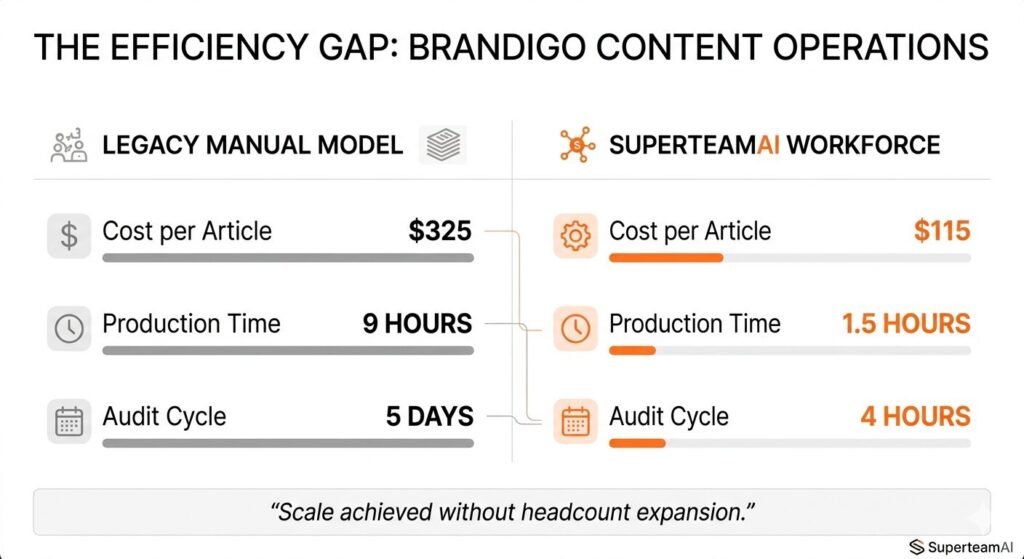
Within 90 days of full deployment, Brandigo reduced per-article production cost from approximately $325 to $115, compressed article turnaround from 8 to 9 hours to 1.5 to 2 hours per piece, and cut their content optimization audit cycle from 4 to 5 days to roughly 4 hours per client. The agency now serves a higher volume of client deliverables per delivery team member without expanding headcount, while also using the visibility tracker as a paid demand-generation tool offered directly to their clients.
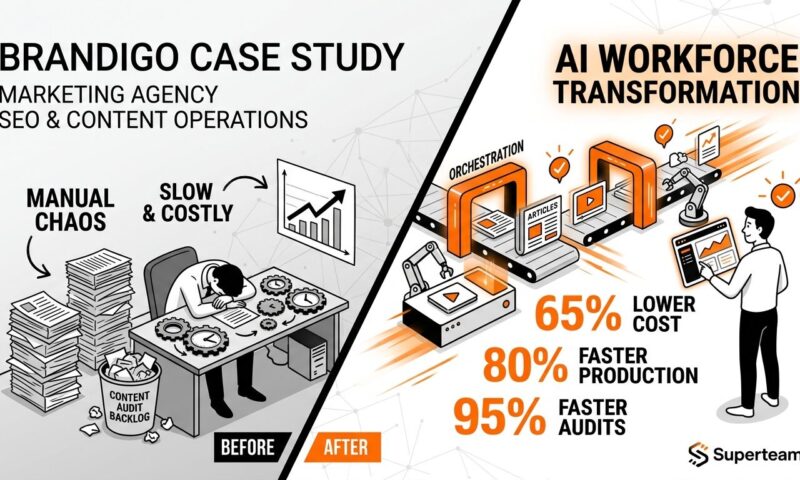
- 65% lower per-article cost
- 80% faster article turnaround
- 95% faster audit cycle
The Challenge
Brandigo operates a content-heavy delivery model. Each client engagement typically requires 45 to 50 content pieces per month, alongside ongoing technical SEO, optimization, and visibility reporting. As the client base grew, three structural bottlenecks emerged.
Bottleneck 1: Content Production Cost and Time
The agency was paying $0.08 per word to writers and $0.30 per word to their editing team. Combined with internal coordination overhead, the fully-loaded cost per article reached approximately $300 to $350. Each article required 8 to 9 hours of total team time across briefing, drafting, editing, and quality assurance. Across 45 to 50 articles per client per month, the delivery team was spending most of their capacity on content production tasks rather than client strategy.
Bottleneck 2: Optimization Audits at Scale
For clients with mature content libraries (in some cases 800+ pages), running a full SEO optimization audit required 4 to 5 days of work to identify gaps, missing alt tags, interlinking opportunities, backlink gaps, and content that needed refreshing. Once the audit was complete, the actual fixes added another 2 weeks of execution time. This made it difficult to scale audit-driven optimization across the client portfolio without continuously expanding the SEO team.
Bottleneck 3: Visibility Reporting Fragmentation
Tracking organic visibility, AI search visibility, and ranking opportunities required pulling data from Google Search Console, GA4, multiple rank tracking tools, and emerging AI search platforms. Producing a single comprehensive client report consumed 3 to 4 hours per client, and the team had no consolidated way to track AI visibility — specifically, whether their clients’ content was being cited by AI engines like ChatGPT and Perplexity.
The Solution
SuperteamAI deployed three integrated AI Workforces in a phased rollout over 6 weeks, each addressing one of Brandigo’s structural bottlenecks.
Workforce 1: AI Visibility Tracker
A multi-agent system that connects directly to Google Search Console and GA4, then layers AI search visibility tracking on top. The workforce identifies high-impression / low-CTR pages, ranking opportunities on pages 2 to 3 of search results, long-tail search patterns, and — critically — whether the brand is being cited by AI engines for relevant queries. When citations are missing, the system documents the exact prompts AI engines use, the chunking patterns of competing content, and the specific content gaps preventing citation.
The deployment also included persona-based AI visibility tracking, a capability most off-the-shelf AI visibility tools do not offer. Before tracking any prompt, the system establishes a persona context, ensuring the tracking reflects how target buyers actually search rather than generic queries.
Workforce 2: AI SEO Content Workforce
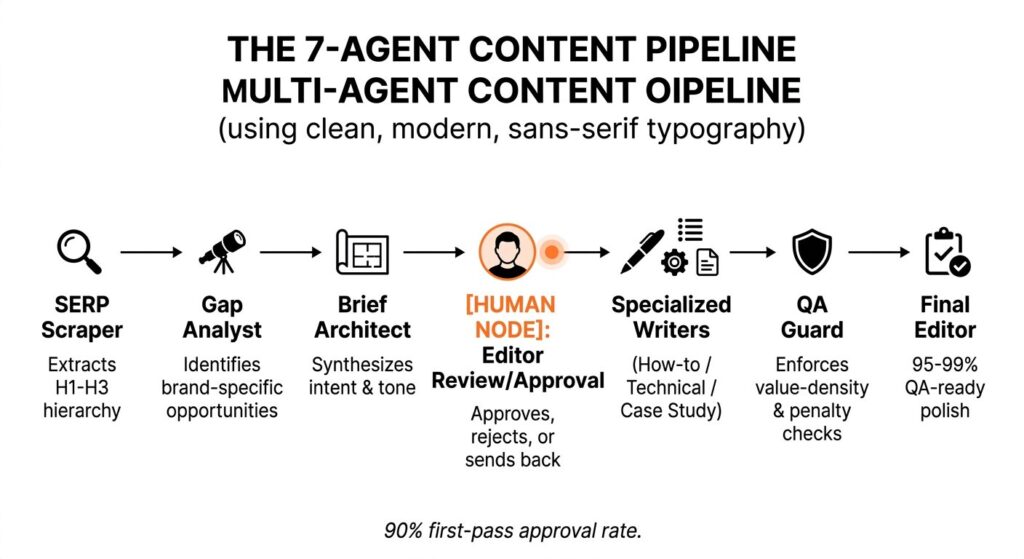
A 7-agent pipeline replacing the manual content production workflow. The workforce takes a target keyword (or pillar keyword) and runs SERP analysis across the first three pages of results — not just page one — to identify high-quality content patterns. A scraper agent extracts and structures all H1/H2/H3 hierarchy and content type signals. A gap analysis agent identifies content gaps the brand can exploit, using contextual awareness of Brandigo’s clients including brand guidelines, persona definitions, premium offerings, free resources, and CTAs.
The brief generation agent synthesizes this into a detailed brief covering intent, content structure, tone, persona, and section-by-section guidance. The brief is reviewed by a human editor and either approved, rejected, or sent back for rework via a dedicated rework agent. Approximately 90% of briefs are approved on the first pass. From there, a content creation manager routes the brief to specialized writer agents — separate agents for how-to content, listicles, case studies, technical content, code-snippet content, and table generation. Each writer agent is paired with a QA agent that enforces Google penalty checks, content quality, keyword density, and value-density standards. Articles only progress to the editor agent at 95 to 99% QA approval.
Workforce 3: AI SEO Optimization Workforce
Two coordinated agents handling content audit and remediation. The audit agent identifies underperforming pages — those with traffic decline, content that’s good but not ranking, missing alt tags, interlinking gaps, and backlink opportunities — and produces a prioritized remediation plan. The optimization execution agent then handles fixes that do not require human creative input: alt tag updates, interlinking improvements, content refresh recommendations, and structural fixes. Backlink-related work continues to require human execution by Brandigo’s team.
The Results
Across the first 90 days of full deployment, the impact was measurable across cost, time, and capacity.
Per-Article Economics
| Metric | Before Deployment | After Deployment | Change |
|---|---|---|---|
| Writing cost per article | $0.08/word (~$240 per piece) | ~$17 per piece | 93% reduction |
| Editing cost per article | $0.30/word (~$90 per piece) | ~$90 per piece (human editor retained) | Unchanged |
| Total cost per article | $300 to $350 | ~$115 to $120 | 65% reduction |
| Time per article | 8 to 9 hours | 1.5 to 2 hours | 78 to 80% reduction |
Optimization Audit Economics
| Metric | Before Deployment | After Deployment | Change |
|---|---|---|---|
| Audit time per client (800+ page site) | 4 to 5 days | ~4 hours human review | 95% reduction |
| End-to-end audit to fix cycle | ~2 weeks | Days, not weeks | Significant compression |
| Capacity to handle additional clients | Bottlenecked by team size | No headcount increase required | Scalable without hiring |
Visibility Tracker as a Revenue Line
Beyond internal efficiency gains, Brandigo repackaged the AI Visibility Tracker as a small-ticket entry offer to their own prospects — a demand-generation tool that brings prospective clients into their funnel and demonstrates SEO competence before any retainer conversation. The tool also became the foundation for monthly client reporting: the team can now generate a comprehensive visibility report in a single click rather than spending 3 to 4 hours per client.
| “We were drowning in content production. 45 to 50 pieces per client every month, hours of editing, weeks of audit work — the math was getting harder every quarter. SuperteamAI didn’t hand us a tool. They built us a workforce. Our cost per article dropped from over $300 to roughly $115, our audits went from a five-day project to a four-hour review, and our team finally has the capacity to focus on the work that actually moves the needle for clients. Honestly, this is the closest I’ve seen to a real shift in how a content agency operates.”Vik Manela, Chief of Staff — Brandigo |
Why It Worked
Domain-specific architecture: The workforces were designed for marketing agency operations specifically, not generic AI-for-everything use cases.
Human-in-the-loop oversight: Editors retained final approval at every stage. AI handled production. Humans handled judgment.
Contextual brand awareness: Each workforce had access to brand guidelines, personas, offerings, and CTAs — producing output aligned with Brandigo’s clients rather than generic SEO content.
Phased deployment: Workforces rolled out one at a time over 6 weeks, allowing the team to absorb each change before adopting the next.


