| Client | EasyOps |
| Industry | SaaS / Cloud-Based Inventory Management (India) |
| Client Type | B2B SaaS Startup |
| SuperteamAI Products Used | AI SEO Workforce (Scale Plan) + DFY Growth Service |
| Engagement Duration | 14 months |
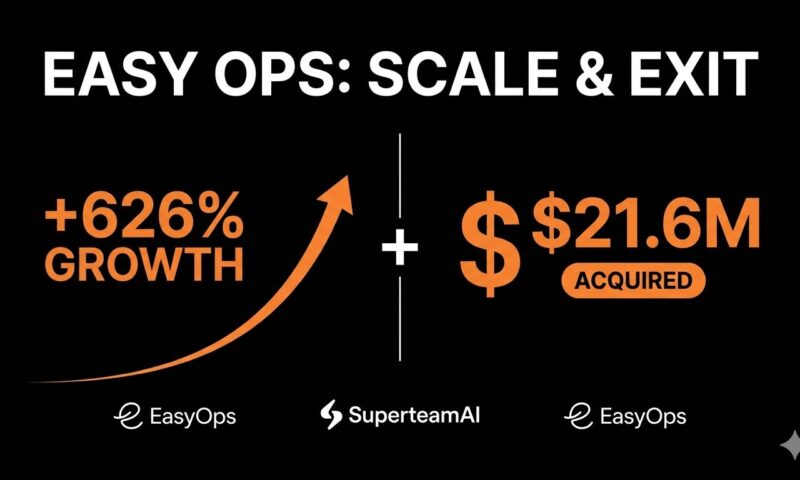
| Organic Traffic | 4,200 to 30,500 monthly visits (+626% over 8 months) |
| Qualified Leads | 95 to 367 per month (+286%) |
| Sales Meetings Booked | 2-3 to 34 per month |
| MRR | $50,000 to $200,000 (4x in 8 months) |
| Exit | Acquired by Unicommerce at $21.6M (9X ARR multiple) |
Founded in 2020, EasyOps built a cloud-based inventory management platform for Indian e-commerce sellers managing stock across Amazon, Flipkart, and their own D2C storefronts simultaneously. The product offered real-time inventory synchronization, AI-powered demand forecasting, and a pipeline leakage detection system designed to catch the stock discrepancies that cost multi-channel sellers revenue every day. On the product side, EasyOps was genuinely competitive. On the growth side, they were stuck.
By early 2024, the company had 12 employees and $50,000 in monthly recurring revenue. That MRR number hadn’t moved in four consecutive months. Organic search brought in 4,200 monthly visitors, almost entirely from branded terms. For commercial queries like “multi-channel inventory management India” or “e-commerce inventory software India,” EasyOps wasn’t appearing in the first ten pages. Five keywords total held any top-10 ranking.
Paid advertising had generated early leads, but the cost per qualified lead had reached $127, and with a modest budget, that channel had hit its ceiling. Three salespeople were booking 2 to 3 outbound meetings per month. They spent roughly 70% of their time on prospecting and only 30% on actual selling.
Rajiv Mehta, CEO, described the situation directly: “We had a genuinely innovative product that solved real problems for e-commerce businesses, but we were invisible in the market. Our paid ads brought some traffic, but the quality was poor and the costs were unsustainable. We knew we needed to build organic visibility and a predictable lead flow, but with a small team, it felt impossible.”
EasyOps had no content strategy, no blog, and no outbound system beyond manual LinkedIn prospecting. Two things needed to be built from scratch: an organic acquisition engine that would compound over time, and a pipeline system that didn’t depend entirely on three salespeople doing manual research.
SECTION 2: THE APPROACH
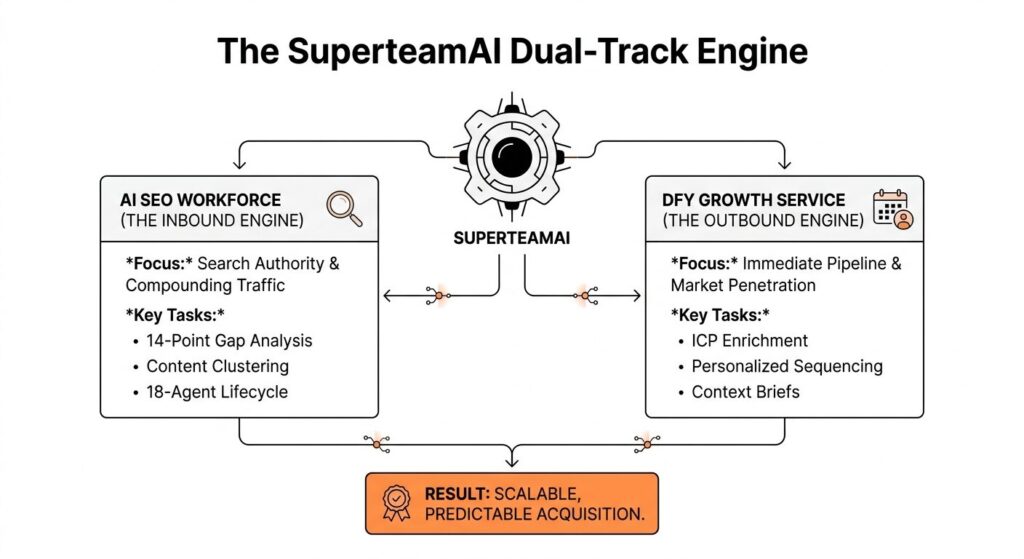
EasyOps engaged SuperteamAI in early 2024 across two service lines, running in parallel from month one.
AI SEO Workforce (Scale Plan)
SuperteamAI deployed the AI SEO Workforce to handle the full content lifecycle. The system’s 18 coordinated agents covered SERP research, 14-point competitive gap analysis, keyword clustering, content brief generation, drafting, editorial QA, SEO optimisation, and meta details. Every article passed through a human review checkpoint before publication. EasyOps’ marketing manager, one of two people on the marketing team, reviewed and approved each brief and final article, maintaining editorial control while the AI SEO Workforce handled production volume.
Content strategy centered on three topical clusters where EasyOps had genuine product depth and where existing content from competitors was thin or generic. The first cluster addressed multi-channel inventory management mechanics for Indian e-commerce sellers. The second targeted inventory leakage and reconciliation challenges specific to D2C brands. The third covered demand forecasting and platform synchronization for businesses scaling across multiple sales channels. Within these clusters, the gap analysis surfaced 243 long-tail keyword opportunities with real search intent and limited competition, mostly terms that established players weren’t creating specific-enough content to own.
DFY Growth Service
SuperteamAI’s team built and managed a full GTM outbound system alongside the content engine. This included ICP research across the Indian e-commerce market, lead enrichment, and personalized outbound sequencing. Four target segments were identified and prioritized: fast-growing D2C brands, multi-channel retailers operating across three or more sales channels, inventory-heavy businesses with over 1,000 SKUs, and recently funded startups at Series A/B stage that were likely hitting scaling pain points. Outreach was personalized per segment, referencing company-specific context including recent funding activity, observable tech stack signals, and industry-specific inventory challenges. Qualified meetings were booked directly into the EasyOps sales calendar with a pre-meeting context brief for each rep.
SECTION 3: THE EXECUTION TIMELINE
Months 1 to 2: Foundation
Weeks one through eight were setup. The AI SEO Workforce was onboarded with EasyOps’ brand guidelines, ICP documentation, and product positioning. SuperteamAI’s DFY team completed the target account research, built the outreach sequences, and reviewed the first batch of content briefs with EasyOps’ marketing manager. Publishing began at the end of month one.
By week five, the DFY outreach system went live. Within two weeks, qualified meetings started appearing on the sales calendar, a meaningfully faster ramp than building an outbound function in-house from scratch.
Months 3 to 5: Early Traction
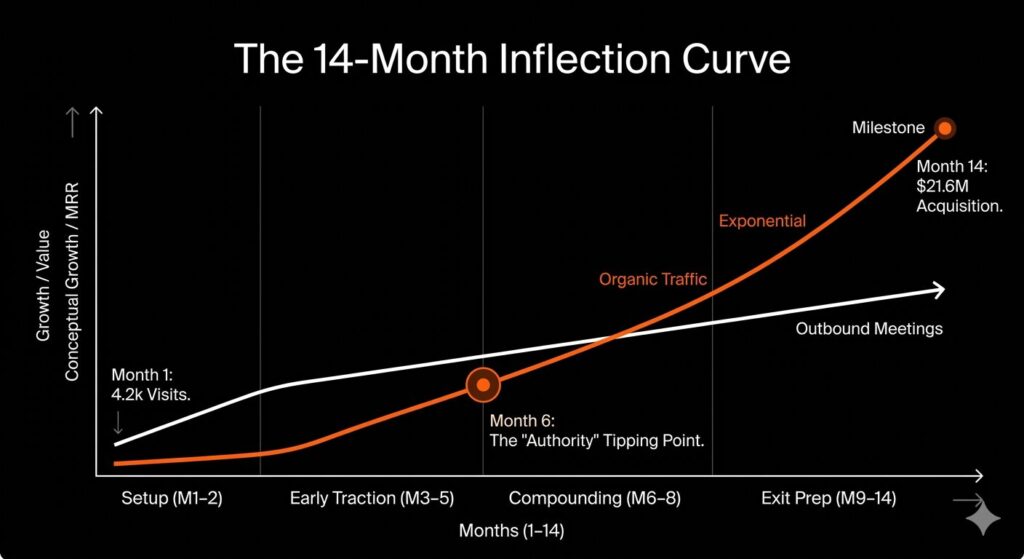
Publishing was running at roughly 24 to 25 articles per month. Early ranking movements appeared in month three, mostly for long-tail terms with lower individual search volume. Monthly organic visits climbed from 4,200 to approximately 10,000 by the end of month five. Keywords in the top 10 grew from 5 to around 30.
The outreach system was booking 20 to 25 meetings per month by month three. Sales team time on prospecting had dropped significantly, and the reps were spending the majority of their week on discovery calls and demos rather than research. Early CRM data showed the close rate on outreach-generated meetings running ahead of the historical baseline from cold outbound.
Months 6 to 8: Compounding
Content published in months one through three had accumulated enough authority to rank competitively. Monthly organic visits climbed from 10,000 to 30,500 by month eight. EasyOps hit the top three positions for “multi-channel inventory management India” and top five for “e-commerce inventory software India,” terms that had been completely out of reach at the start.
Qualified leads from organic reached 367 per month by month eight. Combined with the outreach pipeline generating 34 meetings per month, the sales team couldn’t handle the volume with three people. EasyOps started hiring and expanded from 12 to 28 employees over the engagement, all revenue-funded.
Cost per qualified lead dropped from $127 to $43 by month eight, reflecting the shift toward organic as the primary acquisition channel. MRR grew from $50,000 to $200,000 over the same period.
By month six, the close rate on outreach-generated meetings had improved from 18% at baseline to 31%, tracked across all deals logged in the CRM where a meeting had been booked through the DFY system. Two factors drove the improvement: the pre-meeting context briefs gave reps specific information about each prospect’s pain points and tech stack before every call, and the outreach qualification process meant reps were speaking to people who had already acknowledged they had an inventory problem, not cold contacts being introduced to the concept for the first time.
Months 9 to 14: Acquisition
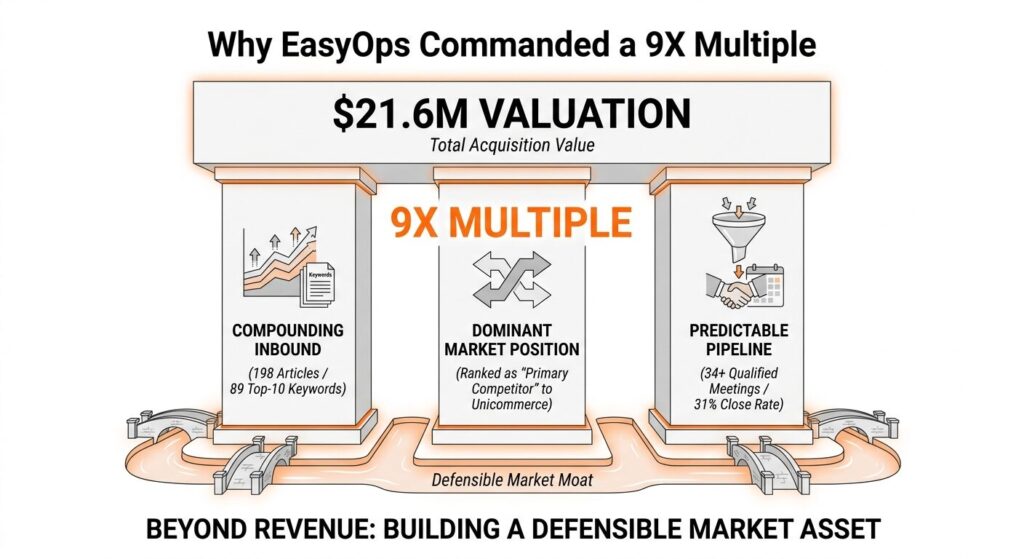
By the end of 2024, EasyOps had 198 published articles, 89 keywords in top-10 positions, and a consistent pipeline of 34-plus meetings per month. Inc42, YourStory, and Entrackr each featured EasyOps in their coverage of the Indian inventory management space, citing the company’s growth trajectory and its emergence as Unicommerce’s primary competitor in the Indian market.
Unicommerce approached EasyOps with an acquisition offer in month 14. The deal closed at $21.6 million, a 9X multiple on $2.4 million in ARR. ($200,000 MRR × 12 months = $2.4M ARR. $2.4M × 9X = $21.6M.) The multiple reflected EasyOps’ growth trajectory and market position, not just current revenue.
SECTION 4: THE RESULTS
Organic traffic grew from 4,200 to 30,500 monthly visits over eight months, a 626% increase. Growth followed the expected SEO compounding curve: roughly 6,000 visits at month three, 10,000 at month five, and 30,500 by month eight as early content began to rank competitively.
Keywords in the top 10 grew from 5 to 89. Targeting competitor content gaps in a niche market accelerated ranking velocity compared to broad SaaS categories where competition is heavier.
Qualified leads increased from 95 to 367 per month, a 286% improvement. Organic visitor-to-lead conversion settled at 1.2%, consistent with niche B2B SaaS benchmarks. The lead volume growth came from traffic scale, not a dramatic conversion rate improvement.
Sales meetings booked went from 2-3 to 34 per month, driven primarily by the DFY outreach system. Sales team time spent on prospecting dropped from 70% to under 25% of their week. Close rate on outreach-generated meetings improved from 18% to 31% by month six, tracked across 127 deals in the CRM, as pre-meeting context briefs and better prospect qualification both took effect.
Cost per qualified lead dropped from $127 to $43, a 66% reduction, as organic and outreach replaced paid ads as the dominant acquisition channels.
MRR grew from $50,000 to $200,000 in eight months. The DFY outreach system, the organic channel, and EasyOps’ own product and sales improvements all contributed. The timing correlation between the channel buildout and the MRR inflection is direct.
Acquisition: Unicommerce acquired EasyOps at $21.6 million, 14 months into the engagement. At $200,000 MRR, EasyOps was generating $2.4 million in ARR. A 9X ARR multiple for a fast-growing niche SaaS being acquired by its market leader is consistent with strategic acquisition pricing, where the buyer is paying for growth trajectory and competitive elimination, not just current revenue.
SECTION 5: IN THEIR WORDS
Rajiv Mehta, CEO, EasyOps:
“SuperteamAI didn’t just provide tools. They became an extension of our growth team. The content engine built our brand authority, and the outreach system filled our pipeline in a way we couldn’t have managed with our small team alone. Within eight months, we went from invisible to being recognized as Unicommerce’s main competitor. The 9X revenue multiple in our acquisition reflected the market position we built together. What SuperteamAI delivered wasn’t just traffic or leads. It was a company worth acquiring at a premium.”
Amit Patel, Marketing Manager, EasyOps:
“As a two-person marketing team, we were stretched. The AI SEO Workforce produced more high-quality content in a month than we could have managed in a year. What impressed me most was that the content spoke directly to the pain points of our ICPs. Our conversion rates from visitor to qualified lead improved because we were attracting the right audience with the right message.”
SECTION 6: KEY TAKEAWAYS
- A combined AI SEO Workforce and DFY outreach engagement can function as a complete growth team for an early-stage B2B SaaS company. EasyOps built a market-leading position starting with 12 people, two marketers, and no existing content engine. The combination of content compounding and structured outbound addressed the visibility and pipeline problems simultaneously, which neither approach alone could have done in the same timeframe.
- Niche SaaS markets with specific, underserved search intent reward depth over volume. EasyOps captured top-3 rankings for their primary commercial keywords in eight months because established competitors hadn’t created specific enough content to answer the queries their potential customers were actually typing. The gap analysis approach identifies exactly these openings.
- Organic growth creates acquisition value beyond revenue. Unicommerce’s offer wasn’t driven by EasyOps’ current MRR alone. A buyer paying 9X ARR is paying for a growing keyword footprint, a compounding inbound engine, and a defensible market position that would have become harder and more expensive to displace over time. That asset was built in 14 months.
The Fastest Way To Upgrade Your Entire Growth Operation.
For the cost of one software subscription, you get the execution power of an elite team without burnout, overhead, or delays. This is how modern companies scale smarter.