Client
Highland Estates
Residential real estate builder
Lead sources: ads, portals, offline marketing campaigns, direct calls, and project-specific enquiries
Core Result
Highland Estates was not struggling to generate leads.
They were already receiving almost 1,900 real estate enquiries every week from ads, property portals, offline marketing sources, and direct inbound calls.
The challenge was scale.
At that volume, even a good sales team cannot manually answer every call, qualify every buyer, respond instantly to every form fill, answer every project question, and update every CRM record cleanly.
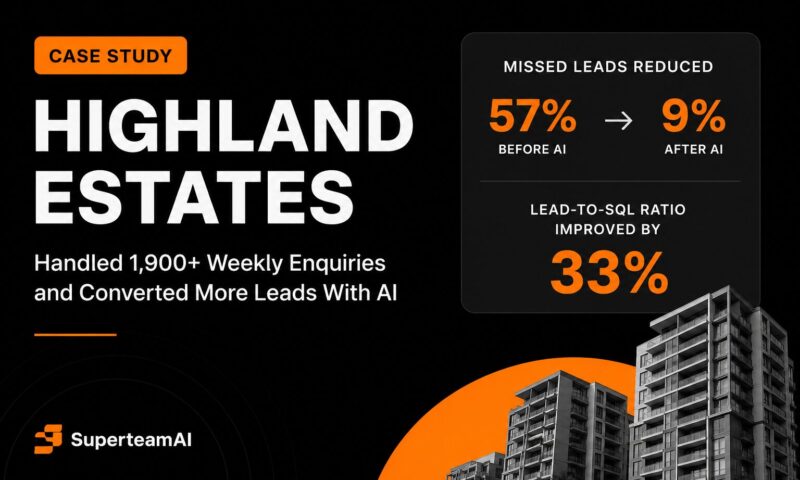
Before SuperteamAI, 57% of leads were missed, delayed, incomplete, or went cold before proper qualification.
After implementing SuperteamAI’s AI Voice Agent and CRM enrichment workflow, missed or cold leads dropped to 9%.
The system also helped Highland Estates improve their lead-to-SQL ratio by 33%, because more leads were answered, qualified, enriched, and handed over to the sales team with full context.
SuperteamAI’s Real Estate AI Operating System is built around this kind of workflow: AI lead qualification, CRM updates, priority tagging, agent briefing, and structured handoff to the sales team.
The Situation
Highland Estates is a residential builder with strong demand generation.
Their marketing engine was already bringing in high-volume project enquiries from multiple channels:
- Facebook and Instagram ads
- Google campaigns
- Property portals
- Offline campaigns
- Hoardings and local marketing sources
- Direct inbound calls
- Website and landing page forms
Most buyers were not asking for a random property search.
They were enquiring about a specific Highland Estates project.
That made the sales process very different from a brokerage.
The buyer already had an interest.
The buyer had already seen the project somewhere.
The buyer usually wanted immediate answers.
The real challenge was making sure every enquiry was answered fast, every buyer question was handled properly, and every sales agent received enriched lead data before making the follow-up call.
Highland Estates had the demand.
They needed a system to protect that demand before it went cold.
The Problem Before SuperteamAI
When a builder receives 1,900 leads every week, the sales problem becomes operational.
It is no longer only about whether agents are good at selling.
It becomes a question of whether the business has the infrastructure to handle buyer intent at scale.
Before SuperteamAI, Highland Estates had four major leakage points.
Problem 1: High Lead Volume Was Overloading the Sales Team
The sales team had to manage calls, callbacks, site visit coordination, CRM updates, buyer questions, lead qualification, and follow-up reminders.
During campaign peaks, enquiries came in faster than the team could respond.
Some calls were missed.
Some form-fill leads were contacted late.
Some portal leads were not reached while they were still warm.
Some offline campaign calls were not captured properly.
The result was simple.
Marketing was creating demand, but sales operations were not able to protect every opportunity.
Problem 2: Project Enquiries Needed Instant Answers
Most buyers were asking about a specific project.
They wanted clarity on:
- Project location
- Unit types
- Price range
- Floor plans
- Amenities
- Possession timeline
- Payment plan
- Booking process
- Site visit availability
- Nearby landmarks
- Connectivity
- Whether the project matched their budget
- Whether it made sense for family use or investment
If the buyer did not receive a quick answer, the momentum dropped.
In real estate, delay creates doubt.
A buyer who does not get an answer quickly may enquire with another builder, another project, or another agent.
Problem 3: Leads Were Entering the CRM Without Enough Context
A lead record usually had basic information.
Name, phone number, source, and project name.
But that was not enough for a high-quality sales call.
The sales team still had to manually discover:
- Budget
- Unit preference
- Purchase intent
- Timeline
- Site visit interest
- Main questions
- Objections
- Urgency
- Language preference
- Whether the buyer was actually qualified
So even when the agent called, the conversation started from zero.
That created friction for the buyer and extra work for the agent.
Problem 4: Too Many Leads Were Never Becoming SQLs
A lead is not valuable just because it enters the CRM.
It becomes valuable when it is qualified, understood, and ready for a sales conversation.
Before SuperteamAI, too many leads were stuck in the gap between enquiry and sales qualification.
Some were missed.
Some were called too late.
Some did not have enough information.
Some were never prioritized properly.
This directly affected the lead-to-SQL ratio.
Highland Estates not only needed more calls answered.
They needed more raw enquiries to become sales-qualified opportunities.
The Weekly Lead Leakage
Highland Estates was handling almost 1,900 leads every week.
Before implementation, 57% of those leads were missed, delayed, incomplete, or went cold before proper qualification.
| Metric | Before AI |
| Weekly Lead Volume | 1900 |
| Missed or cold lead rate | 57% |
| Missed leads | 1083 |
| Engaged leads | 817 |
That meant more than 1,000 buyer enquiries every week were not being properly captured at the moment of highest intent.
After SuperteamAI, the rate of missed leads dropped to 9%.
| Metric | After AI |
| Weekly Lead Volume | 1900 |
| Missed leads | 9% |
| Missed leads per week | 171 |
| Engaged Leads | 1729 |
The improvement was significant.
1,729 handled leads after AI minus 817 handled leads before AI = 912 additional handled buyer conversations per week
That is approximately:
3,648 additional handled buyer conversations every 4 weeks
without increasing lead volume.
Convert more real estate leads before they go cold.
See how AI Voice Agents respond instantly, qualify buyers, enrich your CRM, and hand your sales team warmer conversations.
What SuperteamAI Built
SuperteamAI implemented an AI Voice Agent and CRM enrichment layer for Highland Estates.
The system became the first-response layer for project enquiries.
It handled leads from:
- Ads
- Portals
- Direct inbound calls
- Offline marketing sources
- Website forms
- Campaign-specific landing pages
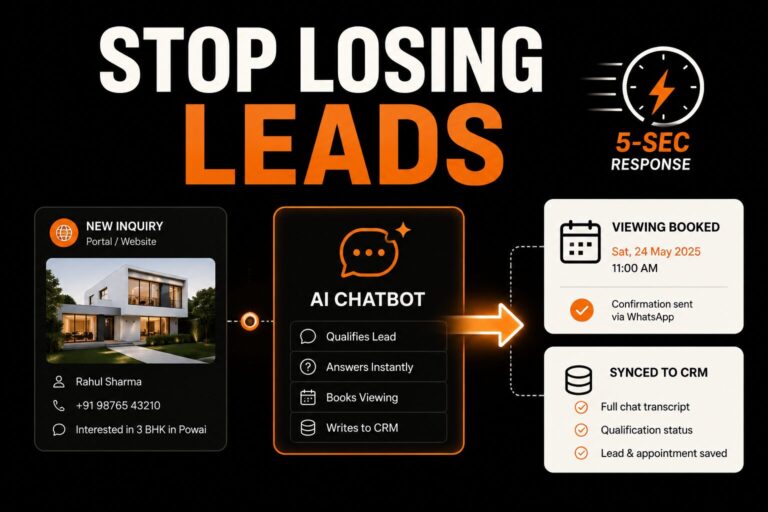
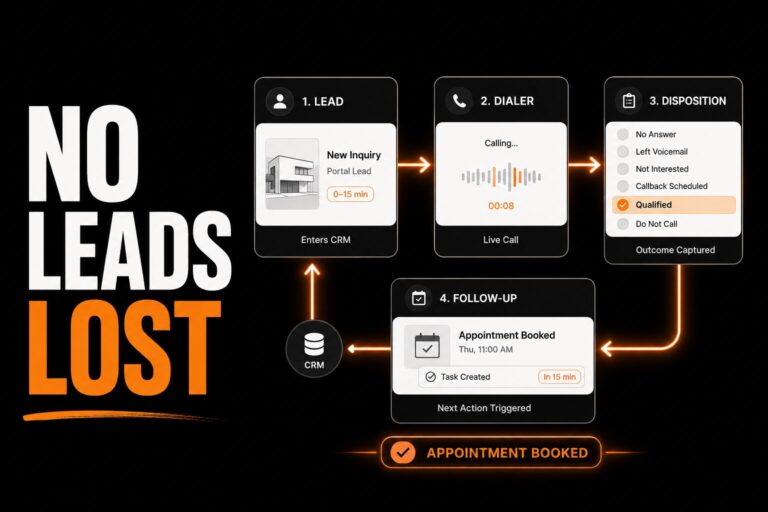
When a lead came in, the AI either answered the inbound call or called the lead quickly after form submission.
The AI then had a structured conversation with the buyer.
It answered project questions where the data was available.
It captured the buyer’s requirement.
It enriched the CRM record.
It prepared the lead for the sales agent.
The sales agent no longer received just a name and phone number.
They received a buyer profile with context.
How the AI Conversation Works
The AI Voice Agent was trained on Highland Estates’ project information.
It was not built to sound like a generic call centre script.
It was built to answer the first layer of buyer questions and collect the information the sales team needed.
During the call, the AI captured:
- Buyer name
- Phone number
- Lead source
- Project enquired about
- Preferred unit type
- Budget range
- Purchase purpose
- Timeline
- Family or investment requirement
- Site visit interest
- Preferred callback time
- Language preference
- Questions asked
- Objections raised
- Urgency level
- Fit for the project
- Recommended next action
This gave Highland Estates clean lead data at scale.
Every conversation became structured.
It became easier to prioritise every serious buyer.
Every agent had more context before calling.
What the AI Answers During the Call
Because most leads were project-specific, the AI focused on answering buyer questions inside the conversation itself.
The AI could answer questions about:
- Project overview
- Location
- Unit types
- Price range
- Available configurations
- Amenities
- Possession timeline
- Basic payment details
- Booking process
- Site visit availability
- Nearby landmarks
- Connectivity
- Project suitability based on buyer requirements
For example, if a buyer asked:
“What is the starting price?”
“Do you have 2BHK or 3BHK units?”
“Where exactly is the project located?”
“Can I visit the site this weekend?”
“What amenities are available?”
“Is this suitable for family living?”
The AI answered immediately if the information was available in the project knowledge base.
This reduced repetitive work for the sales team.
Agents no longer had to personally answer every basic project enquiry before the buyer could be qualified.
What the AI Does Not Handle
The AI was not designed to replace Highland Estates’ sales team.
It was designed to prepare for better sales conversations.
So the AI avoided areas where human judgment or updated commercial approval was required.
The AI did not handle:
- Final price negotiation
- Discount commitments
- Custom payment promises
- Legal commitments
- Loan approval guarantees
- Appreciation promises
- Rental return promises
- Any answer where project data was not updated or verified
When a buyer asked a sensitive question, the AI routed the conversation to the sales team.
For example:
“For the latest price flexibility and payment discussion, I will share your requirement with the sales consultant. They will guide you with the most accurate details.”
This kept the AI useful while protecting the builder from wrong commitments.
The Sales Agent Brief
After every completed AI conversation, the assigned sales agent received an enriched buyer brief.
The brief included:
- Buyer details
- Project interest
- Requirement summary
- Budget
- Preferred unit type
- Timeline
- Purchase intent
- Questions asked
- Objections raised
- Site visit interest
- Lead urgency
- Recommended next step
Example:
Lead: Rahul Sharma
Source: Facebook ad campaign
Project: Highland Estates residential project
Requirement: 3BHK unit
Budget: Within target range
Timeline: Looking to decide within 30 to 45 days
Intent: Family use
Main question: Asked about price range, amenities, and site visit availability
Concern: Wanted clarity on possession timeline
Next step: Call and schedule a site visit this weekend
Priority: High intent
This changed the first human call.
Before AI, the agent might say:
“Hello sir, you enquired about our project. What are you looking for?”
After AI, the agent could say:
“Hello Rahul, I saw you are looking for a 3BHK unit for family use and wanted to understand the possession timeline. I have the latest details ready. Let me help you with the next available site visit slot.”
That is a stronger sales conversation.
It feels faster.
It feels more personal.
It makes the buyer feel understood.
How Lead-to-SQL Ratio Improved by 33%
The biggest business impact was not only the reduction in missed leads.
The bigger impact was that more leads became sales-qualified.
Before SuperteamAI, many enquiries entered the system but did not become proper SQLs because the team lacked speed, context, or clean qualification data.
After implementation, the AI improved the lead-to-SQL process in four ways.
1. More Leads Were Actually Reached
The missed or cold lead rate dropped from 57% to 9%.
This meant the sales team had a much larger pool of properly handled leads to work with.
2. Basic Qualification Happened Before Human Follow-Up
The AI captured budget, unit preference, intent, timeline, and site visit interest before the agent called.
This made it easier to identify serious buyers.
3. Agents Received Better Context
The sales team could prioritize leads based on urgency and fit.
They did not have to treat every enquiry equally.
4. Low-Quality Leads Were Filtered Earlier
Wrong numbers, irrelevant enquiries, language mismatch cases, and low-intent leads were identified earlier.
This helped the sales team focus on better opportunities.
As a result, Highland Estates improved its lead-to-SQL ratio by 33%.
That means the same lead flow started producing more sales-ready opportunities.
The marketing engine did not need to work harder.
The conversion infrastructure became stronger.
Results After Implementation
| Metric | Before AI | After AI |
| Lead volume (Weekly) | 1900 | 1900 |
| Missed leads rate | 57% | 9% |
| Missed leads | 1083 | 171 |
| Enriched leads | 817 | 1729 |
| Lead to SQL ratio | 24% | 57% |
| Lead Scoring | 40 mins | 5 mins |
| Sales team handoffs | 2 – 5 hours | 10 mins |
| CRM Update rate | 40% | 100% |
| Data leakage | 60% | 0% |
| Agent time saved per lead | 3 hours | 20 mins |
| Sales growth rate | 84% | 163% |
The main result was not just fewer missed calls.
The bigger result was that Highland Estates created a more reliable path from lead to SQL.
More leads were answered.
More buyers were qualified.
More CRM records were enriched.
More agents received clear context.
More serious enquiries moved forward.
Convert more real estate leads before they go cold.
See how AI Voice Agents respond instantly, qualify buyers, enrich your CRM, and hand your sales team warmer conversations.
What the Remaining 9% Means
The remaining 9% was not purely missed-call leakage.
Most of it came from cases that were either low quality or outside the system’s current language coverage.
These included:
- Wrong numbers
- Incorrect contact details
- Buyers disconnecting immediately
- People not interested after the first response
- Buyers expecting Malayalam support
- Calls where the buyer declined because the AI could not continue in Malayalam
- A few incomplete conversations where the buyer dropped before qualification
The main known limitation was language support.
The system did not support Malayalam at the time.
So if a buyer preferred Malayalam and did not want to continue in another supported language, the conversation could not be completed properly.
This is an identified improvement area, not a core sales process failure.
Business Impact
1. More Leads Handled Without Increasing Lead Spend
Highland Estates did not need to generate more leads to improve output.
They needed more of their existing leads to be handled properly.
Before AI, around 817 leads per week were properly handled.
After AI, around 1,729 leads per week were properly handled.
That means roughly 912 additional buyer conversations per week were recovered from the same lead flow.
2. Higher Lead-to-SQL Conversion
The lead-to-SQL ratio improved by 33% because the AI created a stronger qualification layer between marketing and sales.
Instead of raw leads entering the CRM and waiting for manual follow-up, leads were answered, qualified, enriched, and routed with context.
This made the sales pipeline healthier.
3. Faster Response to Ads and Portal Leads
Ads and portal leads lose value quickly.
The AI created immediate response capacity.
Buyers were contacted while their interest was still fresh.
This improved the chances of moving them to the next step.
4. Less Manual Work for Sales Agents
Agents no longer had to spend as much time collecting basic information.
The AI handled the first layer of qualification and project answering.
This allowed agents to focus on:
- Serious follow-up
- Project explanation
- Site visit booking
- Objection handling
- Commercial discussions
- Closing
5. Cleaner CRM Data
Every AI conversation created structured lead data.
Highland Estates could now understand:
- Which campaigns generated serious buyers
- Which sources produced wrong numbers
- Which buyers were budget-fit
- Which buyers wanted site visits
- Which questions came up repeatedly
- Which objections were common
- Which leads should be prioritized
The CRM became more useful for both sales agents and leadership.
Before vs After
Before SuperteamAI
- 1,900 weekly leads were difficult to manage manually
- 57% of leads were missed, delayed, incomplete, or cold
- Agents had to answer repetitive project questions
- CRM records lacked buyer context
- Sales agents started calls from basic discovery
- Lead-to-SQL conversion was lower
- Wrong numbers and low-fit leads consumed agent time
- Follow-up quality depended heavily on individual agent discipline
After SuperteamAI
- AI handled the first-response layer
- Missed or cold leads dropped to 9%
- Around 1,729 leads were properly handled every week
- Around 912 additional buyer conversations were recovered weekly
- Project questions were answered during the AI conversation
- Buyer data was enriched before human follow-up
- Sales agents received structured lead briefs
- Lead-to-SQL ratio improved by 33%
- Human agents focused on serious buyers and site visits
The Strategic Lesson
Highland Estates did not need a generic chatbot.
They needed a high-volume lead response and enrichment system built for builder sales.
For builders, the buyer often comes in with interest in a specific project.
The real questions are:
Can you answer immediately?
Can you qualify the buyer quickly?
Can you capture the right data?
Can you identify serious buyers faster?
Can you hand over the lead to sales with full context?
Can you improve the percentage of leads that become SQLs?
That is what SuperteamAI helped Highland Estates solve.
The AI handled speed, qualification, project answering, CRM enrichment, and structured handoff.
The human sales team handled trust, persuasion, site visits, pricing discussions, and closing.
That balance helped Highland Estates turn high-volume enquiries into a more predictable sales pipeline.
Summary
Highland Estates was receiving almost 1,900 real estate enquiries every week from ads, portals, offline marketing sources, and direct calls.
Most buyers were enquiring about a specific project, so the biggest need was not property discovery.
The biggest need was immediate response, project question answering, lead qualification, CRM enrichment, and sales-ready handoff.
Before SuperteamAI, 57% of leads were missed, delayed, incomplete, or went cold before proper qualification.
After implementing SuperteamAI’s AI Voice Agent and CRM enrichment workflow, that dropped to 9%.
This helped Highland Estates properly handle approximately 1,729 leads per week, compared to only 817 before AI.
That is roughly 912 additional buyer conversations recovered every week.
The system also improved the lead-to-SQL ratio by 33%, because more buyers were reached, qualified, enriched, and routed to the sales team with context.
The remaining 9% mostly came from wrong numbers, immediate drop-offs, and language limitations where buyers preferred Malayalam, which the system did not support at the time.
Highland Estates did not just reduce missed leads.
They turned a high-volume lead flow into a structured, sales-ready pipeline.
Convert more real estate leads before they go cold.
See how AI Voice Agents respond instantly, qualify buyers, enrich your CRM, and hand your sales team warmer conversations.