| Client | Kanaz Realty |
| Industry | Ultra-Luxury Real Estate Brokerage, Dubai |
| Client Type | Enterprise |
| Property Segment | 5 million AED ($1.36M USD) and above |
| SuperteamAI Products | Demand Gen Platform Build + Custom AI Agents + DFY Growth Service (AI SEO Workforce) |
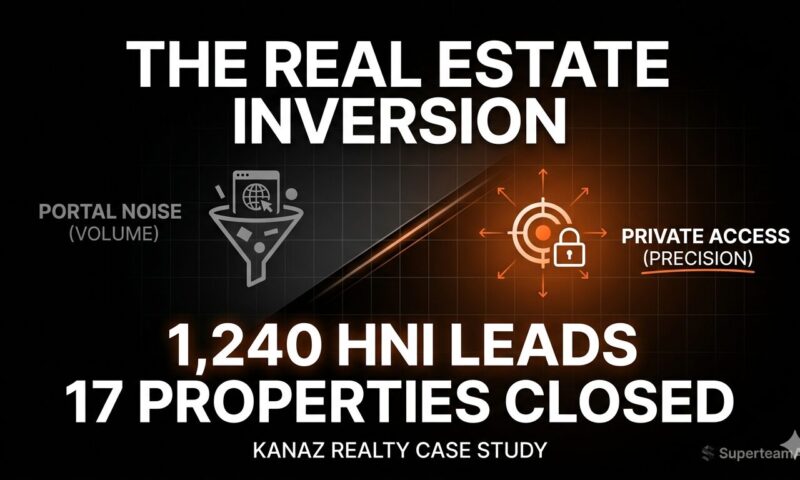
| Key Metric 1 | 1,240 verified HNI leads identified, scored, and invited to the platform |
| Key Metric 2 | 17 luxury properties closed from platform-sourced leads (1.37% close rate) |
| Key Metric 3 | Minimum $462,400 in commissions from platform-generated deals |
| Key Metric 4 | Platform exclusivity generated organic word-of-mouth demand, with buyers requesting access through their own networks |
SECTION 1 — THE STARTING POINT
Kanaz Realty operates in Dubai’s ultra-luxury property segment. Their inventory starts at 5 million AED. At that price point, the property is not just a transaction. It is a statement of positioning, lifestyle, and financial standing. Closing a deal at this level requires a specific category of buyer, a specific quality of conversation, and a level of trust that standard real estate lead generation cannot produce.
The existing model was not built for any of that.
Two problems were compounding each other, and neither was immediately visible from revenue figures alone.
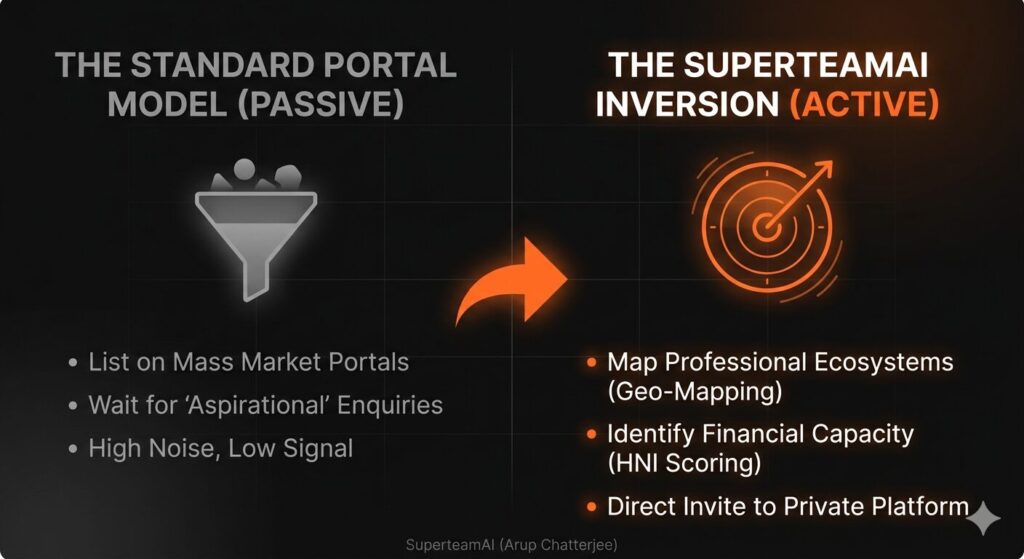
The first was a branding problem. Dubai’s major portals are mass-market platforms by design. They serve buyers across every price bracket, every neighborhood, every profile. A 15 million AED waterfront penthouse appearing in the same listing grid as sub-million dirham apartments communicates the wrong thing. It communicates availability rather than exclusivity. For buyers genuinely operating at the 5 million AED level, the context of where a property is listed matters as much as the listing itself. Kanaz’s premium inventory was sitting in a volume marketplace, and the positioning damage was real.
The second problem was structural. Standard real estate lead generation asks one question: who wants to buy? Then it waits. The issue is that the people who raise their hand through a portal form or an ad click represent the full spectrum of the market. At a 5 million AED minimum, the proportion of genuinely qualified buyers inside a standard inbound mix is extremely small. The rest are aspirational browsers, researchers, or people who clicked a listing out of curiosity with no realistic path to completing a transaction at this price point.
Kanaz’s agents were spending most of their working hours managing conversations with people who could not buy what they were selling. Every hour a specialist luxury advisor spends pre-qualifying an unqualified enquirer is an hour not spent with someone who can actually close. At this ticket size, that is an expensive pattern to run.
The deeper issue was that many of the people who could realistically purchase a Kanaz property were not browsing portals at all. They were running businesses, managing companies, and living their professional lives within proximity to the properties, unaware the opportunity existed. The right buyers were simply not coming through the existing channels.
The right question was not how to get more leads. It was: how do we identify the people who can already afford this specific property before they ever think to look for it?
SECTION 2 — THE APPROACH
SuperteamAI built a purpose-specific demand generation platform for Kanaz Realty that inverts the standard real estate model entirely. Most systems wait for buyers to come to them. This one starts with a property and builds the buyer list from first principles.
The Outbound Identification Engine
For each Kanaz listing, the process starts with geography. Every property is geo-mapped, not just by neighborhood, but by the specific commercial and professional ecosystem within a 10-15 minute radius. Which companies operate nearby. What those businesses do. What the ownership and leadership structure looks like. What a CEO of a company of that size in that industry earns. What a business owner operating that type of establishment realistically nets.
The platform draws from available and ethically sourced data to construct financial capacity estimates: company size, industry vertical, role seniority, business revenue signals, and location proximity to the property. These signals are not used to produce precise income figures. They are directional enough to determine whether a professional is operating at a level where a 5 million AED purchase is a realistic consideration rather than an aspiration.
Contacts who pass the capacity threshold for a specific property receive a personally addressed email invitation with a unique access code. That invitation grants entry to a private, login-gated platform. These contacts had no prior relationship with Kanaz Realty. They were not searching for property. The platform identified them as people who could afford this specific listing based on where they work, what they do, and what the available data suggests about their financial position.
The Private Platform
The invite code leads to a platform that operates nothing like a standard portal. Access is restricted. Buyers only see listings relevant to their profile and geographic proximity. A contact identified near a Business Bay listing does not receive Kanaz’s full inventory. They see the properties most relevant to them, matched to their location and financial profile.
The curation is deliberate and immediately felt by the user. Platform members understand they have been specifically selected and that what they are accessing is not publicly available. That changes how they engage with the listings, how seriously they approach viewings, and how they interact with agents.
Inside the platform, 75+ behavioral signals are tracked continuously. Which listings a user views. How long they spend on each property. How many times they return to the same listing across separate sessions. Which properties they save. How their engagement patterns evolve over time. Whether their interest in a specific location or property type is intensifying or plateauing. Every signal adds context to a composite score. Every return visit tells the agent something a form submission never could.
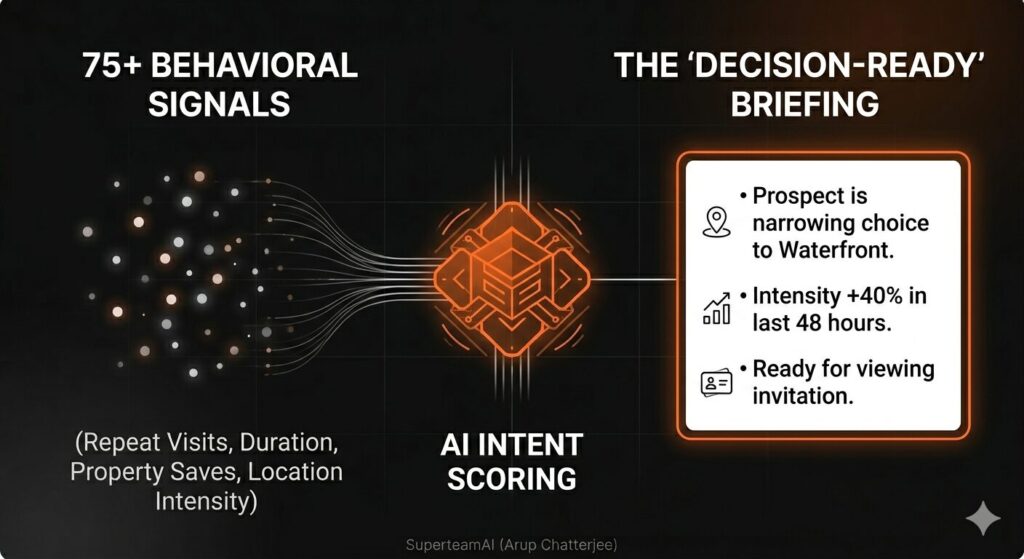
Before any agent call, a briefing is ready. Which properties the prospect has returned to three or more times. How long they spent on a specific listing last week compared to the week before. Whether their engagement suggests a buyer narrowing toward a decision or still exploring. Agents walk into conversations already informed.
Inbound Segmentation
Leads arriving through existing channels, portals, social media, and direct enquiries, pass through the same AI scoring system. Contacts showing genuine HNI signals are elevated to the premium platform track, given access to the curated inventory, and tracked with the same behavioral system as outbound-identified buyers. Leads without HNI signals are handled through a separate workflow appropriate to their profile.
The result is a single qualified pool regardless of lead origin. Every agent conversation, whether the contact came from outbound identification or arrived through a standard channel, begins with a scored prospect and a behavioral history attached.
DFY SEO Program
SuperteamAI’s team manages Kanaz Realty’s organic content program using the AI SEO Workforce. The content strategy targets high-value luxury and investment search queries: specific development and location terms, HNI buyer research questions, international investor queries, and lifestyle-oriented luxury property searches. Organic visitors from these terms enter the scoring system from their first site visit, feeding the same platform that outbound-identified contacts access.
SECTION 3 — THE EXECUTION TIMELINE
Phase 1: Architecture and Build
The first eight weeks were spent in design and construction. SuperteamAI worked backward from Kanaz Realty’s historical closed deals to understand what behavioral and financial profile characterized buyers who actually completed transactions at the 5 million AED level. Senior agents contributed their knowledge of how genuine HNI buyers behave differently from aspirational enquirers. That knowledge became the foundation of the scoring model.
The geo-mapping logic was calibrated for each property category in Kanaz’s portfolio. The income estimation framework was tested against the Dubai professional market. The invite email sequence was written to communicate curated access without pitching inventory. The platform was built with both tracks operational from launch: the outbound identification engine running property by property, and the inbound segmentation layer processing existing lead flow through the same criteria.
Phase 2: Launch and First Invitations
At launch, the system began processing Kanaz’s active listings and running the geo-mapping and company research for each one. First invitation batches went out to contacts who met the capacity threshold for specific properties.
The early signal was clear. Contacts who matched the financial profile the system identified were opening invitations and accessing the platform. The behavioral engagement inside the platform from these early users was different from what portal enquirers typically produce. These were people who had been correctly identified as capable of buying. Their behavior inside the platform reflected that.
As data accumulated from active platform users, agent briefings became more specific. Agents began entering conversations having already reviewed which properties a prospect had returned to, how long they had engaged with specific listings, and whether their interest was sharpening toward a decision.
Phase 3: Scale and Word-of-Mouth Effect
As the platform scaled across more listings and admitted a larger group of verified HNI contacts, something the team had not explicitly planned for began happening. Platform members started sharing access requests within their own professional and social networks. People were asking other people how they had gotten access to Kanaz’s private listing library. The exclusivity, which had been designed to signal quality to admitted buyers, was generating its own organic demand from outside the platform.
Access requests began arriving from people connected to existing platform members. The invite-only architecture, originally built as a qualification mechanism, had become an attraction mechanism in its own right.
SECTION 4 — THE RESULTS
Platform-Generated Lead Results
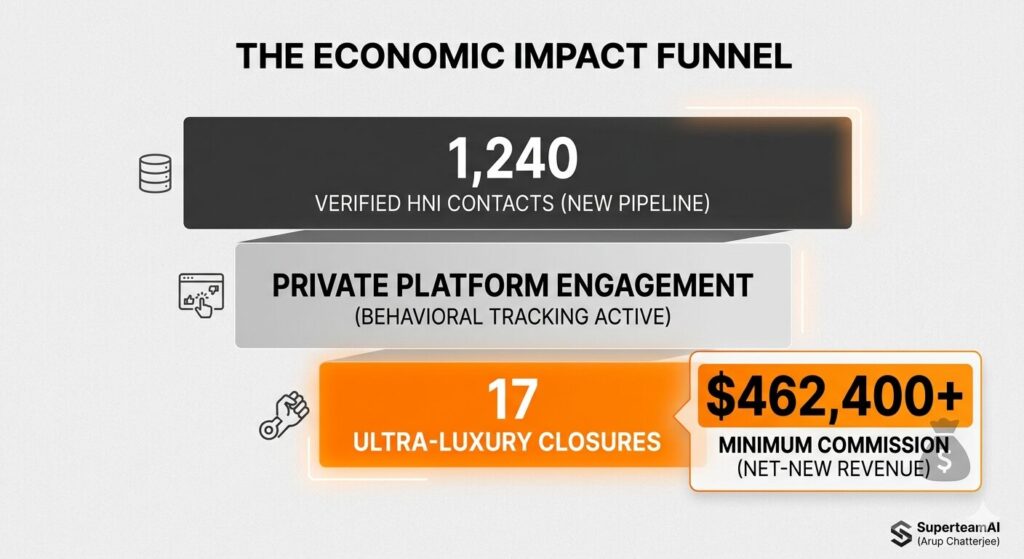
The demand generation platform identified, scored, and invited 1,240 verified HNI contacts across the engagement. These were not inbound leads. They were not people who had searched for property or clicked an ad. They were professionals and business owners identified through geo-mapping, financial capacity estimation, and behavioral scoring as people who could realistically purchase a property at the 5 million AED level. None of them were in Kanaz Realty’s pipeline before the platform reached them.
Seventeen of those properties closed with buyers the platform sourced. At a 1.37% close rate from the identified pool, that result reflects the quality of the identification methodology. These were not cold names purchased from a list. They were contacts selected because the data suggested they could afford a specific property, invited into a curated environment, and tracked through behavioral signals until their intent was visible enough to warrant an agent conversation.
At the 5 million AED floor and a 2% commission, 17 closings represent a minimum of $462,400 in commissions from leads that did not exist in Kanaz’s pipeline before the platform was built. Every one of those transactions is net-new revenue from a channel that previously did not exist.
Inbound Conversion
Standard inbound leads now pass through the same AI scoring system before reaching any agent. HNI-signal contacts are moved to the premium platform track with behavioral tracking active. Agents receive scored leads with documented engagement histories rather than cold form submissions. Conversion from HNI-qualified inbound leads improved significantly following the segmentation implementation.
The Word-of-Mouth Effect
Platform members began generating organic access requests from within their own networks. People connected to existing members, colleagues, business associates, and personal contacts, started reaching out to ask how to get access to Kanaz’s private listing library. The platform’s exclusivity, designed as a quality signal for admitted buyers, became a demand signal for people outside it. Access requests that arrived through member networks represented buyers who came pre-validated by the financial and social context of the person who told them about it.
This outcome was not part of the original platform brief. It emerged from the architecture working as intended. When access is genuinely restricted and the experience inside is genuinely curated, the people who have access tell others.
SECTION 5 — IN THEIR WORDS
Kanaz Realty’s leadership responded to the engagement with consistent satisfaction across the organization.
The chief of staff described the premium listing concept as the most impactful change in how the brokerage positioned its inventory. The idea that a 5 million AED property should not sit alongside mass-market listings had always been intuitive to the team. What the platform did was give that intuition a concrete architecture. The private access model changed how buyers perceived the inventory before they spoke to an agent, and that shift in perception carried into every subsequent conversation.
The growth the brokerage experienced through the platform exceeded internal expectations. What began as a lead generation system became a positioning asset. The word-of-mouth effect, buyers telling other buyers about the platform and asking for access on their behalf, was something the team had not anticipated and viewed as a validation of the model’s underlying logic. Exclusivity that is real generates its own demand. The team recognized that and responded by deepening the platform’s role in how Kanaz presents inventory rather than treating it as a supplementary channel.
The overall sentiment across the team was that the engagement changed how Kanaz Realty thinks about growth. Generating more leads from the same mass-market channels was not the answer to the brokerage’s problem. Building a different system, one that identifies the right people before they identify themselves, was. The 17 closed properties from platform-sourced contacts represented that thinking in practice.
SECTION 6 — KEY TAKEAWAYS
- Starting with the property instead of the lead changes the economics of luxury real estate entirely. The 17 deals Kanaz Realty closed from platform-sourced contacts came from buyers who were not browsing portals or filling in forms. They were professionals operating within proximity of properties they could afford, unaware the opportunity existed. The platform found them by asking “who can buy this specific property?” rather than “who is looking for property?” That question produces a smaller but far more qualified list, and a 1.37% close rate from a cold-identified pool reflects the quality difference.
- Genuine exclusivity generates its own demand. The word-of-mouth effect that emerged from the platform was not engineered. It was a consequence of the access model working as designed. When platform members began asking on behalf of people in their networks, those requests carried implicit financial validation. The people asking to get in were people whose connections had already been verified as HNI buyers. Exclusivity that is real, not manufactured, compounds in a way that mass-market visibility cannot.
- Behavioral signals replace guesswork for high-value decisions. A buyer who fills in a portal form has declared interest. A buyer who has returned to the same listing across four separate sessions, spent more than three minutes on a specific property page each time, and saved two comparable listings has demonstrated interest through repeated behavior over time. At 5 million AED and above, the difference between those two buyer types is the difference between a conversation that takes 90 days to go nowhere and a transaction that closes at the right pace because the buyer’s intent was already visible before the agent picked up the phone.
The Fastest Way To Upgrade Your Entire Growth Operation.
For the cost of one software subscription, you get the execution power of an elite team without burnout, overhead, or delays. This is how modern companies scale smarter.


