| Field | Details |
|---|---|
| Case Study | Pixis Marketing |
| Industry | Marketing Agency — Content and SEO |
| Workforces Deployed | AI SEO Content Workforce, AI SEO Optimization Workforce |
Pixis Marketing deployed two of SuperteamAI’s AI Workforces — the AI SEO Content Workforce and the AI SEO Optimization Workforce — to address the same core operational pressure most mid-size content agencies face: rising client demand for content volume and ongoing SEO optimization, against a near-flat capacity to deliver that work profitably.
The deployment compressed content production timelines, reduced cost per piece, and freed the team’s senior SEO talent from low-leverage audit work so they could focus on strategic client-facing work. Pixis reports the same per-article economics achieved at Brandigo, with audit cycles reduced from days to hours per client.
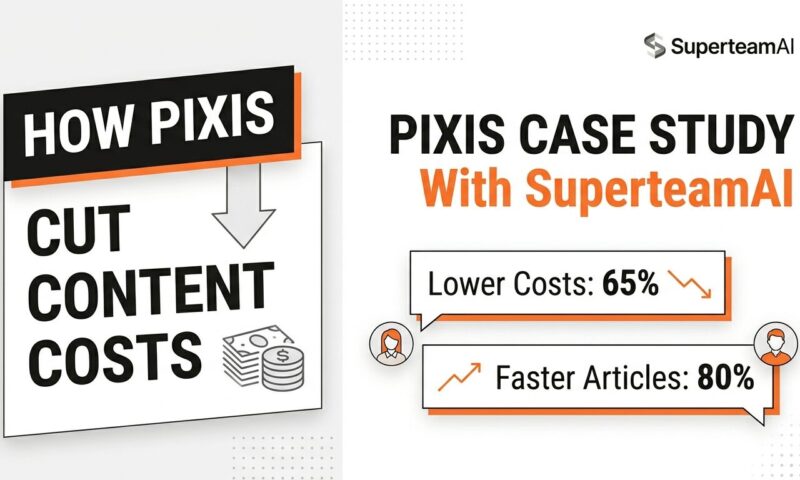
- 65% lower per-article cost
- ~80% faster article turnaround
- Zero headcount increase needed
The Challenge
Pixis Marketing was managing the operational tension every successful content agency faces: their best clients wanted more content, more SEO work, and faster turnarounds. Their delivery team was already at capacity. Hiring more writers and SEO specialists meant adding fixed cost and management overhead, and the talent market for both skill sets had become competitive and expensive.
The team had experimented with AI writing tools — Jasper, Copy.ai, and direct ChatGPT — but consistently found the output required so much human editing that the time savings barely offset the lost quality consistency. The output also lacked brand voice fidelity, since none of the off-the-shelf tools could maintain the contextual depth Pixis’s clients expected.
On the optimization side, the agency was running manual audits across client content libraries, spending days identifying gaps, then weeks executing fixes. The work was high-leverage for client retention but the time investment per client made it difficult to scale across a growing portfolio.
The Solution
Phase 1: AI SEO Content Workforce
SuperteamAI deployed the same 7-agent content production pipeline used at Brandigo, calibrated to Pixis Marketing’s brand voice, persona definitions, and client-specific knowledge bases. SERP analysis, gap analysis, brief generation, specialized writer agents, QA agents, editor agent, and rework agent — all running with human review checkpoints at brief approval and final draft stages.
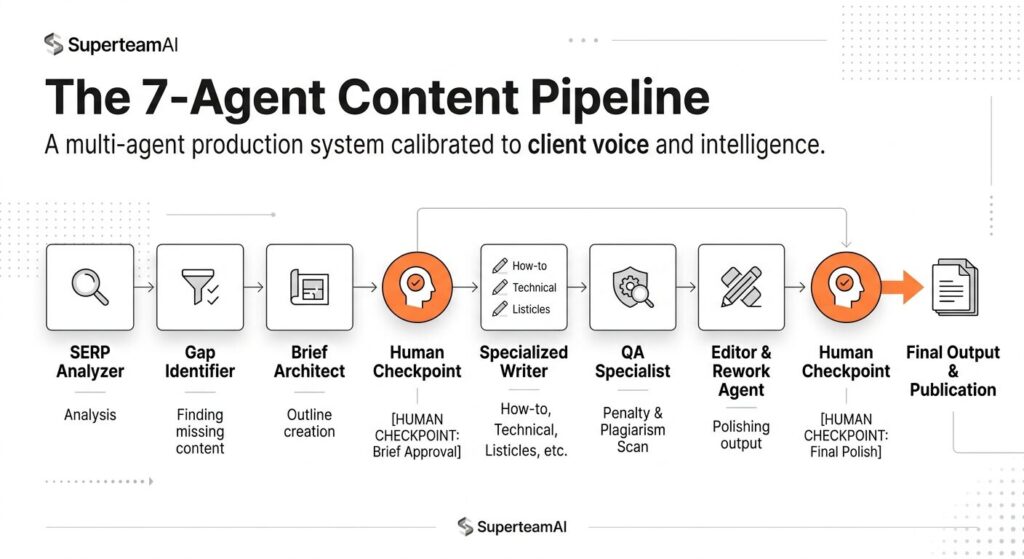
Pixis’s editorial team retained full creative authority. The workforce produced briefs and drafts; humans approved, rejected, or routed back for rework. Writer agents are specialized by content type: how-to guides, listicles, case-study-style content, technical pieces, and pieces with structured tables or code snippets all routed to dedicated writers calibrated for that format. QA agents enforced Google penalty avoidance, keyword density, plagiarism, and value-density before any draft reached the editor agent.
Phase 2: AI SEO Optimization Workforce
Once the content workforce was running stably, Pixis deployed the optimization workforce. The audit agent surfaces underperforming pages, identifies gaps in alt tags, interlinking, content freshness, and ranking opportunities, and produces a prioritized remediation plan. The execution agent handles fixes that do not require creative judgment — alt tags, interlinking, content refresh suggestions, structural improvements — while backlink work remains human-executed by Pixis’s SEO team.
The Results
Pixis Marketing’s outcomes mirror Brandigo’s on the per-article economics, with the additional benefit of redirected senior SEO time.
Per-Article Economics
| Metric | Before Deployment | After Deployment |
|---|---|---|
| Total cost per article | $300 to $350 | ~$115 to $120 |
| Time per article | 8 to 9 hours | 1.5 to 2 hours |
| Brand voice consistency | Variable across writers | Consistent (knowledge-base anchored) |
| First-pass approval rate | ~50 to 60% (human writers) | ~90% (AI workforce) |
Optimization Workflow
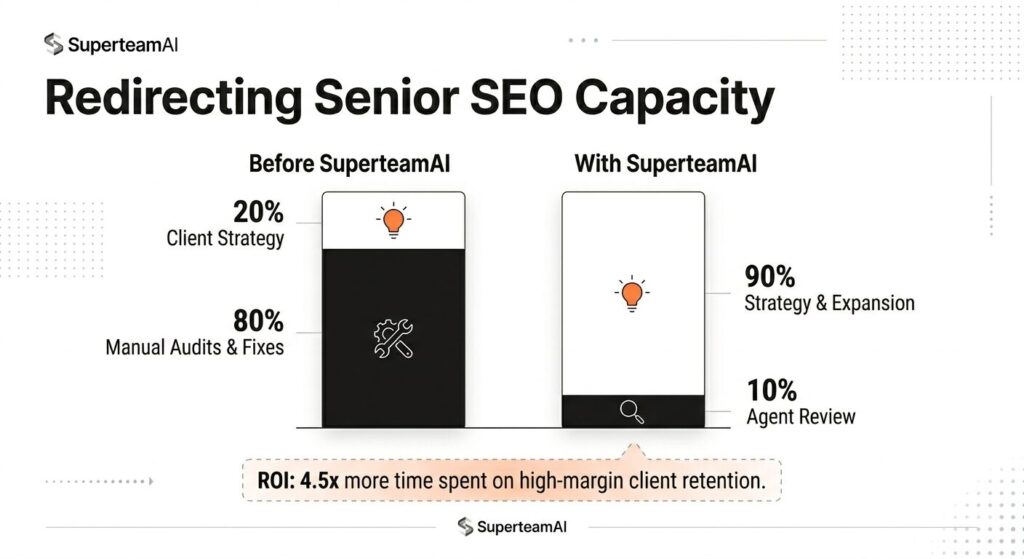
The audit-and-fix cycle that previously occupied multiple days of senior SEO time per client now operates as a roughly 4-hour human review of agent-generated audit reports, followed by automated execution of the non-creative fixes. The team’s senior SEO talent is now spending the freed time on client strategy, search architecture decisions, and the higher-judgment work that drives retention and account expansion — the work that AI cannot replicate.
| “We tried the standard AI writing tools. Every time, the output came back generic, off-brand, and required so much editing that the savings disappeared. SuperteamAI was different from the start — they didn’t hand us a tool, they built us an actual production system trained on our voice and our clients. Our content cost dropped roughly 65 percent and our turnaround time per article fell from a full day to under two hours. But the bigger win was getting our senior team off audit work and back into client strategy. That’s where we actually create margin.”Ana Vippelius, Co-Founder & Head of Operations — Pixis Marketing |
Why It Worked
Brand-voice calibration: The knowledge base setup phase — brand guidelines, personas, CTAs, premium offerings — made the workforce’s output meaningfully different from generic AI tools.
Specialized writer agents: How-to, listicle, technical, case study, table-heavy, and code-heavy content each route to dedicated writer agents. Generic single-model output could not match this.
QA enforcement at 95 to 99%: Drafts do not reach editors until they pass automated QA. This protected reviewer time.
Phased rollout: Content workforce first, then optimization. The team absorbed one major workflow change before the next.


