AI agent development cost depends on three variables: what you are building, who builds it, and what it costs to run after launch. For a single-workflow custom agent, SMB buyers typically spend $5,000 to $25,000 for initial development and $1,000 to $3,000 per month for ongoing management. Enterprise multi-agent systems start at $50,000 and scale significantly higher.
Most published cost guides for AI agent development are written for enterprise buyers evaluating six-figure projects. This guide is written for marketing agencies, real estate firms, and other SMBs evaluating their first agent engagement. The pricing reality for an agency automating campaign reporting is fundamentally different from a financial services firm building a multi-agent compliance system. The cost drivers, the cost model, and the payback timeline all differ. This guide covers each of them specifically for SMB buyers.
What Drives AI Agent Development Cost
AI agent development cost is not primarily determined by the technology. It is determined by four specific variables. Understanding these variables lets buyers evaluate proposals accurately and identify the difference between a scoped engagement and a templated quote.
Workflow Complexity and Integration Footprint
The single largest cost driver for any AI agent project is integration complexity. An agent that operates within a single system costs significantly less to build than one that reads from a CRM, writes to a project management tool, sends communications through an email provider, and logs results to a reporting dashboard. Each integration requires API connection work, authentication handling, error state management, and testing. Budget $3,000 to $10,000 per integration for a custom build [VERIFY]. A three-integration agent costs materially more than a one-integration agent even if the core workflow logic is similar in complexity.
Model Selection and Inference Cost
The model powering an AI agent is both a build-time decision and an ongoing operating cost. Faster, cheaper models cost less per inference but may require more prompt engineering to perform reliably. More capable models handle ambiguous instructions and edge cases with fewer failures but cost more per inference. For an agent processing 500 workflow instances per month, the difference between model tiers can represent a cost swing of $200 to $800 per month in inference fees alone [VERIFY]. Open-source models deployed on private infrastructure eliminate inference fees entirely, though they require hosting costs in their place.
Human Oversight Architecture
Agents that include human review checkpoints at high-stakes decision points require additional architecture: routing logic, review interfaces, approval workflows, and audit logging. This oversight layer is not optional for client-facing workflows. It adds to build cost but reduces the operational risk of running an autonomous agent on real business processes. The oversight architecture is also what distinguishes a genuine custom AI agent development engagement from a basic workflow automation.
Who Builds It and How
Development team rates create wide cost variation for identical scopes of work. US-based AI engineers typically charge $150 to $250 per hour [VERIFY]. Offshore teams typically charge $25 to $60 per hour [VERIFY]. Managed service providers who handle both build and ongoing management charge a combined monthly retainer that is often more cost-effective for SMBs than managing a custom build relationship independently.
The Three Cost Models for AI Agent Development
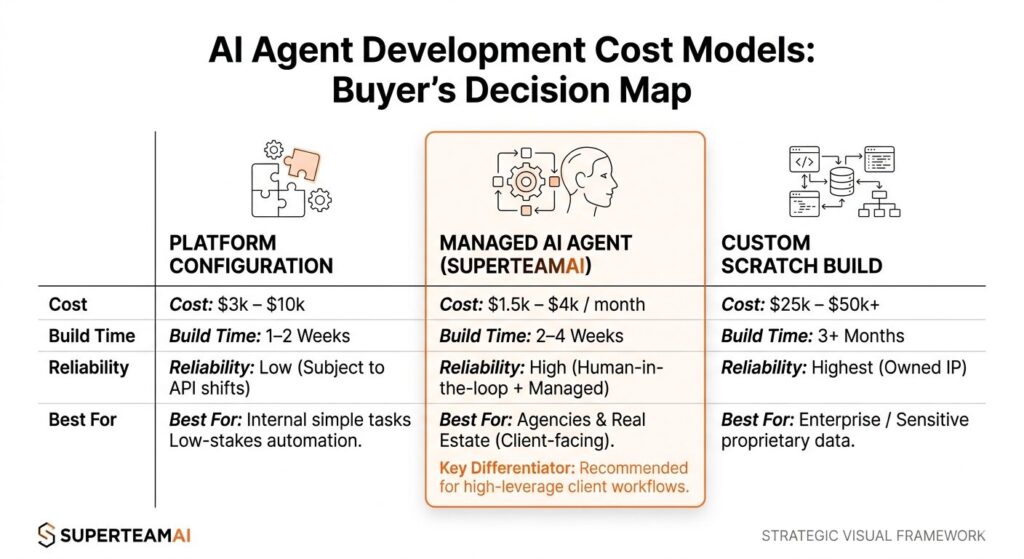
Buyers evaluating AI agent development will encounter three distinct cost models. Knowing which model a proposal falls into matters more than comparing headline numbers.
Custom Development From Scratch
A custom build means a firm designs the agent architecture from scratch, builds integrations specific to the client’s software environment, engineers system prompts around the client’s domain, and deploys on infrastructure the client controls. This is the highest-cost model and produces the most reliable agents for complex workflows. For a single-workflow SMB build, costs typically fall in the $5,000 to $25,000 range for initial development [VERIFY], with $1,000 to $3,000 per month for ongoing management. Enterprise builds start at $50,000 and scale to $400,000 or more [VERIFY].
Platform Configuration
A platform configuration uses tools like n8n, Make, Zapier, or Lindy to build workflow automations and positions them as AI agent development. These are faster and cheaper to deliver, typically costing $3,000 to $10,000 for an initial setup [VERIFY]. The output is a configured workflow, not a custom agent. Platform-based agents are limited by the capabilities of the underlying tool, break when the platform changes its API or pricing, and cannot be engineered around the specific behavioral constraints of complex client workflows. Platform configurations are appropriate for simple, rule-based automations with low reliability requirements and no sensitive data.
Managed AI Agent Service
A managed service provider handles both the build and ongoing operation of an AI agent as a combined offering. The client pays a monthly fee covering initial development, integration, oversight design, and ongoing management. For SMBs, this model is often more cost-effective than a custom build-and-manage relationship because costs are predictable and the management burden stays with the provider.AI agent development services priced as managed services typically start at $1,500 to $4,000 per month for a single-workflow agent.
AI Agent Development Cost by Workflow Type
For marketing agencies and real estate firms, cost estimation is more useful at the workflow level than at an abstract complexity tier.
Campaign Reporting and Analytics Automation
An agent that pulls performance data from advertising platforms, compiles it against client targets, generates a narrative summary, and formats a draft report for human review is a two-to-three integration build. For a custom SMB build, expect $8,000 to $18,000 for initial development and $1,000 to $2,000 per month for ongoing management [VERIFY]. A senior account manager spending eight hours per week on manual reporting is spending $20,000 to $30,000 per year in fully-loaded labor cost on a task an agent handles in minutes.
Lead Qualification and CRM Enrichment
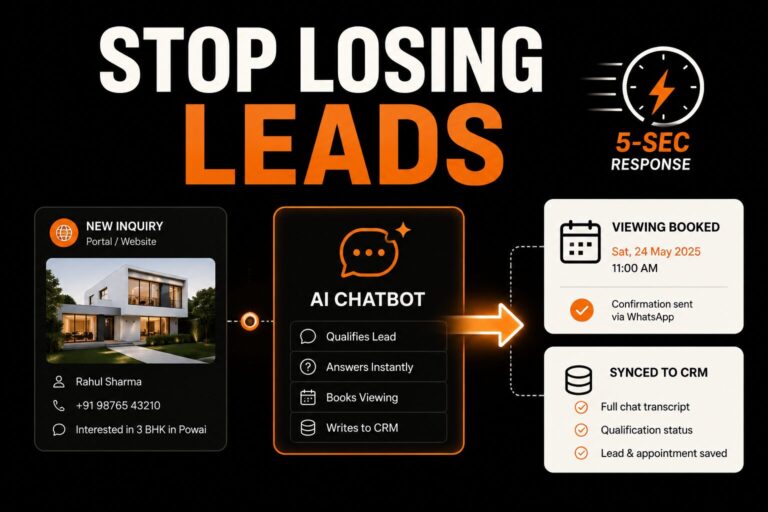
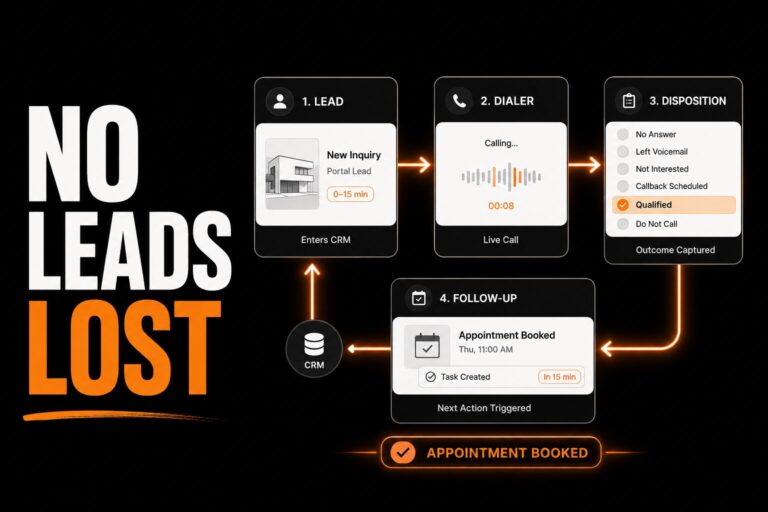
An agent that scores inbound leads, enriches contact records, routes high-priority leads to the appropriate team member, and logs activity to a CRM is a three-to-four integration build with moderate reasoning requirements. Custom build cost for this workflow typically falls in the $10,000 to $22,000 range [VERIFY]. For real estate firms processing high inbound lead volumes, this workflow produces compounding returns as the agent operates consistently across every inbound record.
Client Communication and Follow-Up Agents
An agent that monitors a CRM or inbox for triggers, drafts contextually appropriate follow-up communications, routes drafts through a human review step, and sends on approval is a moderate-complexity build with high oversight requirements. Because the output is client-facing, the oversight architecture is not optional. Expect $12,000 to $20,000 for initial development and $1,500 to $3,000 per month for ongoing management [VERIFY]. Proposal and document generation agents follow a similar cost profile, typically $15,000 to $25,000 for the initial build [VERIFY], with additional prompt engineering time required to handle the edge cases that appear in real client briefs.
The Real Cost of AI Agent Development: Total Cost of Ownership
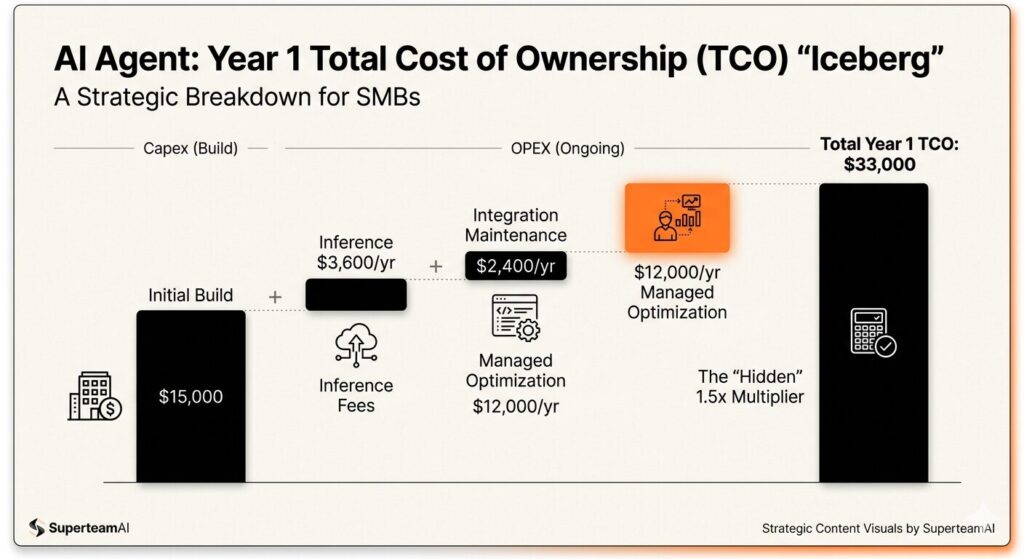
Build cost is not the right comparison number for evaluating an AI agent investment. Total cost of ownership over 12 months is the correct frame.
First-Year TCO vs. Build Cost
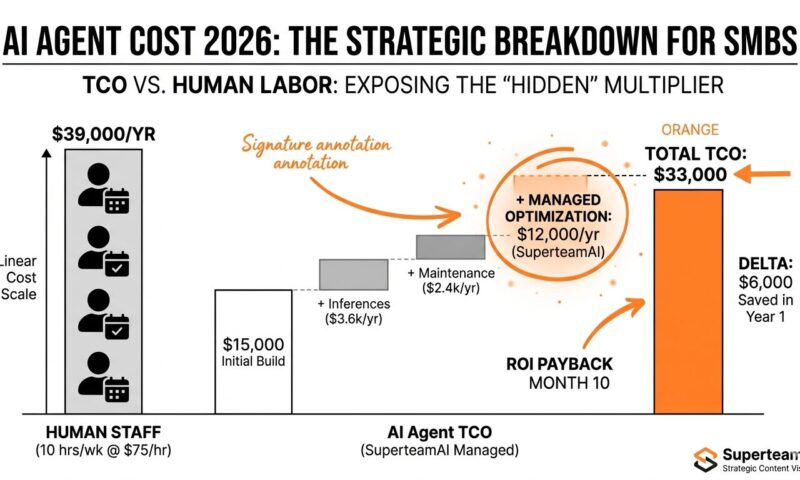
For most SMB AI agent projects, the first-year total cost of ownership is approximately 1.3 to 1.5 times the build cost [VERIFY]. A $15,000 custom build will cost approximately $27,000 to $33,000 in year one when ongoing management, model inference fees, and integration maintenance are included. This is the correct comparison number when evaluating the project against the alternative: paying staff to execute the same workflow manually every week.
Ongoing Management and Maintenance
Ongoing management is not optional for production AI agents. Integrations break when software platforms update their APIs. Model behavior shifts as providers release new versions. Workflow edge cases emerge after deployment that did not appear during testing. Without active management, an agent that worked well at launch gradually degrades until it fails, often silently. Agents that silently fail when an upstream API changes, produce incorrect outputs that staff catch but do not report, or gradually drift from intended behavior represent a real operational risk for client-facing workflows. Monthly management fees for SMB-scale agents typically run $1,000 to $3,000 [VERIFY], covering monitoring, incident response, and ongoing optimization. Budget for this from day one rather than discovering its value after a production failure.
How to Calculate Your Payback Period
For marketing agencies and real estate firms, the payback period calculation is the most useful number in any AI agent cost evaluation.
The Staff Hours Replacement Formula
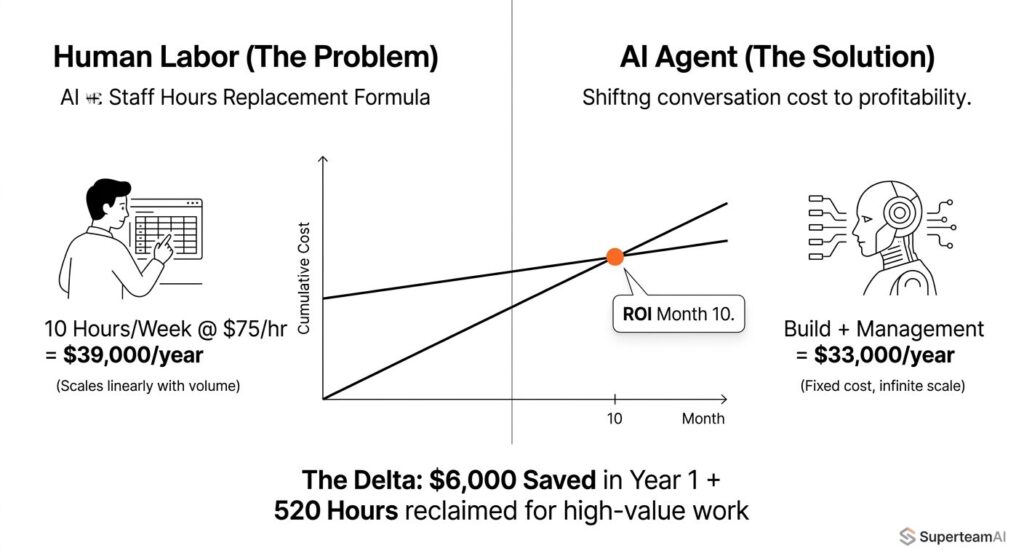
Start with the workflow the agent will handle. Count the staff hours per week currently spent on it. Multiply by the fully-loaded hourly cost of the staff involved. A senior account manager at $80,000 salary with standard overhead represents approximately $65 to $75 per hour in fully-loaded cost [VERIFY]. Ten hours per week on a manual workflow represents $650 to $750 per week in labor cost, or roughly $34,000 to $39,000 per year. Set that against the first-year TCO of the agent.
When AI Agent Development Pays for Itself
At these numbers, a $15,000 custom build with $24,000 in first-year management and operating costs ($39,000 total TCO) breaks even in approximately 12 months against a workflow consuming ten senior staff hours per week. A workflow consuming 15 to 20 hours per week produces payback in six to eight months. These estimates do not account for quality and consistency improvements that agents deliver over variable human execution, which means actual payback in production is typically faster than the formula predicts.
AI Agent Development Cost for Marketing Agencies and Real Estate Firms
For marketing agencies and real estate firms, the relevant cost comparison is not against enterprise deployments. It is against the staff hours currently consumed by the target workflow and the risk of client-facing manual processes that do not scale reliably under volume.
SuperteamAI builds and manages AI agent workforces exclusively for marketing agencies and real estate firms. Pricing is transparent: a scoped proposal names the workflow, integrations required, oversight architecture, build cost, and monthly management fee before any commitment. Every engagement includes an open-source deployment option for clients with data privacy requirements, routing all agent reasoning through the client’s own infrastructure rather than third-party model APIs. One marketing agency client reduced manual campaign reporting time by more than 60% within 90 days of deployment, with a first-year payback period under eight months [VERIFY].
Marketing agency or real estate firm ready to get a scoped cost estimate? Book a free 30-minute discovery call and we will map your highest-impact workflow and produce a transparent pricing proposal before any commitment.
What Controls AI Agent Development Cost, and What Does Not
Understanding which cost variables a buyer can influence prevents the common mistake of optimizing for the wrong number.
Variables You Control
Workflow scope is the most powerful cost lever available to buyers. A single, well-defined workflow is cheaper to build and manage than an ambiguous scope that expands during development. Starting with one workflow, deploying it, and adding workflows after the first is live is always more cost-effective than scoping a multi-workflow build upfront. The deployment model also matters: open-source model deployment eliminates inference fees at the cost of hosting infrastructure. The development partner’s engagement structure determines whether ongoing management is included in the monthly fee or billed separately as incidents arise.
Variables You Do Not Control
Model inference pricing is set by the model provider and changes independently of the client engagement. This is true for every vendor in the market. Platform API pricing from integrated tools changes without notice and has broken cost assumptions for agents relying on fixed-price platform tiers. Regulatory requirements in certain industries add compliance architecture costs that cannot be reduced without reducing compliance coverage. Development team rates in specific geographies shift with market conditions. Buyers who understand this distinction evaluate proposals more accurately and avoid blaming the wrong variable when costs change after launch.
Every SuperteamAI engagement begins with a structured workflow discovery session at no cost. The session maps the target workflow end to end, identifies integrations required, defines the oversight architecture, and produces a scoped proposal with transparent line-item pricing before any build begins. There are no package tiers or flat-rate quotes: every proposal is specific to the client’s workflow, software environment, and data privacy requirements. Build pricing for a single-workflow SMB engagement typically falls in the $5,000 to $15,000 range. Monthly management retainers start at $1,000 and scale with integration complexity and iteration volume. All code, system prompts, and configuration are owned by the client from the start of the engagement.
For more context on how to evaluate AI agent development companies before requesting a proposal, the buyer’s guide to company types and evaluation criteria covers the six questions to ask before any vendor call.
Frequently Asked Questions
How much does AI agent development cost for a small business? For a single-workflow custom agent, SMB buyers typically spend $5,000 to $25,000 for initial development and $1,000 to $3,000 per month for ongoing management [VERIFY]. Platform configurations cost $3,000 to $10,000 for initial setup but are not genuinely custom and have real limitations for complex or client-facing workflows.
Why do AI agent development costs vary so widely? The primary variables are workflow complexity, integration footprint, model selection, oversight architecture requirements, and development team rates. A single-integration agent built by an offshore team costs a fraction of a multi-integration agent built by a US-based firm. The use case matters as much as the technical scope: client-facing agents require oversight architecture that internal automation tools do not.
What are the ongoing monthly costs for an AI agent? For SMB-scale agents, ongoing costs typically include management fees ($1,000 to $3,000 per month), model inference fees ($100 to $800 per month depending on volume and model tier), and hosting costs for open-source deployments ($100 to $500 per month) [VERIFY]. Unmanaged agents accumulate costs in the form of gradual degradation and eventual emergency remediation.
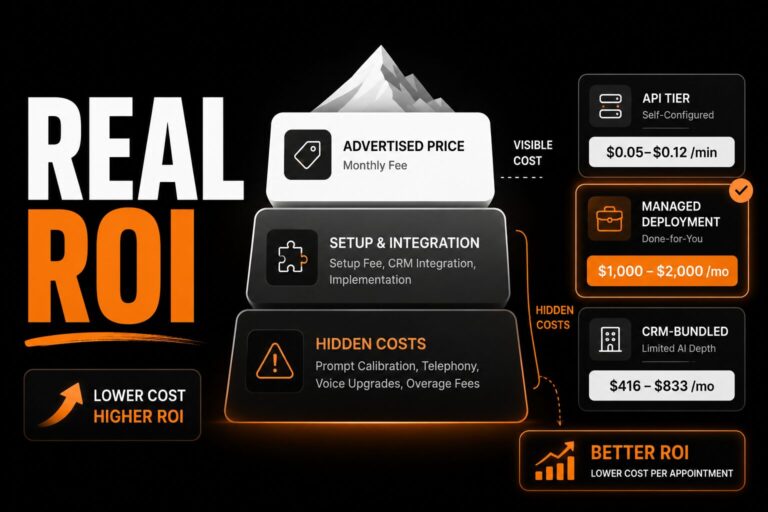
What are the hidden costs of AI agent development? The most common hidden costs are integration maintenance when upstream platforms update their APIs, model inference fees that scale with usage volume, prompt engineering time as workflows evolve, and human review time for oversight-enabled agents. Budget an additional 30 to 50 percent above the build cost to estimate true first-year total cost of ownership [VERIFY].
Does open-source model deployment reduce AI agent development cost? Open-source deployment eliminates inference fees by routing model reasoning through the client’s own infrastructure. This reduces ongoing operating cost but adds hosting infrastructure cost. For high-volume agents, open-source deployment produces meaningful savings over 12 months. It also eliminates the data privacy exposure of routing client data through third-party model APIs.
What is the difference in cost between custom AI agent development and a platform configuration? Platform configurations cost $3,000 to $10,000 for initial setup and carry low monthly costs, but they are constrained by the underlying platform and break when the platform changes its API or pricing. Custom agents cost more to build but perform reliably on complex workflows and are not subject to third-party platform risk. For any workflow with client-facing outputs or sensitive data, the cost difference is justified by the reliability a custom build provides.
How long does AI agent development take, and how does timeline affect cost? A single-workflow SMB agent typically takes two to six weeks from discovery through deployment. Compressed timelines that skip structured discovery and testing produce agents that fail in production. The cost of timeline compression shows up in remediation and ongoing management costs after launch, not in the initial build price.What should a complete AI agent development cost proposal include? A complete proposal names the specific workflow being automated, integrations required and their individual costs, the oversight architecture, model selection rationale, initial build cost as a line item, monthly management fee as a line item, and the data handling approach including whether open-source deployment is included. Proposals that do not address all of these variables are incomplete and should be questioned before any engagement begins.