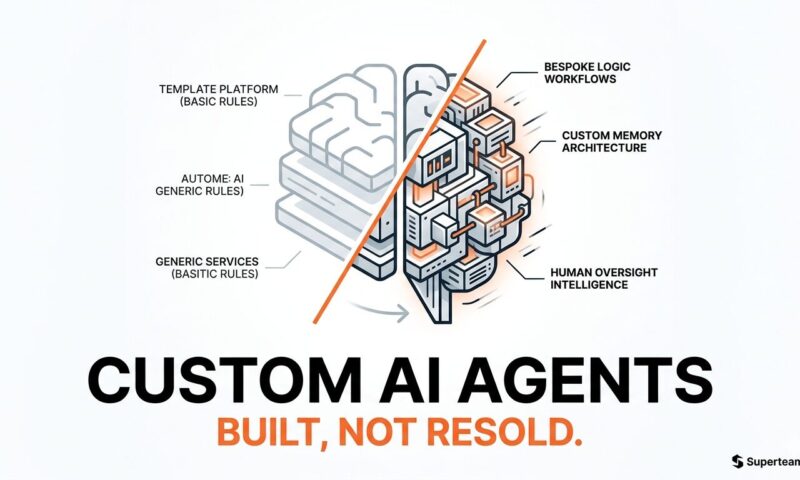
Custom AI agent development services include workflow discovery, model selection, system prompt engineering, API integration, human-in-the-loop oversight design, and ongoing management. Unlike platform-based tools, custom services build agents around your specific business processes, data sources, and industry requirements. The result is an agent configured entirely for your workflows rather than adapted from a generic template.
The phrase appears frequently in vendor marketing. What it actually means varies considerably. Some providers build bespoke agentic systems from the ground up. Others resell platform configurations: n8n or Make workflows any consultant could build, rebranded as custom. This guide covers what genuine customization involves, the full scope of custom AI agent development services, how to evaluate providers, and what it costs.
What Makes an AI Agent Development Service Genuinely “Custom”
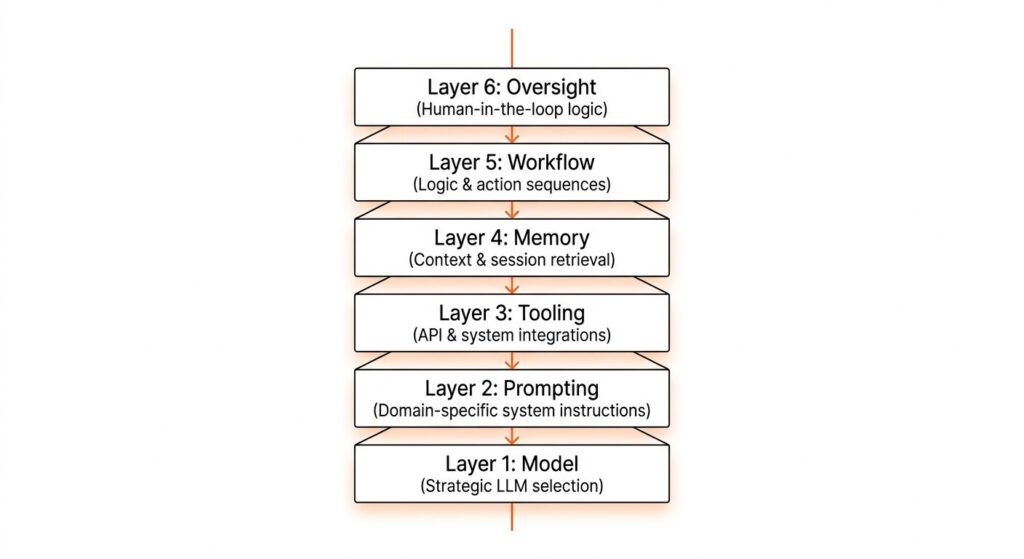
The Six Layers of the Customization Stack
Custom AI agent development is not a binary state. Services can be custom at one layer and template-based at another. Understanding where customization occurs helps you evaluate whether a vendor’s proposal reflects actual bespoke work or repackaged platform defaults.
The six layers where genuine customization occurs are: the model layer (which underlying LLM is selected and why), the prompting layer (how the system prompt is designed for your specific domain and voice), the tool layer (which external APIs and integrations are built or configured), the memory layer (how the agent stores and retrieves context across sessions), the workflow layer (the logic governing how the agent moves between actions), and the oversight layer (how human review is structured for high-stakes outputs).
A genuinely custom service makes deliberate decisions at each of these layers. A platform configuration typically touches only the tool and workflow layers and accepts defaults everywhere else.
Custom vs. Platform-Based vs. Template Services
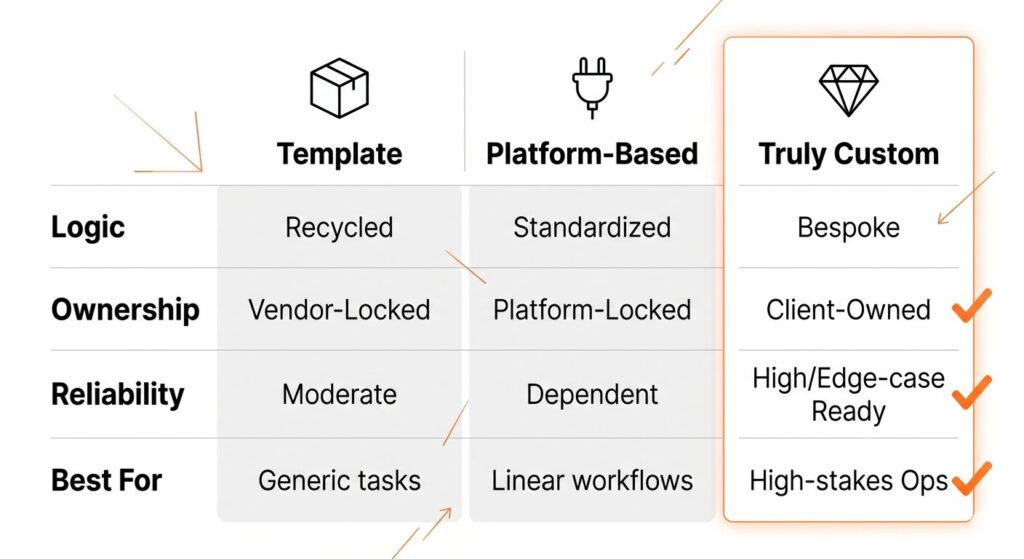
Three distinct service categories exist under the “AI agent development” label, and the distinctions matter for buyers evaluating proposals.
Platform-based services use existing workflow tools (n8n, Make, Zapier, Lindy) and configure them to your specifications. These services are faster and cheaper to deliver but are limited by the capabilities of the underlying platform and can break when platforms change their APIs or pricing.
Template services adapt pre-built agent frameworks to a new client context. The core logic is recycled across clients with minor adjustments. Delivery is fast, but the “custom” element is essentially the data inputs and branding.
Truly custom services design the architecture from scratch for each client. Model selection, prompt design, integration development, memory architecture, and oversight logic are all built specifically for the client’s workflows, data, and industry context. The resulting agent cannot simply be copied to a different client.
When You Need Custom Development vs. a Platform
Platform tools deliver real value for linear, rule-based automations: routing, scheduling, tagging, and sorting. If your automation need is simple and consistent, a platform-based configuration is faster and more cost-effective.
Custom development is appropriate when: the workflow involves contextual reasoning rather than simple rules, output quality directly affects client relationships, data sensitivity rules out third-party cloud processing, or the workflow is distinctive enough that no template fits.
What Custom AI Agent Development Services Include
Workflow Discovery and Architecture Design
Every genuine custom engagement begins with a structured discovery process. Before any agent is built, the development team maps the target workflow end to end: what triggers it, what decisions it makes, what tools it touches, what outputs it produces, and where human oversight is required. This stage typically takes one to two weeks and produces a documented architecture the client reviews and approves before build begins.
Discovery is where most of the intellectual work happens. Getting the architecture right prevents expensive rebuilds. Providers who skip it and build immediately are not offering a genuine custom service.
Model Selection and System Prompt Engineering
The choice of underlying model and the design of the system prompt together determine most of an agent’s behavior. A custom AI agent development services provider makes deliberate decisions about both: which model to use based on the latency, cost, and reasoning requirements of the task, and how to engineer the system prompt to reflect the client’s domain vocabulary, output format expectations, and behavioral constraints.
A well-engineered system prompt specifies persona, scope, tone, tool usage rules, exception handling, and output format, tested against real scenarios before deployment.
Integration Development and Tool Configuration
Most business AI agents need to read from and write to existing software systems: CRMs, email platforms, project management tools, databases, calendars, and communication channels. Integration development involves connecting the agent to these systems via APIs, building the logic for when to query each system, and handling authentication, rate limiting, and error states reliably.
This is where platform configurations and custom development diverge most visibly. Pre-built connectors handle standard cases but break on edge cases. Custom integration handles each client’s specific data structures, authentication methods, and error states.
Human-in-the-Loop Oversight Design
For non-trivial business workflows, defining where the agent acts autonomously and where it routes to a human for review is not optional. It is part of the architecture. Custom services design this oversight layer specifically for the client’s risk tolerance and operational model.
A client handling sensitive communications might require review for all outbound messages. A client running internal reporting might flag only anomalies. Both decisions are made during discovery and built into the agent’s logic.
Ongoing Management and Iteration
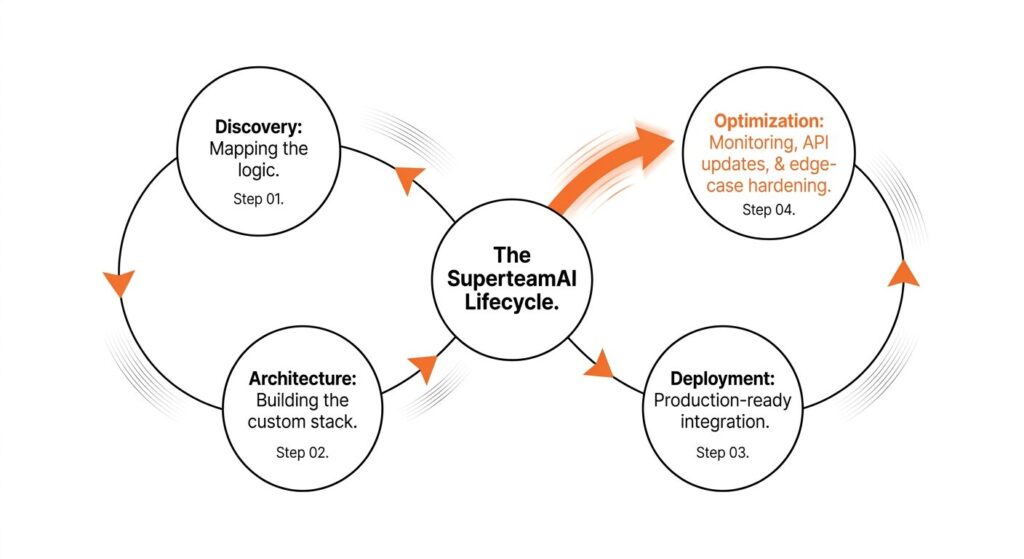
A custom AI agent is not a static deliverable. Integrations change when software platforms update their APIs. Business processes evolve as the company grows. Model providers release new versions that alter agent behavior in subtle ways. Workflow edge cases appear only after production deployment and require targeted fixes.
Ongoing management means a dedicated team monitors performance, responds to failures, and iterates on the configuration as the business changes. This is the element that most clearly separates a full custom service from a one-time build.
Custom AI Agent Development Services by Industry
Marketing Agency Workflows
Marketing agencies operate with high client volume, tight turnaround expectations, and a premium on voice consistency across deliverables. These requirements make template-based solutions unsuitable and custom development necessary.
Custom agents built for marketing agencies handle client intake triage (routing new project requests to the right team member based on service type and client tier), campaign reporting (pulling data from multiple platforms, identifying performance anomalies, and drafting client-ready summaries in the agency’s defined format), and lead qualification (scoring and routing inbound inquiries based on budget, timeline, and service fit criteria).
One SuperteamAI client, a twelve-person marketing agency, reduced manual reporting time by over 60% within the first 90 days of deploying a custom campaign reporting agent [VERIFY]. The same result is not achievable with a platform template because the reporting logic, client voice guidelines, and anomaly thresholds were all unique to that agency.
Real Estate Operations
Real estate firms combine high transaction volume with precision-critical documentation and time-sensitive lead response requirements. The cost of an error in a contract or a delayed lead response is measurable and immediate.
Custom agents in real estate handle listing intake (extracting property data from unstructured emails and documents and populating MLS fields correctly), lead qualification (engaging new buyer inquiries within minutes, qualifying on budget and timeline, and scheduling showings without agent involvement), and follow-up sequences (personalized check-ins triggered by specific pipeline stages rather than generic time intervals).
For custom agent deployment for non-technical teams at real estate firms, custom prompt engineering (agents understand MLS terminology and local conventions) and custom oversight design (no contract-adjacent communications sent without human review) is what separates a reliable deployment from a liability.
Small Business and Operations Teams
Outside agencies and real estate, operations-heavy small businesses benefit from custom development when their workflows are distinctive enough that no platform template fits. A professional services firm with a unique client onboarding process, a logistics company with custom dispatch logic, or a healthcare-adjacent business with specific privacy requirements all fall into this category.
The threshold question is not “can a platform tool do this?” but “will a platform tool do this reliably for my specific workflow, data, and risk profile?” When the answer is no, custom development is the correct decision.
How to Evaluate a Custom AI Agent Development Company
Five Questions to Ask Before You Sign
Before committing to a custom AI agent development provider, five questions clarify whether the engagement is likely to deliver value.
First: does the provider conduct a structured discovery process, or do they begin building immediately? Skipping discovery is a sign the provider is delivering a template, not a custom build.
Second: what is the provider’s ownership model for the agent code and configuration? You should own the output of the engagement. Providers who retain code ownership create ongoing dependency.
Third: how does the provider handle ongoing management after deployment? An agent that goes live and is then abandoned is not a custom service. Ask specifically how failures are detected and how long response time is.
Fourth: what is the provider’s data handling architecture? Does the agent process client data through third-party cloud infrastructure, or can it be deployed on your own environment? For businesses with privacy obligations, this is a filtering question.
Fifth: does the provider have experience in your specific industry? Generic AI development firms build generic agents. Vertical specialists understand the workflows, terminology, and risk profile of your industry.
Ready to evaluate SuperteamAI against your criteria? Book a free 30-minute discovery call and we will map your highest-impact workflow before any commitment.
Red Flags in Custom AI Agent Proposals
Several signals indicate a template service being sold as custom. Watch for proposals that arrive within 24 hours (genuine scoping takes longer), flat-rate package pricing without workflow-specific variables, vague references to “existing frameworks” without specifics, and no mention of oversight architecture or ongoing management. A provider who delivers and disappears is not offering a custom service.
What Custom AI Agent Development Services Cost
SMB vs. Enterprise Pricing Reality
Custom AI agent development costs vary significantly by scope, integration complexity, and ongoing management requirements. The enterprise ranges cited in most cost guides ($50,000 to $400,000+) reflect multi-agent systems with complex compliance requirements and large integration footprints [VERIFY]. They are not representative of SMB custom deployments.
For single-workflow custom agents at marketing agencies and real estate firms, project costs typically fall in the $5,000 to $25,000 range for initial build and configuration, with ongoing management retainers in the $1,000 to $3,000 per month range depending on the volume and complexity of iteration required [VERIFY]. These figures reflect genuinely custom builds (not platform reskins) and include discovery, architecture design, build, testing, and deployment.
The factors that most significantly affect cost at the SMB level are: the number of external integrations required, whether the agent needs a custom oversight interface, whether open-source model deployment is required for data privacy, and the expected volume of ongoing iteration.
Total Cost of Ownership: The Right Way to Compare
Upfront build cost is the least useful comparison point when evaluating custom AI agent development services. Total cost of ownership over 12 months is the correct frame. This includes initial build cost, monthly management retainer, platform or infrastructure costs, and the staff time saved by the agent multiplied by the hourly cost of that time.
For agencies and real estate firms with workflows consuming 10 to 20 staff hours per week, a custom agent that automates 60 to 70% of that workflow typically pays for itself within the first quarter [VERIFY]. Understanding what AI agent development services cost across 12 months is the right analysis before any vendor comparison.
Data Privacy and Open-Source Custom Development
Standard AI agent services route your data through third-party APIs. When a custom agent reads your client emails, queries your CRM, or processes your contracts, that data travels to OpenAI, Anthropic, or whatever model provider the service uses. For businesses with client confidentiality obligations or industry privacy requirements, this creates real exposure.
Open-source development addresses this directly. SuperteamAI builds agents on open-source model stacks, including Llama and Mistral variants, deployed on infrastructure the client controls. The agent reasons and responds entirely within the client’s own environment. Client data does not leave. This is not an option available through platform-based services or any custom engagement using proprietary model APIs.
For marketing agencies handling confidential campaign strategies and for real estate firms handling client financial data, open-source deployment is not a premium feature. It is a baseline requirement for responsible deployment.
How Custom Services Compare to Standard AI Agent Development
The distinction between custom and standard AI agent development services comes down to where flexibility exists and where it does not. Standard services adapt your workflow to fit a pre-built agent framework. Custom services adapt the agent to fit your workflow. That inversion determines everything about how the agent performs in production.
Standard services are faster and cheaper to deploy. They are the correct choice when the workflow is simple and consistent, the data is not sensitive, and the tolerance for a 70 to 80% reliability rate is acceptable. For transactional workflows with no client-facing outputs, standard is often sufficient.
Custom services take longer and cost more to build. They are the correct choice when reliability must be high, when the workflow is specific to your industry and processes, when data privacy is a requirement, and when the agent needs to evolve alongside the business rather than stay static. For any workflow where an agent failure has direct client impact, custom development is not optional.
Frequently Asked Questions
What do custom AI agent development services include? Custom AI agent development services include workflow discovery, architecture design, model selection, system prompt engineering, API integration development, oversight design, and ongoing management through the full agent lifecycle.
How much do custom AI agent development services cost? For SMB deployments such as marketing agencies and real estate firms, custom AI agent development typically costs between $5,000 and $25,000 for initial build and configuration, with ongoing management retainers ranging from $1,000 to $3,000 per month [VERIFY]. Enterprise deployments with compliance requirements and multi-agent systems cost significantly more.
What is the difference between custom and standard AI agent development? Standard services adapt your workflow to a pre-built framework. Custom services design the agent architecture for your specific workflow, data, and industry. The practical difference shows in reliability, data privacy, and edge-case handling.
How do I know if I need custom AI agent development or a no-code platform? No-code platforms work for simple, rule-based automations. Custom development is the right choice when the workflow involves contextual reasoning, data privacy is a requirement, output quality affects client relationships, or no existing template fits your process.
How long does custom AI agent development take? A single-workflow custom agent typically takes two to six weeks from discovery through deployment. Multi-agent systems with multiple integrations take six to twelve weeks [VERIFY]. Integration complexity and testing cycles drive most of the timeline variance.
Who owns the code and configuration after a custom development engagement? In a well-structured engagement, the client owns the code, prompt architecture, and all configuration. Confirm ownership terms before signing. Providers who retain code ownership create dependency and limit your ability to maintain or transfer the agent.
Do custom AI agent development services include ongoing support? They should. Ongoing management, including monitoring, failure response, and iterative improvement, is a core component of a full custom service. Providers who deliver the agent and disappear are not offering a custom service in any meaningful sense. Ask specifically how post-deployment support is structured and priced.
What makes SuperteamAI’s custom AI agent development services different? SuperteamAI builds custom AI agents exclusively for marketing agencies and real estate firms. Every engagement includes structured discovery, open-source model deployment, human-in-the-loop oversight, and ongoing management. Vertical focus means the team understands each industry’s workflows, terminology, and risk profile before any configuration begins.
The Next Step for Businesses Evaluating Custom Services
The most common mistake buyers make when evaluating custom AI agent development services is comparing proposals on price before confirming whether each proposal reflects genuine custom work. A $5,000 platform configuration and a $15,000 custom build are not comparable products. They have different reliability profiles, different data handling characteristics, and different trajectories over time.
The right sequence: confirm discovery process, confirm code ownership, confirm data handling, confirm ongoing management, then compare price among providers who clear all four.


