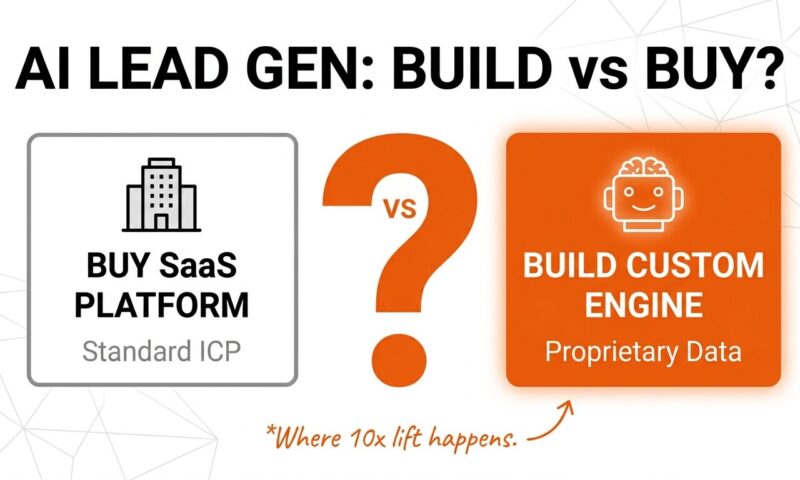
AI lead generation software automates the process of identifying, scoring, and engaging potential buyers using machine learning and behavioral data. The software captures intent signals, ranks contacts by conversion likelihood, enriches contact records with firmographic data, and personalizes outreach sequences. Platforms range from all-in-one prospecting suites to specialized point solutions for each stage of the pipeline.
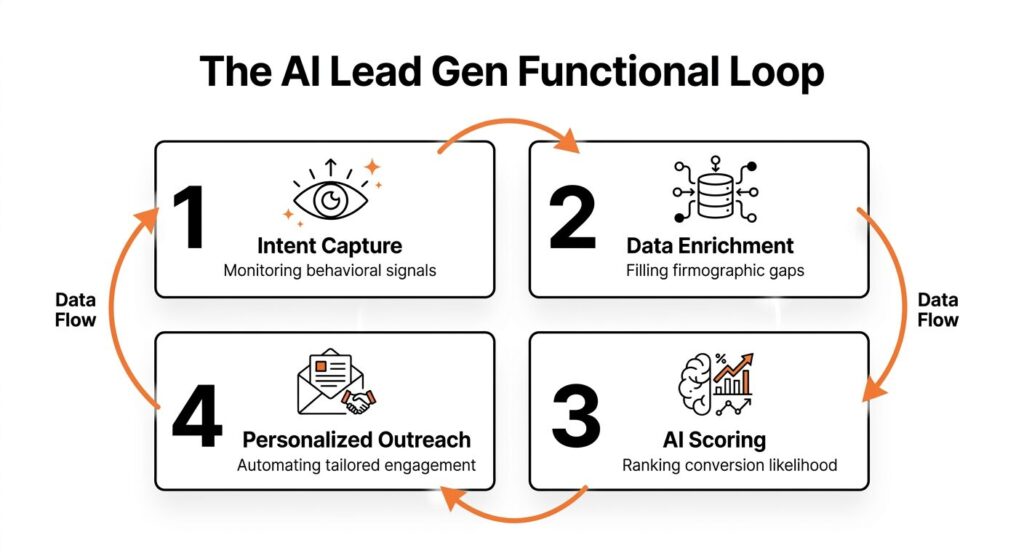
The platform market has expanded significantly, and most evaluation guides respond by making longer lists. What those lists skip is the framework that tells a buyer whether any particular platform will actually improve their pipeline or just add another subscription to manage.
This guide covers what the software category actually does, how it differs from a tool stack, and the five criteria that separate platforms worth buying from ones that produce modest lift at premium prices.
What AI Lead Generation Software Actually Does
The Four Functions Every Platform Claims to Perform
Every AI lead generation software vendor positions their product around four core capabilities: identifying high-intent prospects, scoring those prospects by conversion likelihood, enriching contact records with firmographic and behavioral data, and automating personalized outreach.
The claims are broadly accurate. What differs is the depth at which each platform performs each function. Some platforms handle all four at a surface level. Others specialize in one or two and rely on integrations for the rest. Understanding which model a platform uses before signing a contract determines how much of the expected lift you actually see.
Where Most Platforms Stop and Where the Gap Appears
The gap between what software vendors claim and what buyers experience typically shows up at the scoring layer. Most platforms apply weighted rules: a prospect that visits your pricing page gets five points, a company with 200 to 500 employees gets three points. The model is deterministic, not predictive. [VERIFY: fewer than 35 percent of SMB-tier AI lead generation platforms offer true predictive scoring based on machine learning models rather than configurable weighted rules]
True predictive scoring learns from your historical pipeline data. It identifies which combinations of signals actually predicted closed deals in your specific context, not which signals are generally associated with buyer intent. The distinction matters because every pipeline is different, and a generic weighted model often produces scores that correlate poorly with how leads actually convert in your market.
How Software Differs From Tools: Why the Distinction Matters for Buyers
Point Solutions vs. Integrated Platforms
The term “AI lead generation tools” describes individual capabilities that can be assembled into a pipeline: an intent data provider, a scoring model, an enrichment platform, and an outreach sequencer operating as separate products that integrate through APIs and CRM data flows.
“AI lead generation software” describes a platform that bundles multiple capabilities behind a single interface and a single subscription. The purchase decision is different: you are not assembling a stack, you are evaluating whether one vendor’s implementation of multiple functions is better for your team than buying each function from a specialist.
The detailed comparison of how individual AI lead generation tools fit together at each pipeline stage is covered separately. This guide focuses on platform evaluation: when to buy a bundled solution and what to evaluate before you do.
What Buyers Who Conflate the Two End Up With
Buyers who search for “software” but approach it as “tools” typically underinvest in integration planning. They purchase an all-in-one platform, find that two of its five capabilities are genuinely strong and three are weaker than specialist alternatives, and spend the next six months either working around the weak functions or buying point solutions that partially duplicate what the platform already does.
The evaluation question is not which platform has the most features. It is which platform’s feature set matches your actual pipeline requirements closely enough that you will not need to supplement it immediately.
The Five Criteria That Separate Platforms Worth Buying
Data Coverage, Freshness, and CRM Integration Depth
Data coverage measures how completely a platform can identify and profile contacts in your target market. Coverage varies significantly by industry and geography. A platform with strong coverage in North American SaaS will underperform in European manufacturing or professional services. [VERIFY: top-tier AI lead generation platforms claim 80 to 95 percent match rates on B2B contacts in their primary markets, with significantly lower rates in secondary geographies and niche verticals]
Data freshness measures how often contact records are re-verified. The practical difference is significant: a platform that re-verifies records every 30 days will have substantially lower bounce rates and higher deliverability than one that refreshes annually. [VERIFY: leading enrichment and prospecting platforms re-verify contact records every 30 to 90 days; commodity platforms typically refresh annually or less frequently]
CRM integration depth determines whether data flows automatically between the platform and your existing records or requires manual handling. A platform with high data coverage and annual re-verification, connected to your CRM through a Zapier middleware layer rather than a native two-way sync, will create manual work that erodes the efficiency gains the platform is supposed to produce.
Scoring Model Transparency and Outreach Personalization Quality
Scoring model transparency refers to whether the platform can explain why a lead received a particular score. Black-box scoring models produce outputs without explanations. Transparent models show which signals drove the score, allowing sales teams to sanity-check outputs and identify when the model is weighting the wrong factors.
Outreach personalization quality depends on the richness of the data inputs available to the personalization engine. AI-generated outreach performs significantly better when it draws from specific, verified data points: a recent trigger event, a technology the company uses, or a role-level insight about the contact. [VERIFY: AI-personalized outreach sequences report 15 to 35 percent higher reply rates than generic sequences across multiple vendor-cited studies] Platforms that personalize based on thin or stale data produce copy that reads as templated rather than researched.
Vendor Data Update Frequency
This criterion is separate from data freshness because it refers to how often the vendor updates the underlying data model, not just the contact records. Vendors that update their intent signal taxonomy, ICP matching criteria, and scoring weights regularly produce better outputs over time. Vendors that configure the model at implementation and leave it running will produce scores that drift from accuracy as your market evolves.
Ask vendors directly how often their signal taxonomy is updated and what triggers a model weight revision. The answer separates platforms that treat the model as a living system from those that treat it as a one-time configuration. For markets that change quickly, such as technology or professional services, model staleness is a meaningful performance variable that most buyers fail to include in their evaluation criteria.
Signal Capture and Intent Data Inside the Software Layer
What Behavioral Intent Looks Like Inside a Platform
Intent data inside an AI lead generation platform typically combines first-party behavioral signals (visits to your site, email opens, content downloads) with third-party intent signals sourced from publisher networks and data cooperatives. The platform aggregates both into a composite intent score that indicates where a prospect is in the evaluation process.
The practical quality difference between platforms often comes down to signal granularity. Some platforms track domain-level intent: a company’s IP address appears in the data associated with your category. Better platforms track page-level behavioral signals: a specific individual visited your pricing page, returned three days later, and downloaded a case study. Page-level granularity produces significantly more actionable prioritization data.
Match Rates and What They Mean for Pipeline Volume
Match rate is the percentage of anonymous site visitors or third-party intent signals that the platform can resolve to a specific company or contact record. Higher match rates mean more of your pipeline activity gets captured as usable lead data. [VERIFY: B2B intent data platforms report match rates ranging from 20 to 80 percent depending on methodology, market segment, and traffic volume, with significant variation between vendor claims and independently audited results]
A platform with a 40 percent match rate on your traffic volume will produce twice as many identified prospects as one with 20 percent, all else equal. Match rate benchmarks should be verified against your actual traffic composition, not the vendor’s headline number, which is typically measured against their best-case audience.
Lead Scoring Inside Software Platforms: What Built-In Models Can and Cannot Do
Rule-Based Scoring vs. Predictive Scoring: The Distinction Buyers Miss
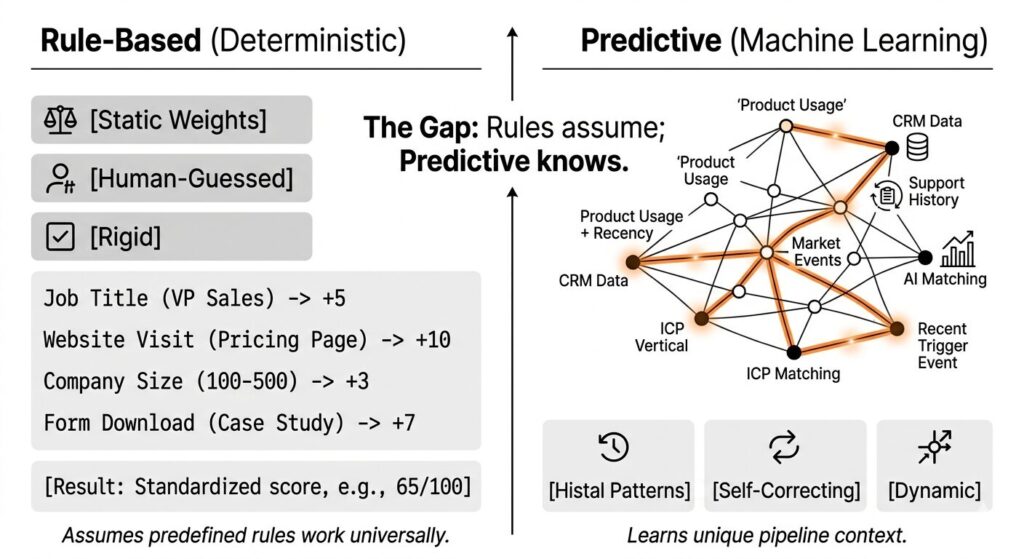
Rule-based scoring assigns fixed point values to predefined criteria: job title, company size, page visits, email engagement. The model is configurable and transparent, but it does not learn. It scores every lead the same way regardless of what your historical data shows actually predicts conversion.
Predictive scoring uses machine learning to identify which combinations of signals, in what sequence, correlated with closed deals in your actual pipeline history. The model improves as it accumulates more conversion data. It can surface non-obvious patterns: that leads from a specific industry segment close at three times the rate of similarly scored leads from other segments, or that a particular engagement sequence predicts disengagement rather than progression.
The AI lead generation overview covers the scoring layer in more detail, including the data volume required before a predictive model produces reliable output.
When Platform Scoring Is Sufficient and When It Isn’t
For firms with clear ICP definitions and sufficient historical pipeline data, platform-level predictive scoring is often adequate. The model trains on your data within the platform’s architecture and produces workable prioritization outputs without requiring custom development.
Platform scoring reaches its limits when your ICP is highly specific, when you operate in a niche vertical with limited platform coverage, or when your conversion patterns depend on signals the platform does not capture. In those cases, the scoring model will produce outputs that feel approximately correct but fail to surface the highest-value leads in your pipeline consistently.
SuperteamAI evaluates your current scoring layer and tells you whether platform-level scoring is sufficient for your pipeline or whether a custom model would produce meaningfully better results. Talk to the team
All-in-One Platforms vs. Point Solutions: Tradeoffs at Each Price Tier
What All-in-One Platforms Trade Away for Convenience
All-in-one platforms offer prospecting, scoring, enrichment, and outreach in a single interface. The operational convenience is real: your team manages one subscription, one login, and one data model. Onboarding is faster, and the integration burden is lower.
The tradeoff is capability depth. An all-in-one platform that covers five functions will typically underperform a specialist tool in each individual function. [VERIFY: approximately 60 percent of SMB and mid-market sales teams use an all-in-one AI lead generation platform rather than a best-of-breed stack, citing integration simplicity as the primary reason] The question is whether the convenience benefit outweighs the capability gap on the functions most critical to your pipeline.
Entry-level all-in-one platforms typically start from $49 to $99 per month for small teams. Mid-market platforms with stronger scoring and enrichment layers run $500 to $2,000 per month. Enterprise platforms with full API access and custom data integrations often start at $15,000 to $50,000 per year. [VERIFY: pricing ranges for all-in-one AI lead generation platforms across SMB, mid-market, and enterprise tiers]
Where Point Solutions Win and Where They Create Integration Debt
Point solutions win when a specific function is critical and the all-in-one alternatives cannot match specialist capability. A firm where outbound reply rates are the primary constraint might find that a specialist sequencing platform outperforms an all-in-one platform’s outreach module significantly enough to justify managing a separate subscription.
The risk is integration debt: every point solution that does not natively sync with your CRM and your other tools adds a maintenance burden. Zapier-dependent integrations fail silently, create sync delays, and add operational complexity that compounds as the stack grows. Before selecting a point solution over an all-in-one, map the full integration path and account for ongoing maintenance cost.
When Off-the-Shelf Software Reaches Its Limits
The Signals That Indicate a Custom Build Is Worth Evaluating
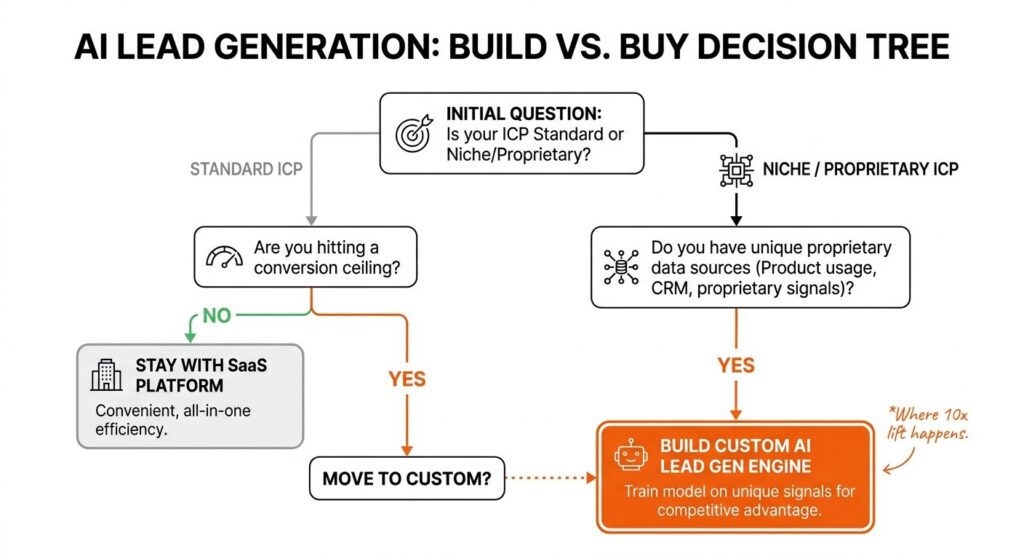
Off-the-shelf AI lead generation software is designed for median use cases. When your pipeline requirements diverge significantly from that median, platform limitations produce compounding friction.
The signals that indicate a custom evaluation is warranted: your ICP includes a niche vertical or geography where platform data coverage is materially weaker than your core market; your conversion patterns depend on proprietary signals the platform does not capture, such as internal CRM events, product usage data, or industry-specific behavioral triggers; your scoring requirements include compliance constraints that limit what data third-party platforms can process; or your team has reached a ceiling on platform-level scoring accuracy and additional configuration is not improving results.
What a Custom Build Adds That No Platform Vendor Can Replicate
A custom AI lead generation build allows your scoring model to train on proprietary signals no platform vendor can access: your product usage data, your support interaction history, and your existing customer attributes at a level of granularity that generic firmographic data cannot approximate.
The cost of custom scoring model development ranges from $20,000 to $80,000 depending on scope and integration complexity. [VERIFY: custom AI lead generation system development cost ranges, including scoring model build, CRM integration, and enrichment pipeline configuration] The full cost framework and the decision criteria for evaluating whether a custom build makes financial sense relative to continued SaaS investment is covered in the AI agent development cost analysis. Firms that have invested in AI agent development infrastructure often find that the custom scoring model extends naturally to other pipeline automation functions, including proposal generation and client onboarding.
SuperteamAI builds custom AI lead generation systems for firms that have reached the ceiling of what off-the-shelf platforms can deliver.See what a custom build looks like for your pipeline
Frequently Asked Questions
What is the difference between AI lead generation software and a CRM?
A CRM stores and manages contact records, deal stages, and communication history. AI lead generation software sits upstream of the CRM: it identifies which contacts are worth adding to the CRM, scores them by conversion likelihood, enriches their records, and sequences outreach. Most AI lead generation platforms integrate with CRMs rather than replacing them.
How much does AI lead generation software cost?
Entry-level all-in-one platforms start from $49 to $99 per month for small teams. Mid-market platforms with stronger scoring and enrichment run $500 to $2,000 per month. Enterprise platforms with full data access and custom integrations typically start at $15,000 per year and scale significantly above that depending on contract terms and seat count. [VERIFY: pricing ranges across tiers are approximate and subject to vendor-specific terms and annual changes]
Do you need technical resources to implement AI lead generation software?
Signal capture and outreach layers in most all-in-one platforms can be configured without technical expertise. The scoring layer, particularly custom model configuration, typically requires either a technical resource or a vendor-provided onboarding service. Custom builds outside the platform environment require dedicated technical resources for the initial build and ongoing maintenance.
How long before AI lead generation software improves pipeline results?
Signal capture and initial scoring output are typically visible within 30 to 60 days. Meaningful MQL-to-SQL conversion improvements, which depend on the scoring model accumulating sufficient training data, typically stabilize between months three and five. Firms that expect conversion lift from day one consistently underestimate the data accumulation phase required for the model to produce reliable outputs.
What happens when the software does not integrate with your existing CRM?
Platforms without native CRM integration require either middleware tools or manual data handling. Middleware integrations introduce sync delays and create failure points that require ongoing monitoring. If a platform does not offer native two-way sync with your CRM, factor the full integration maintenance cost into the total cost of ownership before committing.


