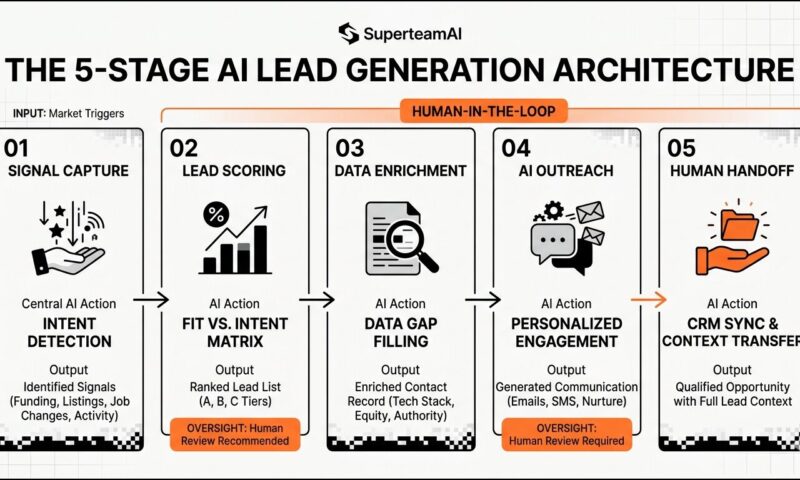
AI lead generation uses artificial intelligence to identify, qualify, and engage potential customers automatically across multiple channels. The process spans five stages: signal capture, lead scoring and qualification, data enrichment, AI-powered outreach, and handoff to a human sales or relationship team. Each stage can be automated partially or fully depending on the workflow’s complexity and the quality of data available.
Most content about AI lead generation is a tool directory. This guide is an architecture guide. It covers what an AI lead generation system actually consists of, how the five stages work in practice, and what separates systems that produce qualified opportunities from those that generate volume without conversion. The applications section covers marketing agencies and real estate firms specifically, since the workflow requirements, data sources, and oversight needs of these buyers differ meaningfully from generic B2B sales use cases.
What AI Lead Generation Actually Is (And What It Is Not)
AI lead generation is the application of machine learning and large language models to the process of finding, qualifying, and beginning a relationship with potential customers. The intelligence layer is what distinguishes it from standard marketing automation: rather than executing a fixed sequence of rules, an AI lead generation system interprets signals, makes decisions, and adapts its behavior based on the data it encounters.
The Difference Between AI Lead Generation and Traditional Automation
Traditional marketing automation executes fixed rules. If a contact opens an email, send a follow-up. If a form is submitted, assign to a sales rep. These rules produce predictable outputs for predictable inputs and fail silently when inputs fall outside the designed parameters.
AI lead generation handles ambiguity. An AI system can read an inbound inquiry, assess the buyer’s intent and qualification against the firm’s criteria, enrich the contact record with publicly available information, draft a contextually appropriate response, and route the lead to the right team member with a qualification summary, all without a human touching the record. The distinction matters because most workflows contain ambiguous inputs: partial contact information, unclear intent signals, or leads that partially match the qualification criteria but require judgment.
Three Approaches: Platform, Workflow Automation, and Custom AI Agent
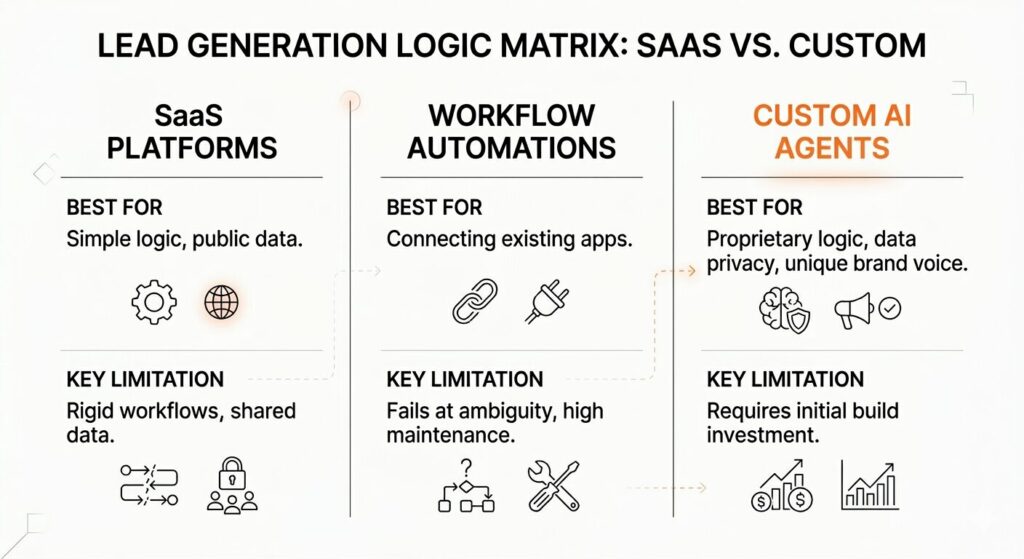
Buyers evaluating AI lead generation will encounter three meaningfully different approaches. SaaS platforms like Apollo, Clay, Instantly, and Seamless.AI offer pre-built AI functionality across prospecting, enrichment, and outreach. They are fast to deploy but constrained by the platform’s logic, pricing model, and data access. Workflow automations built on n8n, Make, or Zapier connect existing tools and apply AI at specific steps, such as scoring a lead when it arrives in a CRM. Custom AI agents are built from scratch around a specific firm’s lead definitions, qualification criteria, voice, and data environment. The right choice depends on the volume, complexity, and sensitivity of the leads being processed, and whether the firm’s qualification logic can be expressed in a SaaS platform’s configuration or requires genuine custom engineering.
The Five Stages of an AI Lead Generation System
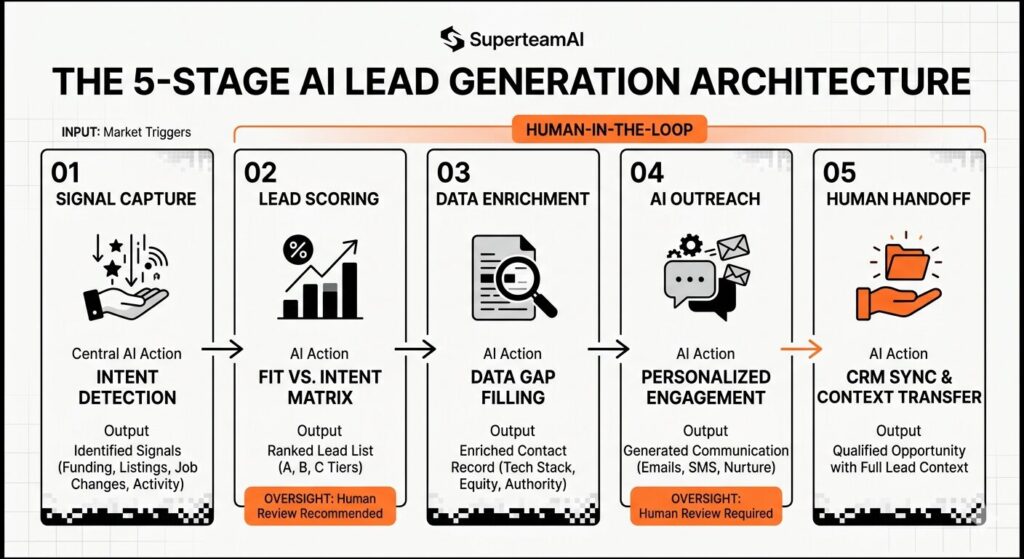
A complete AI lead generation system operates across five sequential stages. Most tools and platforms cover one or two of these stages. A system that covers all five without gaps produces reliable qualified lead flow. A system with gaps produces activity without consistent results.
Stage 1: Signal Capture
Signal capture is the process of identifying and collecting indicators that a potential lead exists. For inbound workflows, signals include form submissions, content downloads, chat interactions, ad clicks, and website behavior patterns. For outbound workflows, signals include job change notifications, funding announcements, new property listings, website technology changes, and social media activity that indicates buying intent. The quality of signal capture determines the quality of the entire system downstream. An AI lead generation system is only as good as the signals it starts with.
Stage 2: Lead Scoring and Qualification
Scoring uses the captured signals to assess a lead’s fit and intent against the firm’s qualification criteria. Fit scoring evaluates whether the lead matches the target profile: company size, industry, geography, role, or property type depending on the use case. Intent scoring evaluates how active and ready the lead appears based on behavioral signals. AI-powered scoring can process hundreds of data points simultaneously and update continuously as new signals arrive, producing a ranked list of leads for outreach rather than a flat list that treats every contact equally [VERIFY]. Human-in-the-loop review at this stage is recommended for any lead that will receive a personalized communication from the firm.
Stage 3: Data Enrichment
Enrichment fills gaps in the lead record with additional information from public data sources, third-party databases, and connected internal systems. For a marketing agency evaluating a prospective client, enrichment might pull the prospect’s current technology stack, recent campaigns, team size, and open positions. For a real estate firm evaluating a potential seller, enrichment might pull property ownership records, estimated equity position, and recent local comparable sales. Enriched records allow outreach to be personalized to the lead’s specific situation rather than generic to their segment.
Stage 4: AI-Powered Outreach and Engagement
Outreach uses the scored, enriched lead record to generate and deliver personalized communications. AI systems can draft personalized emails, SMS messages, or chat responses based on the lead’s profile and the stage they are at in the qualification process. They can manage multi-touch sequences, adjust timing based on engagement signals, and handle initial responses without human involvement. For client-facing communications, human review before send is a critical oversight requirement. Outreach that reaches the wrong audience or sends the wrong message at scale produces reputational damage that takes longer to recover from than any volume benefit justifies.
Stage 5: Human Handoff and CRM Sync
Handoff transfers a qualified lead to a human team member with the full qualification context: score, enrichment data, interaction history, and a recommended next action. The quality of the handoff determines whether the human relationship can begin effectively or must restart the qualification process manually. A well-designed handoff syncs all data to the CRM automatically, creates a task for the assigned team member, and provides a summary of what the AI has already learned about the lead. A poorly designed handoff passes a name and email address with no context and negates the value of the first four stages.
AI Lead Generation for Marketing Agencies
Marketing agencies have two primary lead generation contexts: acquiring new clients for the agency itself, and building lead generation systems for their clients. Both applications benefit from AI, but the architecture differs.
Campaign Inquiry Qualification
Agencies receiving inbound new business inquiries can deploy AI to handle the first layer of qualification before a business development team member engages. An AI system reads the inquiry, scores it against the agency’s ideal client profile (industry, budget signals, project type, timeline), enriches the contact record with the prospect’s company information and recent marketing activity, and routes qualified inquiries with a summary to the BD team within minutes of submission. Unqualified inquiries receive a polite automated response while the team focuses on high-fit opportunities. For agencies receiving significant inbound volume, this workflow eliminates hours of weekly BD triage [VERIFY].
Inbound Content Lead Routing
Content-driven agencies generating leads through blog content, gated reports, or webinar registrations often have large contact lists with inconsistent qualification data. An AI lead generation system can score the existing database based on engagement behavior, enrich records with missing firmographic data, and segment contacts into tiers for human follow-up priority. This converts a dormant list into an active lead pipeline without additional traffic investment. An AI agent development workflow built specifically for the agency’s CRM and content platform produces significantly better results than a generic platform configuration applied to the same data.
AI Lead Generation for Real Estate Firms
Real estate firms operate in a relationship-driven market where lead quality matters more than lead volume. An AI system that produces a hundred low-intent contacts per month is worth less than one that produces ten genuine buying or selling signals with enriched property and financial context.
Buyer and Seller Intent Signals
AI systems can monitor multiple signal sources simultaneously to identify potential buyers and sellers before they raise their hand: property search behavior, recently expired listings, life event triggers (divorce filings, probate records, out-of-state ownership), and engagement with property valuation content. For buyer leads, intent scoring against active search behavior, pre-qualification status, and property match data allows agents to prioritize contacts with genuine near-term purchase intent over early-stage browsers [VERIFY]. For markets with high inbound lead volume from portals, AI qualification that routes only genuinely active buyers to agents dramatically reduces time spent on low-conversion contacts.
Automated Follow-Up and Nurture Sequences
Real estate lead conversion timelines are long: the average buyer takes three to six months from first contact to transaction [VERIFY]. Human teams cannot maintain consistent, personalized contact with every lead in a large database across that timeline. AI-powered nurture sequences maintain contact with leads that are not yet ready to transact, delivering relevant market updates, property alerts, and contextually appropriate check-ins on a schedule calibrated to the lead’s last engagement signal. When a lead reengages, the system alerts the assigned agent with full interaction history. This is one of the highest-ROI applications of AI lead generation for real estate firms: converting existing database volume into active opportunities without additional lead acquisition cost.
What Makes an AI Lead Generation System Reliable
Volume is not the output of a well-designed AI lead generation system. Qualified opportunities delivered with enough context for a human to begin a genuine conversation are the output. Systems that produce volume without reliability fail in production even when the underlying technology works correctly.
Data Quality Requirements
An AI lead generation system is constrained by the quality of data it operates on. Incomplete CRM records, inconsistent contact data across systems, and missing qualification fields produce incorrect scoring and misdirected outreach. Before deploying any AI lead generation system, audit the data it will process: what percentage of records have complete contact information, what enrichment sources are connected, and whether the qualification criteria can be expressed in data fields the system can read. Firms that skip this audit build AI systems on bad data and attribute the resulting failures to the technology rather than the input.
Human-in-the-Loop Oversight at the Qualification Stage
For any AI lead generation system producing outreach on behalf of the firm, human review before send is not optional. It is the oversight layer that prevents a scoring error or enrichment gap from producing a communication that reaches the wrong person with the wrong message. The oversight structure should be built into the system architecture, not added as an afterthought. This means a defined review interface, a maximum queue time before a lead is escalated, and a clear protocol for what happens when a human reviewer disagrees with the AI’s qualification decision. The AI agent development services required to build this layer correctly are distinct from the tools used to score and enrich leads.
[IMAGE: AI lead generation reliability checklist showing data quality requirements, oversight checkpoints, and common failure modes | Alt: “What makes an AI lead generation system reliable: data quality, oversight, and failure mode prevention” | Suggested type: checklist or diagnostic card]
Marketing agency or real estate firm ready to build an AI lead generation system?Book a free 30-minute discovery call and we will map your highest-value lead source and identify the right system architecture before any commitment.
AI Lead Generation Tools vs. Custom AI Agents: Which Do You Need?
The choice between a SaaS platform, a workflow automation, and a custom AI agent is not primarily a technology decision. It is a decision about how specific your lead qualification criteria are, how sensitive your lead data is, and how much the performance of the system matters to your business.
When a SaaS Platform Is Sufficient
SaaS platforms are the right choice when the qualification logic is simple and standard, the data being processed is not confidential, the use case matches the platform’s designed workflow, and speed of deployment matters more than depth of customization. For a firm that needs basic lead scoring and email sequencing with a standard contact database, platforms like Apollo, Clay, or Instantly deliver real value without custom development.
When You Need a Custom AI Agent
Custom AI agents are necessary when the qualification logic is specific to the firm’s market position or relationship criteria and cannot be expressed in a platform’s configuration. When the data being processed includes confidential client information that cannot pass through third-party APIs, open-source model deployment on private infrastructure is required. When the workflow spans multiple systems that do not have native platform integrations, custom API work is unavoidable. When the outreach must reflect the firm’s specific voice, relationship history, and contextual knowledge of the lead, generic platform templates produce output that damages rather than advances the relationship. For a detailed comparison of how AI agent development companies approach this decision, the evaluation framework covers the six questions to ask before any engagement.
The Managed Service Option
A managed AI lead generation service handles both the build and ongoing operation of the system as a combined offering. The firm pays a monthly retainer covering initial architecture design, integration development, ongoing management, and iteration as the workflow evolves. This is the most cost-effective model for marketing agencies and real estate firms that want the output of a custom system without managing a vendor relationship, monitoring integration health, or handling the prompt engineering work required to keep the system performing as lead characteristics change.
How SuperteamAI Builds AI Lead Generation Systems and What They Cost
SuperteamAI builds and manages custom AI lead generation systems exclusively for marketing agencies and real estate firms. Every engagement begins with a workflow discovery session that maps the current lead flow, identifies where volume is lost to slow qualification or inconsistent follow-up, and defines the qualification criteria in terms the AI system can evaluate. The discovery session produces a system architecture document before any build begins.
Build pricing for a single-workflow AI lead generation system for an SMB buyer typically falls in the $8,000 to $20,000 range, depending on integration complexity and the number of signal sources the system monitors [VERIFY]. Ongoing management retainers start at $1,500 per month and cover monitoring, integration maintenance, prompt optimization, and iteration as the system is refined against real-world lead data. For firms with client data confidentiality requirements, open-source model deployment routes all AI reasoning through the firm’s own infrastructure rather than third-party APIs.
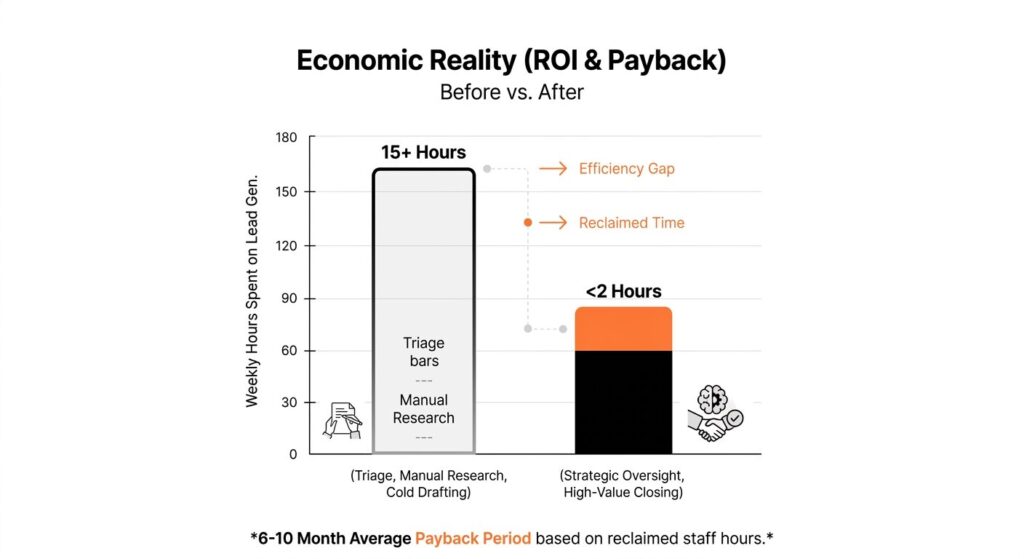
The correct comparison frame is not system cost versus no system. It is system cost versus the fully-loaded cost of the staff hours currently spent on lead qualification, triage, and follow-up. For a marketing agency spending fifteen hours per week on BD qualification or a real estate firm with an agent spending twelve hours per week on database follow-up, the first-year payback period on a managed AI lead generation system is typically six to ten months [VERIFY]. The detailed cost breakdown covering build, management, and first-year total cost of ownership is covered in the guide to AI agent development cost.
SuperteamAI builds and manages custom AI lead generation systems exclusively for marketing agencies and real estate firms.Book a consultation to discuss your lead flow and receive a scoped proposal with transparent pricing.
Frequently Asked Questions
What is AI lead generation? AI lead generation uses artificial intelligence to identify, qualify, and engage potential customers automatically. It spans five stages: signal capture from inbound and outbound sources, lead scoring and qualification against defined criteria, data enrichment, AI-powered outreach, and handoff to a human team member with full qualification context.
How does AI lead generation differ from traditional lead generation? Traditional lead generation uses fixed rules and manual processes. AI lead generation interprets ambiguous signals, makes qualification decisions based on hundreds of data points simultaneously, adapts its behavior based on new data, and handles personalized outreach without requiring a human to process each contact individually. The practical difference is in qualification quality and throughput at scale.
What are the best AI lead generation tools? The most-used platforms include Apollo for B2B prospecting and outreach, Clay for enrichment-first lead workflows, Instantly for high-volume email sequencing, and Podium for real-time lead response in local business contexts [VERIFY]. The right tool depends on whether the qualification logic, data sensitivity, and workflow complexity of the use case fit the platform’s designed capabilities.
How much does AI lead generation cost? SaaS platforms typically cost $300 to $2,000 per month depending on contact volume and features [VERIFY]. Custom AI lead generation agents for SMB buyers typically cost $8,000 to $20,000 to build and $1,500 to $3,000 per month to manage. Managed service offerings bundle build and management into a single monthly retainer. Full pricing ranges by system type are covered in the AI agent development cost guide.
Does AI lead generation work for real estate? AI lead generation produces measurable results in real estate across buyer intent scoring, seller lead identification, and automated nurture for long-conversion-cycle contacts. Firms that deploy AI qualification and follow-up systems report 35 to 50 percent higher lead conversion rates compared to manual processes [VERIFY]. The highest-ROI use case is typically automated follow-up for existing database contacts that human teams cannot maintain consistent contact with.
What data does an AI lead generation system need to work? At minimum, a functional AI lead generation system requires a contact database with consistent fields, a defined set of qualification criteria, connected signal sources (website, CRM, ad platforms, or outbound data providers), and a CRM or destination system for enriched lead records. The more complete and consistent the input data, the more accurate the qualification output.
How do I know if I need a SaaS platform or a custom AI agent for lead generation? A SaaS platform is sufficient when the qualification logic is standard, the data is not confidential, and the workflow matches the platform’s designed use case. A custom AI agent is necessary when qualification logic is specific to the firm’s criteria, data privacy requirements prevent routing leads through third-party APIs, or the workflow spans multiple systems without native integrations.How long does it take to see results from an AI lead generation system? SaaS platforms can be deployed and producing output within days. Custom AI lead generation systems typically take two to six weeks from discovery through deployment. Production results, meaning qualified leads delivered to the sales team with accurate enrichment and scoring, typically stabilize within the first 30 to 60 days as the system is calibrated against real lead data [VERIFY].