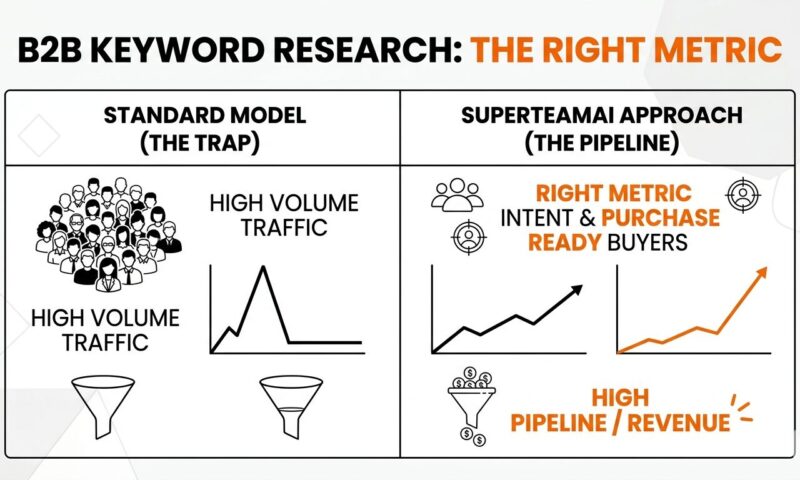
Most b2b keyword research starts in Ahrefs and ends with a list of 500 terms sorted by search volume. I have run keyword builds across 50+ companies through SuperteamAI and found that this approach reliably produces the same outcome: a content calendar full of articles attracting the wrong audience, ranking for terms that generate traffic but not pipeline. The framework I use starts with your ICP and your sales call recordings, not a keyword tool. For the full programme architecture, see the B2B SEO strategy guide.
Why B2B Keyword Research Is Different From B2C
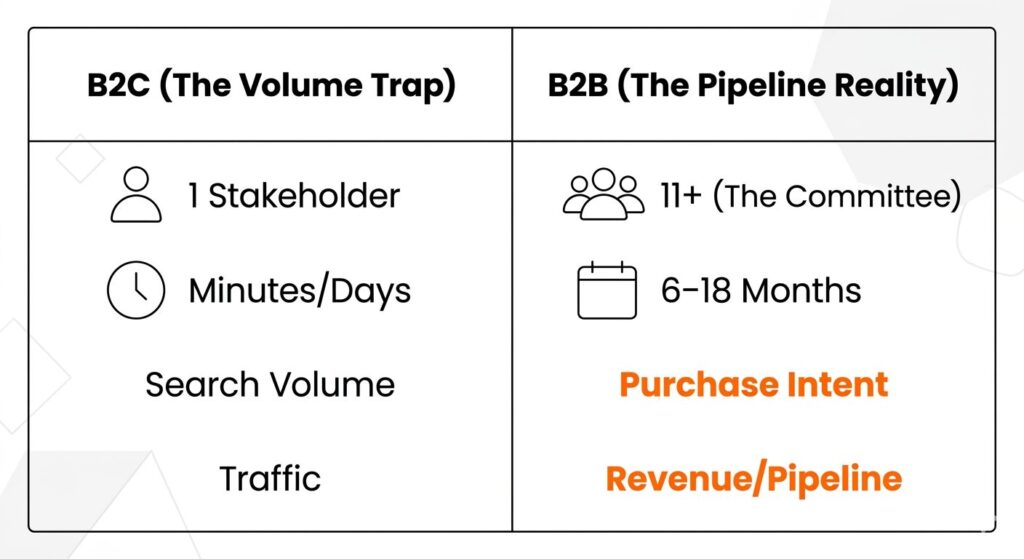
B2B keyword research operates under fundamentally different economics from consumer keyword research. A B2C buyer searches once, clicks, and converts in a single session. A B2B deal involves an average of 11 stakeholders running independent research over a 6 to 18 month evaluation cycle (Gartner 2024). Each stakeholder uses different language, searches at a different stage, and needs different content to move forward.
The volume metric that drives B2C keyword strategy is actively misleading in B2B. A keyword with 50 monthly searches from CFOs evaluating enterprise software is worth more than a keyword with 5,000 monthly searches from a mixed audience that never converts. Long-tail keywords account for 91.8 percent of all searches and convert at higher rates than broad terms because specificity signals intent (Semrush 2025). Organic leads generated through intent-matched keyword targeting close at 14.6 percent, compared to 1.7 percent for outbound (HubSpot 2025). Volume is a measure of audience size, not audience quality. In B2B, audience quality determines pipeline, not audience size. The B2B SEO statistics guide covers the full pipeline conversion benchmarks by keyword type.
ICP Mapping Before You Open a Keyword Tool
The step that separates effective b2b keyword research from ineffective b2b keyword research is ICP definition. Before I open Ahrefs or Semrush in any SuperteamAI engagement, I document four things about the target buyer: job title and seniority, industry and company size, the business problem they are trying to solve, and the language they use to describe that problem. Most teams skip this step and go straight to the keyword tool, which means their list reflects what the tool thinks is popular rather than what their specific buyer actually searches.
An ICP document changes every downstream keyword decision. A keyword like “CRM software” has high volume but attracts buyers at every stage, from every industry, at every company size. A keyword like “CRM integration for manufacturing sales teams” has lower volume but maps directly to a specific ICP and converts at a rate that justifies targeting. Without an ICP document, a keyword list is just a list. With one, it becomes a targeting system. I build the ICP document in week one of every SuperteamAI engagement before a single keyword is selected, and every article brief written after that references it to confirm the content is aimed at the right buyer.
Buying Committee Keyword Mapping: Technical Buyers vs Business Buyers
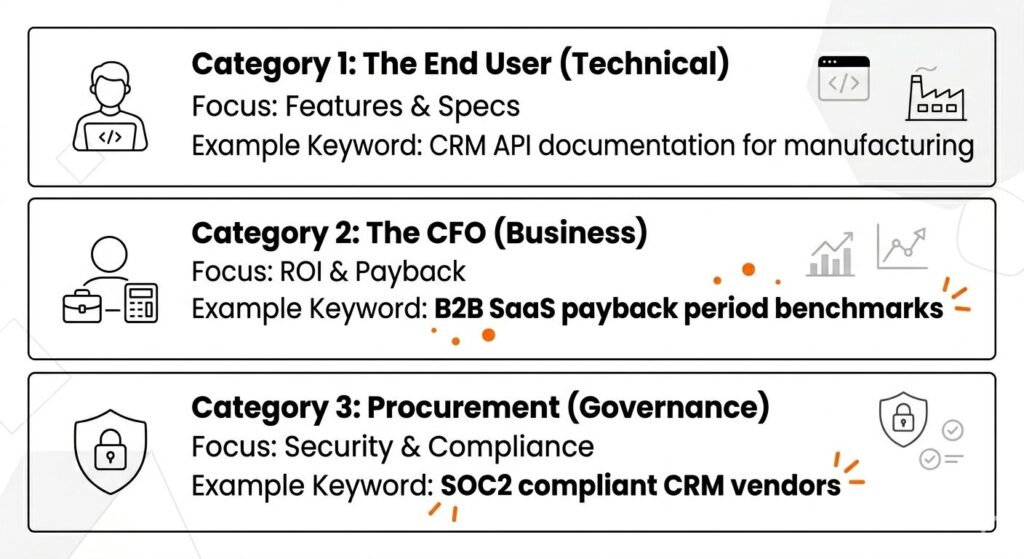
A B2B buying committee is not a monolith. The end user searches for specifications, features, and implementation requirements. The CFO searches for ROI benchmarks, payback period, and total cost of ownership. The procurement team searches for vendor compliance, security certifications, and contract terms. Each role is in the same deal, searching independently, and landing on different pages.
Effective b2b keyword research maps keywords to buying committee roles, not just to topics. I categorise every keyword in a cluster build into two groups: technical buyer keywords and business buyer keywords. Technical buyer keywords cover product capabilities, integration documentation, and implementation guides. Business buyer keywords cover ROI data, pricing comparisons, and executive case studies. A complete cluster covers both groups so every committee member who researches the category finds your content. An average B2B deal involves 11 stakeholders each running 7 to 11 independent research queries (Gartner 2024), which means a cluster covering only one buyer role misses the majority of the committee.
Intent Layering Across the B2B Funnel
Intent is not a single attribute of a keyword. It is a position on a spectrum from problem-aware to solution-aware to vendor-evaluating. Keyword research that does not map keywords to funnel stage produces content that attracts buyers at the wrong moment and fails to move them forward.
The three intent layers I use in every cluster build are awareness, evaluation, and decision keywords. Awareness keywords are problem-named: “why is our sales pipeline stagnant” or “how to improve B2B lead quality”. Evaluation keywords are solution-named: “B2B content marketing platforms” or “best b2b seo tools for SaaS”. Decision keywords are vendor or comparison-named: “HubSpot vs Salesforce for B2B” or “b2b seo agency pricing”. Long-tail keywords of 8 or more words carry 50 percent less competition and convert at 20 percent higher rates than shorter equivalents (Ahrefs 2025). Decision-stage keywords in B2B are almost always long-tail. Mapping keywords to these three layers before publishing ensures the content library covers the full evaluation cycle rather than clustering around the awareness stage where most generic content lives.
The Low Volume Paradox: Why B2B Targets Keywords Tools Mark as Zero
The paradox at the centre of b2b keyword research is that the keywords worth targeting are often those a tool rates as zero volume. Zero volume does not mean zero searches. It means fewer searches than the tool’s reporting threshold, typically under 10 to 50 per month depending on the platform. A buyer who searches “enterprise inventory management software for Tier 1 automotive suppliers” has already defined their problem, their industry, and their procurement context. That query converts at 15 to 20 percent for a relevant vendor (case data, 2025).
I target zero-volume and sub-100-volume keywords in every SuperteamAI cluster build because specificity is a proxy for purchase intent in B2B. A keyword with 20 monthly searches from senior procurement managers at manufacturing firms may generate more pipeline than a keyword with 2,000 monthly searches from a mixed audience that never converts. Published content covers the primary keyword and all semantic variants, so even low-volume targets capture related long-tail traffic across the full intent neighbourhood.
Sales Calls and CRM Data as Keyword Sources
The highest-converting keywords in any B2B vertical are not in Ahrefs. They are in your sales call recordings, support ticket logs, and demo request forms. These sources contain the exact language your buyers use to describe their problems before they have been introduced to your product’s framing. That language is what they type into Google.
I run a sales call keyword extraction in every new SuperteamAI engagement. I review 10 to 20 recorded sales calls or demo sessions, extract the phrases prospects use to describe their problem, and run those phrases as seed terms in Ahrefs. The gap between the terms prospects use organically and the terms a company targets in its content is almost always wide, and it represents keyword territory that competitors relying on tool-generated lists cannot access. The best B2B SEO tools guide covers the tool stack for this process, including Ahrefs for seed expansion and Screaming Frog for competitive gap analysis.
The Keyword Research Process I Use in Every SuperteamAI Engagement
The b2b keyword research process I run follows a fixed sequence. First, I build the ICP document covering target roles, industries, company sizes, and pain points. Second, I map buying committee roles and identify which roles need separate keyword clusters. Third, I review sales call recordings and support tickets to extract seed phrases in the buyer’s own language. The first three steps alone surface keyword categories that no competitor using a tool-first approach will find, because they are grounded in actual buyer language rather than tool-generated approximations.
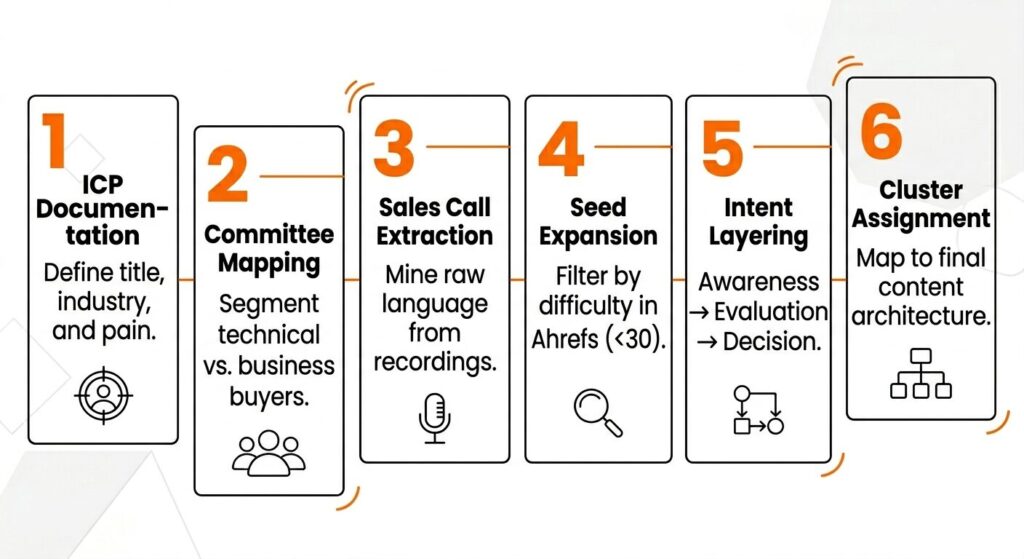
Fourth, I expand those seed phrases in Ahrefs using Keywords Explorer, filtering by keyword difficulty under 30 to build early content velocity while topical authority accumulates. Fifth, I layer each keyword by intent stage: awareness, evaluation, or decision. Sixth, I assign each keyword to a cluster and a pillar, mapping the full content architecture before any articles are written. Running the sequence in this order means every article targets a verified buyer, at a verified stage, in verified language.
ReachInbox came to SuperteamAI with a content library built on high-volume, low-intent keywords that were generating traffic but not demos. After I rebuilt the keyword architecture using committee-mapped, intent-layered clusters and deployed the AI SEO Workforce at 25 to 28 articles per month, traffic grew 750% from 2,000 to 17,000 monthly visitors in 12 months. CEO Anup Sharma: “We went from 2,000 visitors to 17,000, and our conversion rates more than doubled.” EasyOps had no keyword architecture at all when we began. After I built the full ICP-to-cluster map and implemented the attribution layer, organic traffic grew 626% from 4,200 to 30,500 monthly visitors. CEO Rajiv Mehta: “We were invisible in the market.” The B2B SEO checklist covers the full 27-step keyword build.
GEO Keyword Research: Queries AI Systems Are Already Answering
GEO keyword research is a layer of the process that guides published before 2025 do not address. AI Overviews now appear for 13 percent of Google queries and that share is growing at 116 percent year over year (Semrush 2025). A portion of your target keyword list is being answered by AI before a buyer clicks any organic result.
The approach I use in SuperteamAI cluster builds is to treat “People Also Ask” results and AI Overview trigger queries as a separate keyword category. These are question-format queries where a direct-answer H2 opening and FAQPage schema markup give your content citation eligibility in AI responses. If an AI system answers “what is the ROI of B2B content marketing” using a cited source, that citation generates branded search as a second step, which is trackable. Question-format, answer-eligible keywords are now a ranking and citation opportunity combined. I flag these during the keyword classification stage, before any content brief is written, so the writer knows which H2 openings require a direct answer in the first sentence. I build a GEO-eligible keyword cluster into every content plan from the start, because retrofitting this structure after rankings plateau takes far longer than building it in at publication.
Frequently Asked Questions
What is B2B keyword research?
B2B keyword research is the process of identifying search terms that buyers at business-to-business companies use at each stage of an evaluation cycle, mapped to the specific roles in a buying committee. It differs from consumer keyword research in that it must account for multiple stakeholders searching independently, buying cycles of 6 to 18 months, and low-volume keywords that carry high commercial intent because of their specificity. Effective B2B keyword research starts with ICP definition and sales call analysis before any keyword tool is opened.
How is B2B keyword research different from B2C?
B2B keyword research targets multiple buying committee members rather than a single consumer. Each committee role uses different language and searches at a different intent stage, from technical specifications to ROI benchmarks to vendor compliance. B2B keywords are typically lower volume but higher intent because specificity signals purchase readiness in a way that generic terms do not. The evaluation cycle runs 6 to 18 months, so keywords must cover awareness, evaluation, and decision stages rather than a single-session purchase path.
Should B2B companies target low search volume keywords?
Yes. Low search volume keywords in B2B often carry higher commercial intent because specificity is a proxy for purchase readiness. A keyword with 20 monthly searches from senior procurement managers converts at a higher rate than a keyword with 2,000 monthly searches from a general audience. Keywords below 100 monthly searches with high specificity should be core targets in any B2B cluster build, particularly at the evaluation and decision stages where buyers are closest to making vendor contact.
What tools should I use for B2B keyword research?
The core tool stack for b2b keyword research is Ahrefs or Semrush for keyword discovery and competitive gap analysis, Google Search Console for identifying existing ranking opportunities to accelerate, and Google’s People Also Ask results for question-format and GEO-eligible keyword candidates. Sales call recordings and CRM data serve as a primary seed phrase source. This last source gives you keyword territory that competitors using generic tool-based research cannot access.
How many keywords should a B2B company target?
A B2B company should target enough keywords to cover the full buying committee across awareness, evaluation, and decision stages. In practice, this means 80 to 150 keywords for a focused cluster covering one product category, expanding to 300 to 500 keywords for a full ICP map across multiple buyer segments. Volume targets matter less than committee coverage. A complete cluster that reaches every stakeholder role at every funnel stage consistently outperforms a high-volume list that covers only awareness-stage searches.