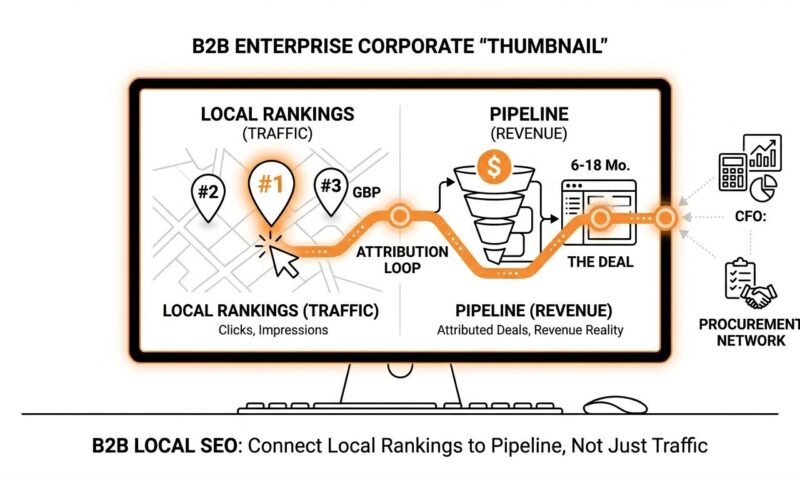
Most B2B companies treat local SEO as an afterthought, or worse, copy their B2C competitors and wonder why Google Business Profile impressions never show up in the CRM. I have run b2b local seo audits across 50+ companies through Superteam AI and found the same gap every time: the business appears in local search, the buyer clicks, the session is never attributed to a deal. Local visibility without pipeline attribution is a vanity metric. This guide covers the framework to fix that, from Google Business Profile through to CRM attribution, built specifically for B2B buying cycles. For the full programme architecture, see the B2B SEO strategy guide.
Why B2B Local SEO Is Different From B2C Local SEO
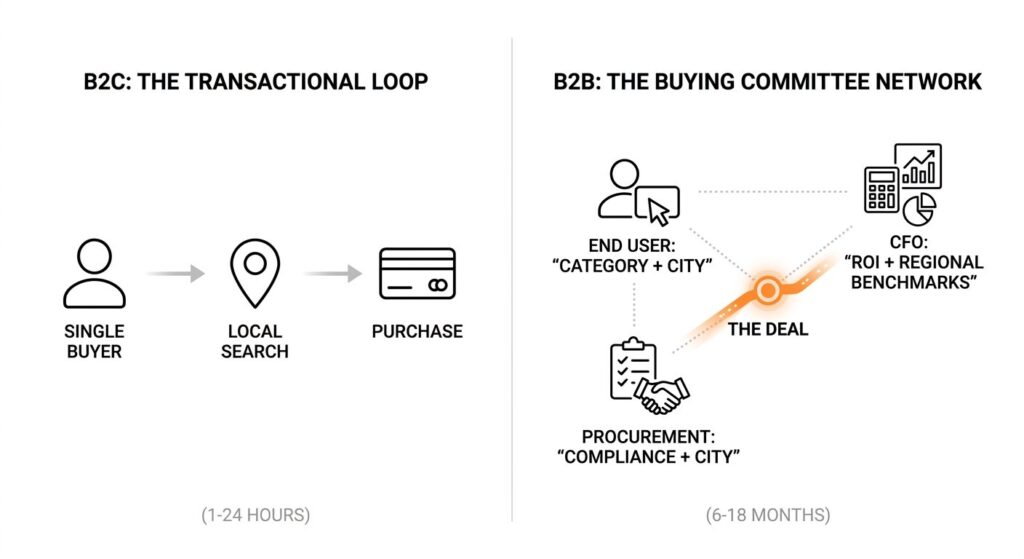
Local SEO for B2B is not simply the B2C version applied to a business audience. The mechanics differ at every layer. In B2C, a single buyer searches, clicks, and converts in one session. In B2B, an average deal involves 11 stakeholders running independent research across multiple sessions over weeks or months (Gartner 2024). Each stakeholder in the buying committee may run a location-based query with a different intent: the end user searches for the product category near their office, the CFO searches for pricing benchmarks by region, and the procurement team searches for vendor compliance records by city.
A B2C local SEO strategy optimises for one query and one conversion. A strategy built for B2B optimises for a buying committee running parallel local queries across a 6 to 18 month evaluation window. That difference changes which keywords to target, which content to produce, and how to measure success. The B2B SEO statistics guide covers the full pipeline conversion benchmarks that underpin this approach.
Google Business Profile: The Non-Negotiable Foundation
Google Business Profile is the starting point for any local SEO programme targeting B2B buyers. In my experience, a recurring error B2B companies make with GBP is treating it as a directory listing rather than a content channel. A fully optimised GBP profile appears in the local pack, in Google Maps, and now in Gemini-powered Ask Maps results, which are increasingly showing local B2B vendor recommendations directly in AI responses.
The setup framework I run in every Superteam AI local engagement covers four elements: correct primary category selection, complete service and product listings with B2B-specific language, a posting cadence of two to three updates per week covering case studies and local use cases, and a review request sequence built into the post-sale process. Profiles that are complete and regularly updated receive significantly more visibility in the local pack than dormant profiles, and in B2B the stakes are higher because a single local impression may be the first touchpoint for a deal worth six figures (BrightLocal 2025).
NAP Consistency and Local Citations
NAP stands for Name, Address, and Phone number. Inconsistent NAP data across directories, data aggregators, and industry listings suppresses local rankings because Google uses citation consistency as a trust signal for business legitimacy. I have seen B2B companies with strong domain authority and quality content plateau in local pack rankings because a legacy address from a previous office was still live across 40 directories.
The approach I implement across SuperteamAI engagements starts with a full citation audit using Screaming Frog to surface inconsistencies, followed by a priority fix list targeting the highest-authority directories first: Google, Bing Places, Apple Maps, LinkedIn company pages, industry-specific directories, and chamber of commerce listings. For B2B companies operating in multiple cities, each office location needs its own GBP listing and a consistent NAP set across all platforms. I have seen B2B companies with strong domain authority and quality content plateau in local pack rankings because a legacy address from a previous office remained live across 40 directories, creating a trust conflict that suppressed rankings despite strong content signals. Fixing NAP consistency alone moved two Superteam AI clients from page two to the local pack within 60 days.
B2B Local Keyword Strategy: Buying Committee Queries by Location
Local keyword research for B2B requires mapping queries by buying committee role, not just by location modifier. The end user searches for “[product category] [city]”. The CFO searches for “[product category] cost [city]” or “[category] ROI [region]”. The technical evaluator searches for “[product] integration support [city]”. Each query maps to a different stakeholder and a different piece of content.
In SuperteamAI keyword builds for B2B local clients, I run ICP mapping before any keyword tool. The ICP defines which roles are searching in which markets, then Ahrefs surfaces the volume and competitor data for each role-based query. Long-tail local keywords with commercial intent convert at 2.5 times the rate of broad local terms (Backlinko 2025), which means a keyword plan built around “b2b [category] [city] pricing” outperforms one built around “[city] [category]” even at lower search volume. The B2B SEO guide covers the full ICP keyword framework.
Local Content Clusters vs. One-Off City Pages
One-off city pages are a common but consistently underperforming local SEO tactic in B2B. A single page titled “[Service] in [City]” with thin content produces minimal topical authority and typically ranks briefly before plateauing. I have audited dozens of B2B sites with 20 to 30 city pages that collectively receive fewer visits than a single well-structured local cluster.
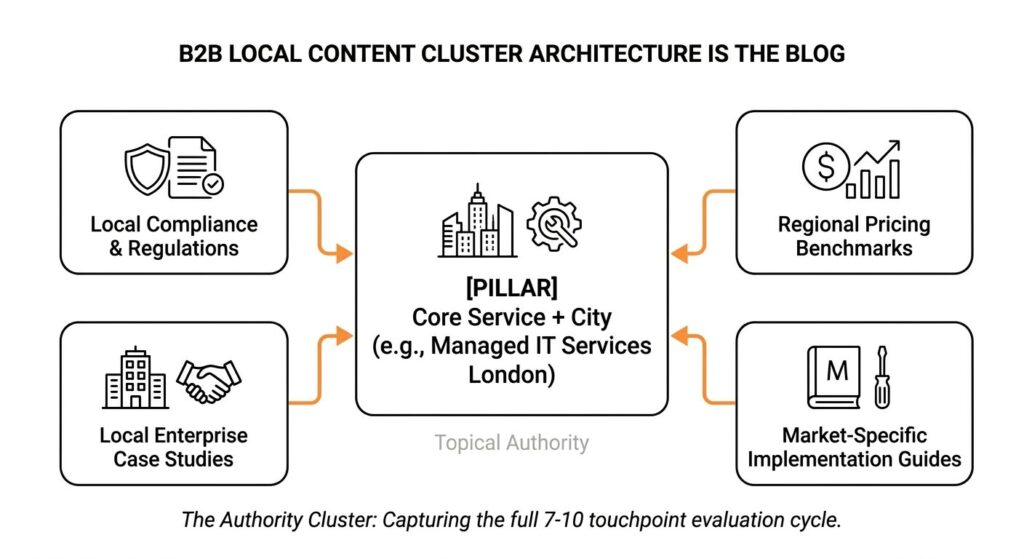
Local content clusters work differently. A pillar page covers the service category at depth for the target region. Cluster articles cover buying committee sub-queries: local compliance considerations, regional pricing benchmarks, local case studies, and market-specific implementation guides. The cluster signals topical authority across the geography, not just keyword presence on a single page. B2B buyers read 7 to 10 content pieces before making vendor contact (Forrester 2024). A local cluster that covers the full evaluation cycle across all those touchpoints builds trust at a depth a single city page cannot match.
The AI SEO Workforce at SuperteamAI produces these local content clusters at 24 to 28 articles per month, structured for both geographic keyword rankings and GEO citation eligibility from day one. ReachInbox ran a similar content cluster programme targeting their core B2B markets and saw traffic grow 750% from 2,000 to 17,000 monthly visitors in 12 months. CEO Anup Sharma: “We went from 2,000 visitors to 17,000, and our conversion rates more than doubled.” Local cluster depth is what drives that compounding, not one-off city pages refreshed annually.
Reviews and Local Reputation for B2B Pipeline
Reviews function differently in local search for B2B than in B2C. The primary review platforms that matter for B2B are Google Business Profile, G2, Capterra, Trustpilot, and industry-specific directories. B2B buyers do not read reviews the way consumers do; they read them as due diligence, specifically looking for evidence that the vendor has worked with companies at their scale, in their industry, or in their geography.
The review strategy I implement in Superteam AI engagements focuses on three things: role-specific review requests (asking the end user, the procurement contact, and the technical evaluator separately so each stakeholder type appears in the review set), geographic tagging in review responses to reinforce local relevance signals, and response cadence that keeps the GBP listing active. Review velocity matters for local pack rankings, and a steady flow of new reviews outperforms a burst of reviews followed by silence (BrightLocal 2025). For B2B companies, the right timing is 14 to 21 days after a project milestone. At that point the client has clear evidence of value and the relationship is warm. A review request process built into the post-sale workflow produces a consistent cadence without relying on ad hoc requests that go unanswered.
GEO Optimisation: Structuring Local B2B Content for AI Overviews
As of early 2025, 13% of Google queries trigger AI Overviews, up 116% since March of the same year (Semrush 2025). Local B2B queries are increasingly represented in that share because they are question-format searches that AI systems synthesise directly: “best b2b [category] company in [city]”, “top [service] providers near me for enterprise”. An article not structured for AI Overview citation eligibility loses visibility to a competitor whose content is.
GEO structure for local B2B content follows three rules. Every H2 addressing a local question opens with a direct answer in the first sentence. FAQ sections use exact-match question phrasing mirroring how local buyers actually search. FAQ schema markup is implemented at publication. The AI SEO Workforce at Superteam AI builds GEO structure into every local content piece at the production stage, ensuring local cluster articles are citation-eligible from day one rather than retrofitted after rankings plateau. Local queries like “best B2B [category] company in [city]” and “enterprise [service] provider near me” are exactly the formats AI systems pull structured answers from, and a direct-answer opening is what determines whether your content gets cited or a competitor’s does.
Connecting B2B Local SEO to Pipeline Attribution
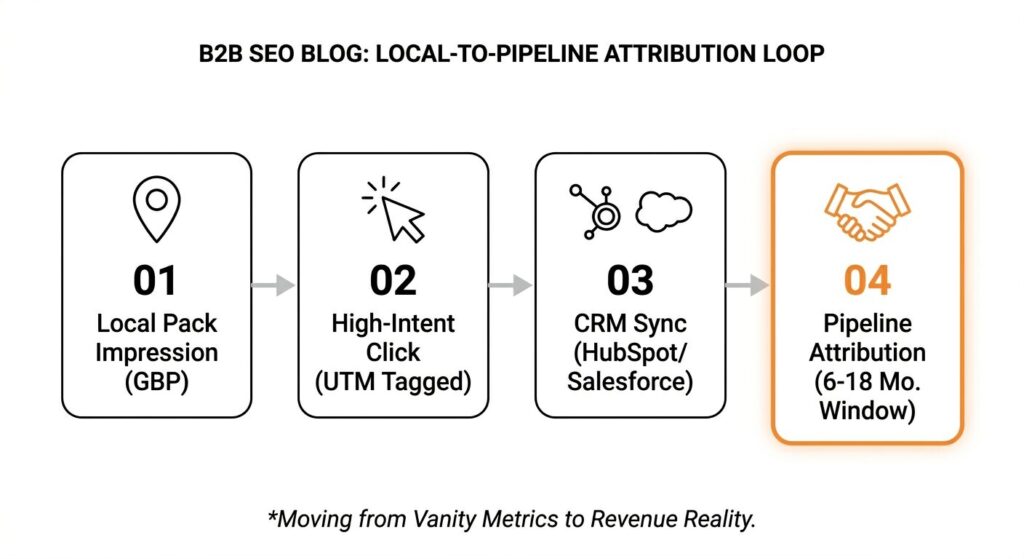
Pipeline attribution is where local SEO programmes for B2B most commonly fail. The local pack drives an impression, the buyer clicks to the website, and the session is never connected to the lead record in the CRM because UTM parameters were not configured on local CTAs and the attribution window is set to 30 days on a buying cycle that runs 12 months.
I configure the full attribution layer in week one of every Superteam AI engagement, before any local content publishes and before the first GBP post goes live. UTM parameters on every GBP CTA, website contact form, and demo request button. GA4 integrated with HubSpot or Salesforce to pass lead source data into the deal record. Attribution window set to 6 to 18 months to capture the full B2B buying cycle. Organic leads close at a significantly higher rate than outbound leads when the attribution model is configured correctly (HubSpot 2025).
EasyOps had no attribution model when we began our engagement. After I configured the pipeline attribution layer and deployed a local content cluster targeting their core service markets, organic traffic grew 626% from 4,200 to 30,500 monthly visitors and CPL dropped from $127 to $43. CEO Rajiv Mehta: “We were invisible in the market.” Local visibility without attribution is invisible to the board. The B2B SEO checklist covers the full 27-item attribution setup. Run the AI SEO Workforce free for 14 days and I will configure the attribution layer in week one.
Frequently Asked Questions
What is B2B local SEO?
B2B local SEO is the practice of optimising a business-to-business company’s online presence to appear in location-based search results when potential buyers in a specific geography are evaluating vendors. It differs from B2C local SEO in that it must account for multiple buying committee stakeholders running parallel local queries across a 6 to 18 month evaluation cycle, and it measures success by pipeline contribution rather than foot traffic or consumer conversions.
Does B2B local SEO work for companies without a physical storefront?
Yes. B2B companies without a public-facing storefront can still appear in local search for service area businesses by configuring their Google Business Profile as a service area business rather than a physical location. The key is specifying the service areas accurately, publishing local content that references those markets, and building NAP consistency across directories that support service area business listings.
How is B2B local SEO different from B2C local SEO?
Local SEO for B2B targets a buying committee with multiple stakeholders running different location-based queries at different stages of a long evaluation cycle. B2C local SEO targets a single consumer making a short-cycle purchase decision. B2B local content must cover role-specific sub-queries such as pricing, compliance, and implementation in addition to the category-level query. Attribution must run on a 6 to 18 month window, not the 30-day window that works for B2C attribution.
Which local SEO signals matter most for B2B companies?
The highest-impact local SEO signals for B2B companies are Google Business Profile completeness and posting activity, NAP consistency across authoritative directories, review velocity and stakeholder diversity in the review set, local content cluster depth across buying committee sub-queries, and Core Web Vitals performance. In 2026, GEO structure for AI Overview citation eligibility is an additional signal that most B2B local SEO guides have not yet accounted for.
How do I measure B2B local SEO ROI?
Measure B2B local SEO ROI by configuring GA4 with UTM parameters on all local organic CTAs, integrating GA4 with your CRM to track lead source from first organic touchpoint to closed deal, and building a Looker Studio dashboard showing organic-attributed MQLs, pipeline value, and cost per organic lead by market. Set the attribution window to 6 to 18 months to capture the full B2B buying cycle. Without this configuration, local SEO ROI is understated by 40% to 60% relative to a correctly modelled attribution report (HubSpot 2025).