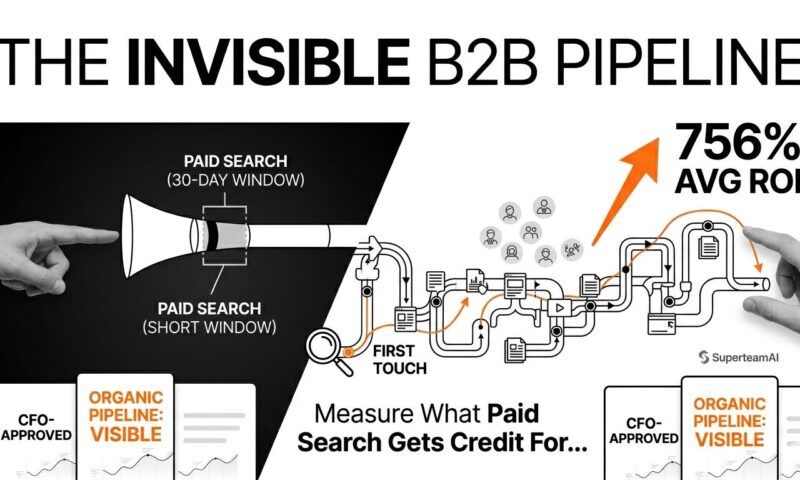
Every B2B company I have audited through SuperteamAI has the same problem: organic search is generating pipeline that the CFO cannot see. The attribution model is built for paid channels with same-day conversion windows, not for organic channels where a buyer reads 11 articles over 14 months before booking a demo. The result is that b2b seo roi looks weak in the dashboard while paid search looks strong, and the SEO budget gets cut in the next planning cycle. This guide covers the formula, the attribution model, and the CFO-facing dashboard that fixes the measurement problem before it becomes a budget problem. For the full programme architecture, see the B2B SEO strategy guide.
Why B2B SEO ROI Is Systematically Understated
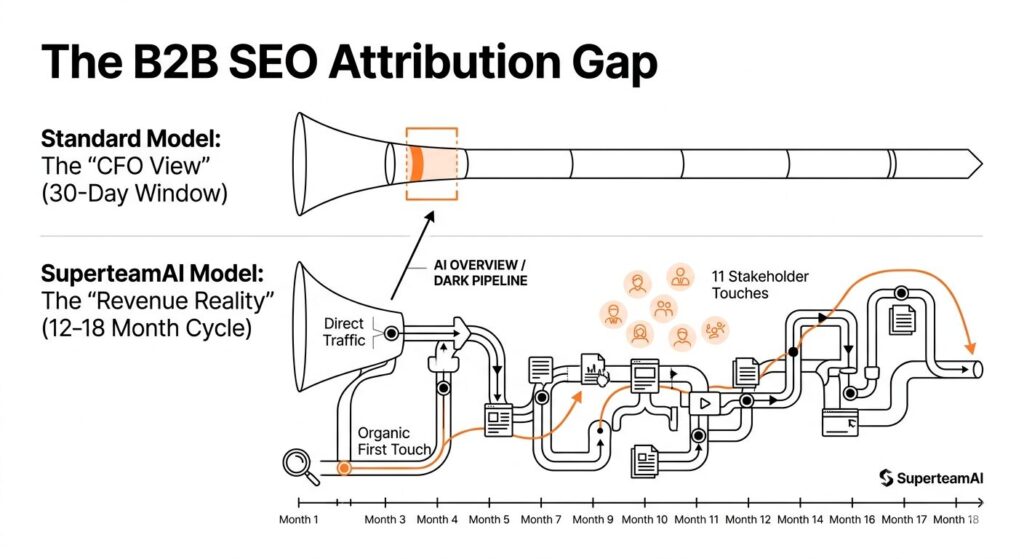
In every B2B company I audit, organic SEO returns are understated not because the channel underperforms but because the measurement model is wrong. Three structural gaps cause the understatement.
First, attribution windows. Most CRM and analytics setups default to a 30-day attribution window. A B2B buying cycle runs 6 to 18 months. A buyer who reads a cluster article in January and closes in October is attributed to direct or paid in most models, erasing the organic first touch. Companies using 30-day windows understate organic pipeline contribution by 40 to 60 percent relative to a correctly configured multi-touch model (HubSpot 2025).
Second, the buying committee. An average B2B deal involves 11 stakeholders running independent research (Gartner 2024). Last-click attribution credits one stakeholder’s final interaction. The ten other committee members who each read two to three organic content pieces before the deal closed receive zero credit. The actual organic influence across the committee is six to ten times what last-click reports.
Third, AI Overview dark pipeline. As of 2025, 13 percent of Google queries trigger AI Overviews (Semrush 2025). Buyers who find your content cited in an AI response and navigate directly to your site are tracked as direct traffic, not organic. The SEO work that earned the citation receives no credit. The B2B SEO statistics guide covers the full attribution gap benchmarks.
The Correct SEO Formula: What to Measure and What to Ignore
The standard formula is: ROI equals revenue from organic minus cost of SEO, divided by cost of SEO, multiplied by 100. Applied correctly to B2B, revenue from organic means closed deal value attributed to organic first touch or organic assist across the full buying cycle, not session revenue or MQL count.
The inputs that matter are organic-attributed pipeline value (not traffic), cost of SEO including agency or tool spend plus internal time, and attribution window set to the actual buying cycle length, typically 12 to 18 months. The inputs to ignore are session volume, keyword rankings, and domain authority. These are leading indicators, not revenue inputs. I have seen B2B companies report strong SEO performance on those metrics for 18 months while the pipeline attribution model showed near-zero organic contribution because UTM parameters were never configured on organic CTAs.
The framework I run in every SuperteamAI engagement starts with the attribution setup before article one publishes. UTM parameters on every organic CTA. GA4 integrated with HubSpot or Salesforce. Attribution window set to 12 months minimum. Without this foundation, the ROI formula has no reliable revenue input to divide by.
SEO Return Benchmarks by Company Stage
Average organic SEO returns across established B2B programmes reach 756 percent, compared to 362 percent for paid search over the same period (FirstPageSage 2025). B2B SaaS specifically averages 702 percent ROI with a 7-month break-even point. These benchmarks apply to programmes running at sufficient content velocity with correct attribution configured from the start.
The benchmarks break down by company stage. Pre-seed and seed companies investing $400 to $500 per month typically reach break-even at 9 to 12 months and deliver 300 to 500 percent ROI in year two. Series A to C companies investing $900 to $1,200 per month with full cluster execution reach break-even at 6 to 9 months and deliver 600 to 900 percent ROI by month 24. Enterprise programmes with $2,000 or more per month in tools and execution deliver peak ROI in years two and three when the content library covers the full ICP evaluation cycle.
The break-even timeline CEOs focus on is directly proportional to publishing velocity. A programme running 4 articles per month takes 24 to 36 months to reach topical authority in most B2B categories (Backlinko 2025). A programme running 24 to 28 articles per month reaches the same authority in 6 to 12 months.
The Attribution Model That Makes SEO ROI Visible to the CFO
The attribution model that makes organic SEO pipeline visible to the CFO is a multi-touch model with a 12 to 18 month window, configured in the CRM before the first article publishes. The approach has five components: UTM parameters on every organic CTA including demo requests, contact forms, and trial signups; GA4 goals configured for every conversion event, not just the final demo booking; CRM lead source fields mapped to capture first-touch organic, last-touch organic, and assisted organic separately; attribution window extended to 12 months minimum; and a Looker Studio dashboard reporting organic-attributed MQLs, pipeline value by channel, and cost per organic lead in one view.
In every SuperteamAI engagement I configure this layer in week one. EasyOps had no attribution model when we began. After I set up the full pipeline attribution stack, organic traffic grew 626% from 4,200 to 30,500 monthly visitors, CPL dropped from $127 to $43, and MRR grew from $50,000 to $200,000. CEO Rajiv Mehta: “We were invisible in the market.” The company was acquired at $21.6 million at month 14. That acquisition was organic-led, and the attribution model is what made that story legible to an acquirer. The B2B SEO checklist covers the full 27-item attribution setup.
Content Velocity and Compounding ROI
Content velocity is an underappreciated driver of organic returns that most ROI calculations treat as a flat monthly cost rather than a compounding asset. The ROI formula misses the compounding nature of a content library: each article adds to the cluster, each cluster addition builds topical authority, and topical authority lifts rankings for every article already published.
A programme publishing 4 articles per month adds 48 articles per year; one publishing 24 articles per month adds 288. At the 24-article rate, topical authority across a cluster builds 6 times faster, rankings compound in 6 to 12 months rather than 24 to 36, and the ROI curve inflects sharply upward in year one rather than year two. ReachInbox ran at 4 articles per month before engaging SuperteamAI. After deploying the AI SEO Workforce at 25 to 28 articles per month, traffic grew 750% from 2,000 to 17,000 monthly visitors in 12 months and runway extended from 6 to 24 months. CEO Anup Sharma: “We went from 2,000 visitors to 17,000, and our conversion rates more than doubled.”
Organic leads close at 14.6 percent, roughly 1.7 times higher than outbound (HubSpot 2025). B2B customers acquired via organic search carry 23 percent higher lifetime values than those acquired via paid channels (Forrester 2024). Velocity accelerates the accumulation of those high-quality customers.
The GEO Attribution Gap: AI Overviews and Dark Pipeline
GEO attribution is a new and growing gap in b2b seo roi measurement. When a buyer searches “best [B2B category] software”, reads an AI Overview that cites your article, and navigates directly to your site without clicking through Google Search, that session is tracked as direct traffic. The organic influence is invisible, and the SEO investment that earned the AI Overview citation receives no credit in the ROI model.
This gap is not theoretical. With 13 percent of queries triggering AI Overviews and that share growing 116 percent year over year (Semrush 2025), a material portion of B2B organic pipeline flows through AI-mediated pathways that conventional attribution cannot track. Actual organic ROI is higher than most companies report, and the gap will widen as AI Overview coverage expands.
A practical mitigation is content structure: articles structured for GEO citation eligibility, with direct-answer H2 openings and FAQ schema markup, are more likely to be cited and generate branded search as a second step. Branded search is trackable. The AI SEO Workforce at SuperteamAI builds GEO structure into every article at the production stage precisely because of this attribution dynamic.
B2B SEO ROI vs. Paid Search: The 12-Month and 36-Month View
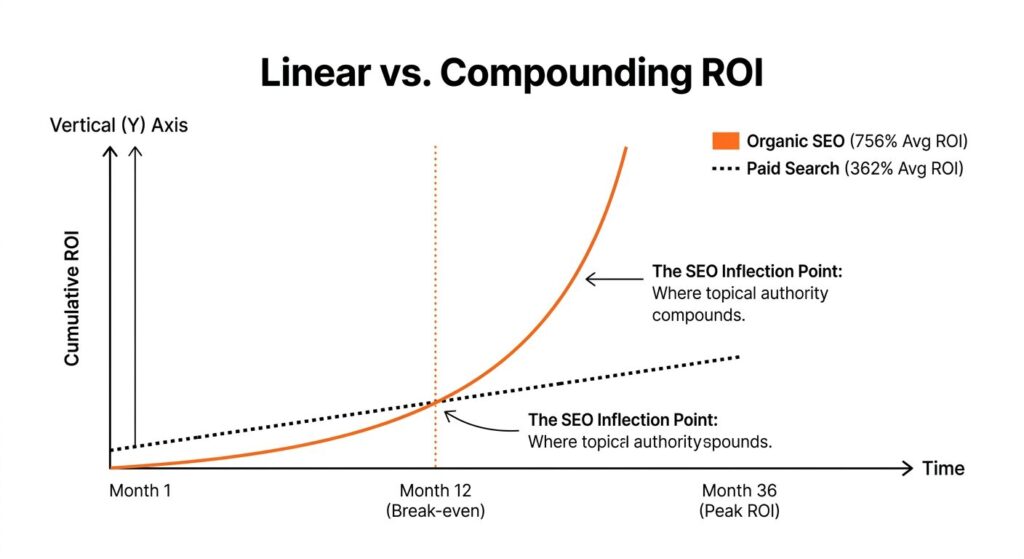
Paid search ROI averages 362 percent versus 756 percent for organic over comparable time periods (FirstPageSage 2025). The gap is not visible at month one. At month one, paid search shows immediate attributed revenue and SEO shows zero. The ROI comparison only makes sense on a 12-month and 36-month timeline.
At 12 months, a well-executed B2B SEO programme is typically at or near break-even while paid search has delivered consistent but linear returns. By month 24, the content library is compounding: cluster authority accumulates, organic CPL falls, and paid CPL holds flat or rises with competition. At 36 months, SEO ROI has typically reached 600 to 900 percent while paid search ROI has not materially changed.
The CFO argument is not that SEO replaces paid. It is that paid acquisition scales linearly with spend and stops the moment the budget stops, while SEO compounds and continues generating pipeline from content published three years earlier. For B2B companies with average deal values above $10,000, the compounding argument is straightforward.
How to Present B2B SEO ROI in a Budget Review
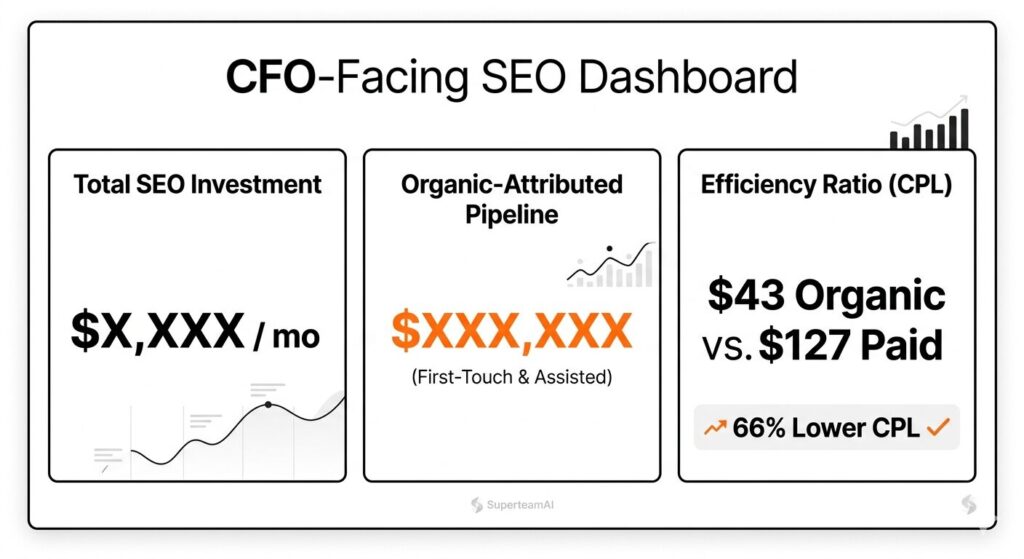
A CFO does not want organic sessions and keyword rankings. They want cost per organic lead, organic-attributed pipeline value, and paid CPL comparison on the same slide. The dashboard that survives a budget review has three numbers: SEO spend, pipeline generated in the last 12 months, and CPL versus paid.
The Looker Studio dashboard I build in every SuperteamAI engagement reports exactly those three numbers, pulled from GA4 and the CRM. When EasyOps could show that organic CPL had dropped from $127 to $43 while paid CPL remained above $100, the SEO budget became untouchable in planning cycles. The attribution model is what produces those numbers. Run the AI SEO Workforce free for 14 days and I configure the full attribution and reporting layer in week one so that by month three the CFO dashboard has three months of real pipeline data to defend the programme.
Frequently Asked Questions
What is a good ROI for B2B SEO?
A good ROI for B2B SEO is 300 percent or above within 18 months for established companies, rising to 600 to 900 percent by month 24 to 36 for programmes running at sufficient content velocity with correct attribution. The industry average across well-executed B2B SEO programmes is 756 percent over a multi-year period (FirstPageSage 2025). Programmes below 300 percent are typically measuring on a 30-day attribution window, publishing fewer than 8 articles per month, or missing the CRM integration connecting organic sessions to closed deals.
How long does B2B SEO take to show ROI?
B2B SEO takes 6 to 12 months to reach break-even and 18 to 36 months to deliver peak ROI. The timeline shortens at higher publishing velocity: programmes publishing 24 to 28 articles per month reach topical authority in 6 to 12 months, while programmes publishing 4 articles per month take 24 to 36 months to reach the same point. The break-even timeline is also affected by attribution window configuration. Companies measuring on a 30-day window will not see positive ROI in the dashboard even when organic is generating pipeline, because the 6 to 18 month B2B buying cycle means most organic-influenced deals close outside the window.
How do you calculate B2B SEO ROI?
Calculate B2B SEO ROI using this formula: ROI equals organic-attributed revenue minus total SEO cost, divided by total SEO cost, multiplied by 100. Organic-attributed revenue should include first-touch organic, last-touch organic, and assisted organic deal value across a 12 to 18 month attribution window. Total SEO cost includes agency or freelancer fees, tool subscriptions, and internal team time. Run the calculation on a rolling 12-month basis, not on a monthly snapshot, because B2B buying cycles mean individual months will show uneven attribution.
Why does B2B SEO ROI look lower than it actually is?
B2B SEO ROI looks lower than it actually is for three reasons. First, short attribution windows miss the majority of organic-influenced deals in a 6 to 18 month buying cycle. Second, last-click attribution ignores the other 10 stakeholders in an 11-person buying committee who each engaged with organic content before the deal closed. Third, AI Overview dark pipeline routes buyers to your site as direct traffic, removing the organic touchpoint from the attribution model entirely. Fix the attribution model first, and the reported ROI will rise to reflect what organic is actually contributing.
How does B2B SEO ROI compare to paid search ROI?
B2B SEO ROI averages 756 percent versus 362 percent for paid search over comparable multi-year periods (FirstPageSage 2025). Paid search delivers faster initial attribution and consistent linear returns. SEO delivers slower initial attribution but compounding returns that grow non-linearly as the content library builds topical authority. The strategic argument for SEO is not that it outperforms paid in month one but that it compounds in years two and three while paid search ROI stays flat, and that it continues generating pipeline from content published years earlier without proportional additional spend.