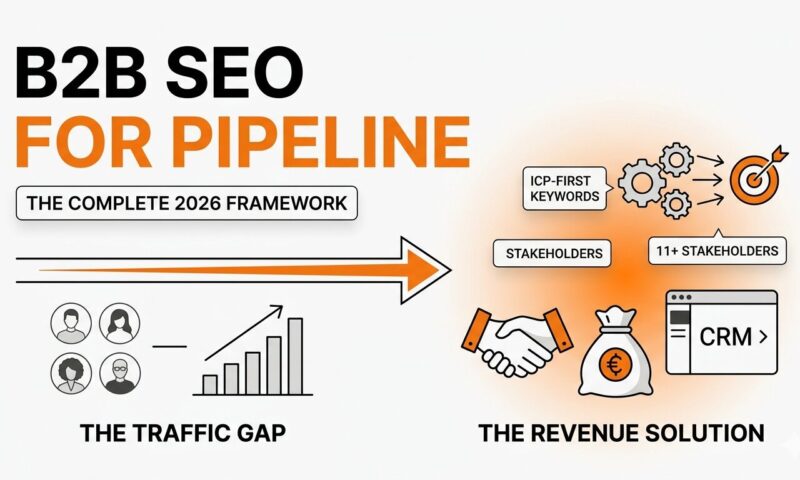
Most B2B SEO strategies produce traffic and nothing in the CRM. In my AI SEO Workforce deployments across 50+ companies, the failure pattern is consistent: the team optimised for rankings on keywords buyers never search at evaluation stage, published content that addressed no specific stakeholder, and built no attribution model to connect organic sessions to closed revenue. Traffic compounded month over month. Pipeline did not move. This guide covers the five-step strategy framework I have built and deployed across B2B SaaS companies to generate pipeline from organic search, including the GEO layer that most strategy guides published before 2025 are missing. If you are evaluating whether to build this programme yourself or hire someone to run it, the B2B SEO guide covers the full execution stack behind every step below.
Why Most B2B SEO Strategies Fail Pipeline Tests
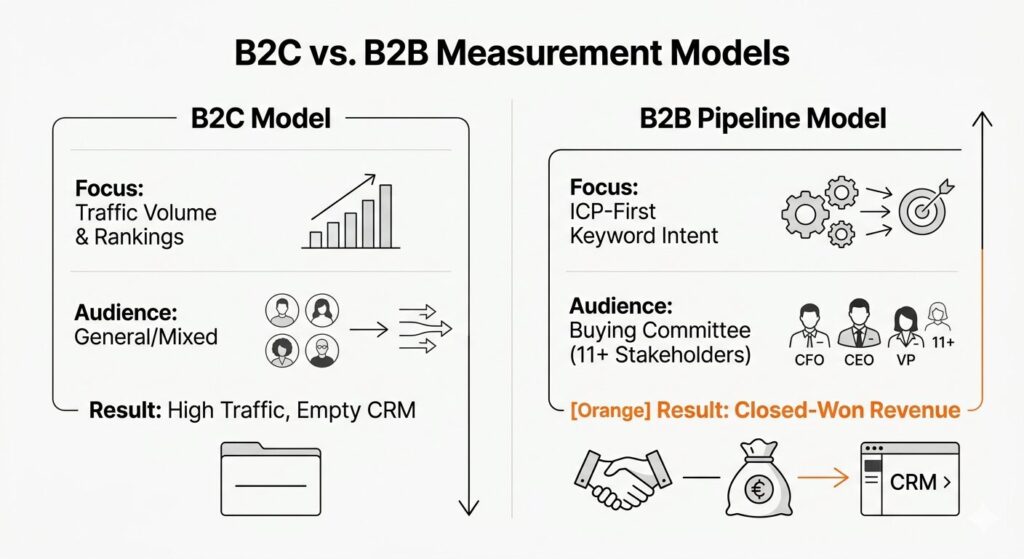
The structural problem in most B2B SEO strategies is that they inherit a B2C measurement model. Traffic volume and keyword rankings are the leading indicators of a B2C content programme. They are the wrong metrics for B2B, where the buying cycle runs 6 to 18 months, the purchasing decision involves an average of 11 stakeholders running independent research (Gartner 2024), and a single closed deal can represent 100 times the value of a single consumer transaction.
An SEO strategy that generates 50,000 monthly visitors from keywords that attract students, journalists, and competitors produces zero pipeline impact regardless of what the dashboard shows. I have seen companies cancel their SEO investment at month six because no pipeline was attributed, only to learn that the keywords being targeted were informational broad terms with no ICP match, not evaluation-stage queries from active buyers.
A B2B SEO strategy has three requirements that a B2C strategy does not: ICP-first keyword selection before any volume analysis, content mapped to every stakeholder in the buying committee rather than one generalised buyer, and CRM attribution configured before the first article is published. Miss any one of these and you have a traffic programme dressed as a pipeline programme. The rest of this guide covers exactly how to build each layer correctly.
Step 1: Build Your ICP-First Keyword Research Framework
A recurring mistake in B2B keyword research is beginning with search volume. Volume is a B2C proxy. In B2B, the keyword that matters is the one your ICP types when they are actively evaluating solutions, not the keyword that gets 10,000 searches per month from a mixed audience that includes students, researchers, and competitors.
ICP-first keyword research runs in this sequence. First, define the buying committee for your product: who is the end user, who is the economic buyer (typically the CFO or VP level), who is the procurement or legal stakeholder, and who is the technical evaluator. Each role runs different queries. Second, map evaluation-stage queries to each role: what does the end user search when they have your problem and are comparing solutions? What does the CFO search when they need to justify the budget? Third, filter those queries by search volume as a final step, not the first.
Long-tail B2B keywords, specifically the queries that capture a buyer mid-evaluation rather than a general researcher, convert at 2.5 times the rate of broad short-tail terms (Backlinko 2025). In my Superteam AI deployments, ICP mapping runs before the keyword spreadsheet is built. That sequence is the entire difference between a keyword plan that generates pipeline and one that generates a traffic report. The B2B SEO statistics article has the full conversion rate benchmarks by keyword intent category.
Step 2: Architect a Topical Cluster Framework
Single articles rank. Topical clusters compound. A single well-written article on “inventory management software” might reach position 15. A pillar article supported by 8 to 12 cluster articles covering every sub-question a buyer asks during evaluation can reach position 3 and hold it, because Google’s algorithm now scores topical authority, not just individual page quality.
The architecture is straightforward: one pillar article covers the primary category keyword in depth, typically 2,500 to 4,000 words. Each cluster article covers one sub-topic that a buyer would research as part of their evaluation. Cluster depth matters more than breadth. Three clusters owned completely outperform ten clusters with one article each, because topical authority is built within a category, not spread across many categories at shallow depth.
In my AI SEO Workforce deployments, cluster architecture is built from the ICP data collected in Step 1. Each stakeholder role generates a cluster. The end user cluster covers product-level queries. The CFO cluster covers ROI and cost comparison queries. The technical evaluator cluster covers integration and implementation queries. Running this structure at 24 to 25 articles per month is how EasyOps built topical authority inside 8 months rather than the 18 months a single-article-per-week model would have required.
Step 3: Map Every Content Piece to a Buying Committee Role
The Gartner research that B2B deals involve an average of 11 stakeholders is not just a statistic to cite in a slide deck (Gartner 2024). It is the architecture specification for your content plan. If your content plan covers one buyer persona while the other 10 stakeholders hit competitor content during their independent research, you are losing deals to content gaps, not product gaps.
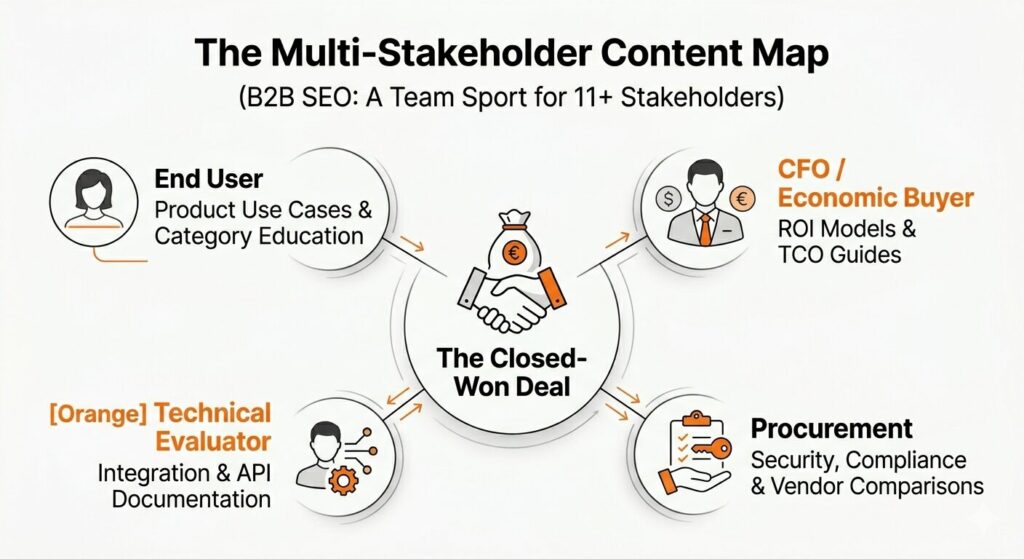
Buying committee content mapping assigns every article a stakeholder role and a decision stage. The end user gets category education and product use-case content. The CFO gets ROI models, cost comparison articles, and total cost of ownership guides. Procurement gets vendor comparison content and security or compliance documentation. Technical evaluators get integration guides and API documentation indexed for organic search.
I have run programmes where deals stalled because the procurement team could not find independent ROI justification for the product, even when the end user had already selected it internally. The content gap was not in volume. It was in stakeholder coverage. A B2B SEO strategy that does not map to every buying committee role is a partial programme by design.
Step 4: Structure Every Article for GEO and AI Search
In early 2025, 13% of Google queries now trigger AI Overviews, up 116% since March of the same year (Semrush 2025). B2B evaluation-stage queries are disproportionately represented in that 13% because they are question-format and comparison-format searches that AI systems are designed to synthesise. An article not structured for AI Overview citation eligibility is competing for a smaller and shrinking share of the SERP.
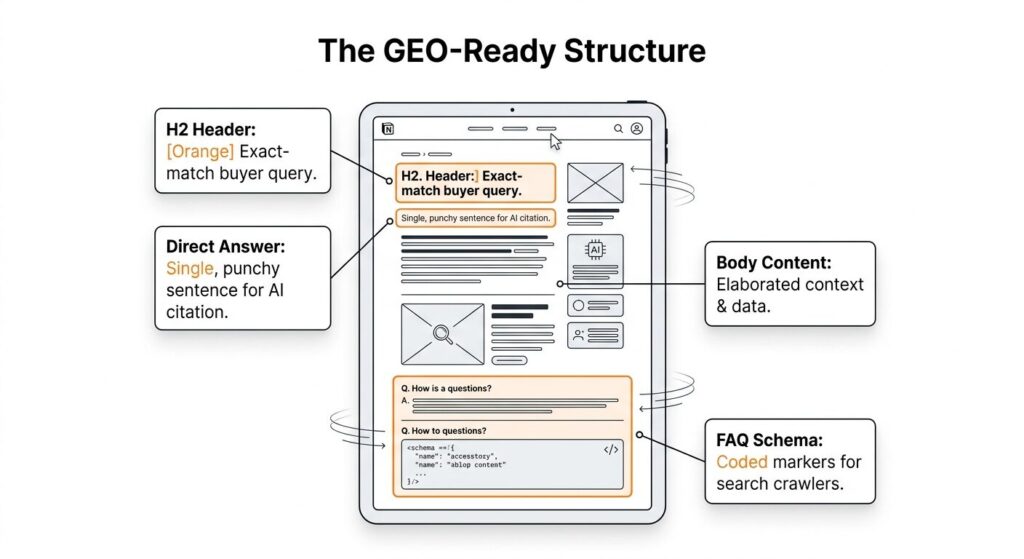
GEO-ready content follows three structural rules. First, every H2 that addresses a specific question opens with a direct answer in the first sentence, before any context or elaboration. The AI system crawling for citation material pulls the sentence immediately following the H2, not the body of the paragraph. Second, FAQ sections use exact-match question phrasing that mirrors the buyer’s natural query, not editorial reformulations. Third, FAQ schema markup is implemented at publication so the structured data is indexed alongside the content.
Through Superteam AI, I build GEO optimisation into every article at publication rather than retrofitting it after rankings plateau. Agencies and in-house teams not building for GEO are optimising for 2022 search behaviour. Their content programmes will require a full retrofit as AI search coverage continues to expand across evaluation-stage query categories.
Step 5: Build Attribution Before You Publish Article One
Pipeline attribution is the structural difference between a B2B SEO programme that survives budget cycles and one that gets cancelled at month six when the CFO asks for ROI data. I have seen companies with 40,000 monthly organic visitors lose their SEO budget because they could not attribute a single closed deal to the channel. The programme was generating pipeline. The CRM had no record of it.
Attribution setup runs before the first article publishes. UTM parameters are configured on every organic CTA: content upgrades, demo request buttons, contact forms, and trial signups. CRM lead source fields are mapped to capture first-touch organic, last-touch organic, and assisted organic across the full multi-touch buying cycle. The attribution window in B2B is 6 to 18 months: a buyer who reads an article in January may not close until Q3, and that relationship needs to survive in the CRM data model (HubSpot 2025).
Without this setup, organic SEO competes against paid channels on a fundamentally unequal basis. Paid attribution is same-day. Organic attribution requires a properly configured model. Companies that report organic channel performance using same-day or 30-day attribution windows consistently understate the pipeline contribution of SEO by 40% to 60% relative to what a properly configured multi-touch model shows. The B2B SEO checklist covers the full 27-item attribution and technical setup list.
What a Real B2B SEO Strategy Looks Like Over 12 Months
The timeline for a B2B SEO strategy is non-negotiable. First ranking movements appear at 3 to 6 months. Measurable pipeline contribution begins at 6 to 12 months. The highest-return period is months 24 to 36, when the full cluster library covers the complete ICP evaluation cycle and compounds without proportional additional investment (FirstPageSage 2025).
EasyOps entered a Superteam AI engagement with a strong product and no organic visibility. I deployed the AI SEO Workforce across three topical clusters, running ICP-first keyword research, buying committee content mapping, and GEO-structured publishing at 24 to 25 articles per month. In 8 months: organic traffic grew from 4,200 to 30,500 monthly visitors (626% increase), CPL dropped from $127 to $43, and MRR grew from $50,000 to $200,000. At month 14, the company was acquired at $21.6 million. CEO Rajiv Mehta: “We were invisible in the market.”
ReachInbox entered with 6 months of runway and the entirety of the GEO layer missing from their content programme. I rebuilt the keyword strategy around commercial-intent long-tail queries, published 25 to 28 articles per month, and retrofitted GEO signals across the existing library. Traffic grew from 2,000 to 17,000 monthly visitors in 12 months (750%), extending runway from 6 to 24 months. CEO Anup Sharma: “We went from 2,000 visitors to 17,000, and our conversion rates more than doubled.” For detailed breakdowns of both programmes including monthly milestones, see B2B SEO case studies.
The AI SEO Workforce runs this entire strategy stack, including Steps 1 through 5, at 24 to 28 articles per month. Pro $79, Business $199, Scale $399 per month.Run it free for 14 days.
Frequently Asked Questions
What is a B2B SEO strategy?
A B2B SEO strategy is a programme designed to generate qualified pipeline from organic search for a company selling to other businesses. It differs from a general SEO strategy in three ways: keyword research is filtered by ICP match before volume, content is mapped to every stakeholder in the buying committee rather than one generalised buyer persona, and success is measured by pipeline contribution and cost per qualified lead rather than traffic volume or keyword rankings.
Which five elements determine whether a B2B SEO strategy generates pipeline?
The five elements that determine whether a B2B SEO strategy generates pipeline are: ICP-first keyword research, topical cluster architecture covering the full evaluation cycle, buying committee content mapping across all 11 average stakeholders, GEO-ready content structure for AI Overview citation eligibility, and pipeline attribution configured in the CRM before publication begins. Remove any one of these elements and the programme produces traffic without measurable revenue contribution to show for it.
How long does a B2B SEO strategy take to show results?
First ranking movements typically appear at 3 to 6 months. Measurable pipeline contribution begins at 6 to 12 months. The peak return period runs from 24 to 36 months, when the content library covers the full ICP buying cycle. Companies that pause their programme at month 3 because nothing is visible in the dashboard are stopping right before compounding begins.
What is the difference between B2B and B2C SEO strategy?
B2C SEO optimises for high-volume keywords targeting individual consumers with short buying cycles and single decision-makers. B2B SEO optimises for ICP-matched evaluation-stage queries with long buying cycles (6 to 18 months), multi-stakeholder buying committees averaging 11 people, and pipeline attribution models that track organic influence across months rather than days. The measurement model, keyword selection logic, and content architecture are fundamentally different. For a detailed breakdown, see B2B SEO vs B2C SEO.
How much content does a B2B SEO strategy require?
A minimum viable B2B SEO strategy requires one pillar article plus 6 support cluster articles per topical cluster, with 3 to 5 clusters covering your core ICP categories. That is 21 to 30 articles before category authority begins to establish. Publishing velocity matters: programmes running at 24 to 28 articles per month produce compounding results inside 12 months. Programmes running at 4 articles per month require 24 to 36 months to reach the same topical depth (Backlinko 2025).