Most B2B companies investing in content and link building are building on sand if their technical SEO foundation has not been audited. I have run b2b technical seo audits across more than 50 companies through SuperteamAI and found the same failure pattern every time. Google cannot crawl the pages that matter. The pages it can crawl are slow.
The content that ranks generates sessions that never appear in the CRM because the attribution layer was never configured. This guide covers the technical layer that determines whether every other SEO investment compounds or evaporates. For the full programme architecture, see the B2B SEO strategy guide.
Why B2B Technical SEO Is Different From Standard Technical SEO
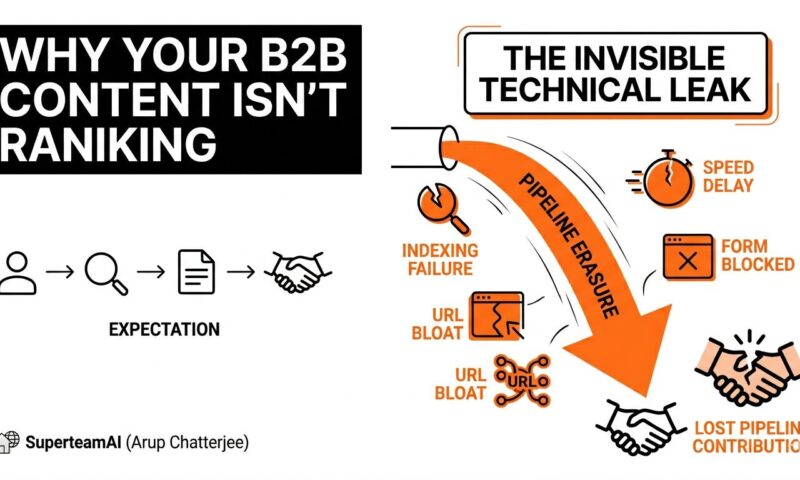
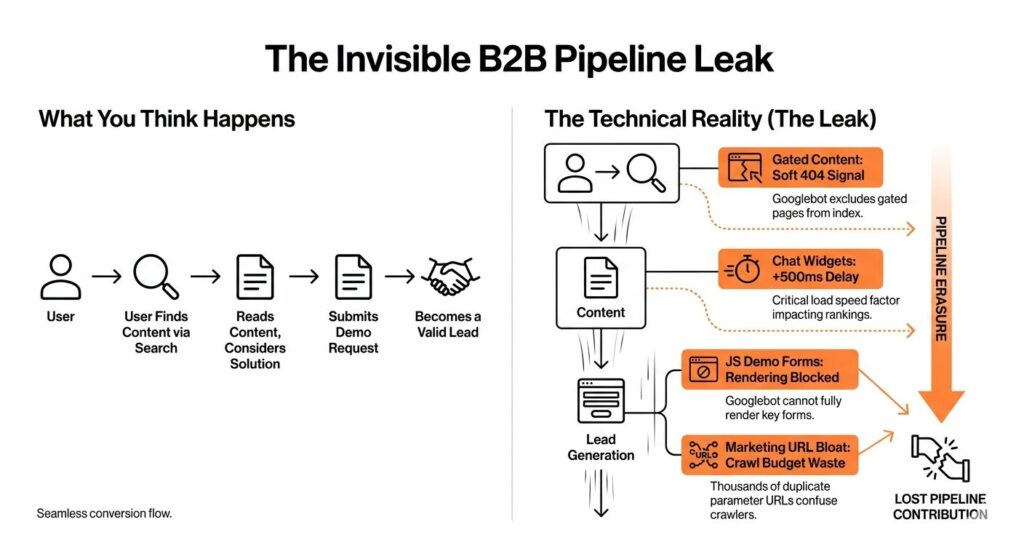
B2B technical SEO presents failure modes that do not appear in generic guides because B2B sites are built differently from publisher or e-commerce sites. A typical B2B site has JavaScript-heavy demo request forms that Googlebot cannot fully render. CRM-embedded chat widgets add 300 to 500 milliseconds of load delay. Marketing automation parameters generate thousands of duplicate URLs. Content gated behind email forms returns a 200 status code with a redirect to a thank-you page, causing crawlers to treat the gated page as thin content. Seventy percent of B2B decision makers use mobile devices during at least one stage of their research process (Gartner 2024), which means these technical failures affect both desktop and mobile pipeline equally.
The buying cycle compounds these problems. B2B buyers run 7 to 11 research queries over 6 to 18 months before making vendor contact (Gartner 2024). Each query is an opportunity to appear in search, but only if the page is crawlable, indexed, and fast. Technical failures at any layer erase organic pipeline contribution silently. The B2B SEO statistics guide covers the full pipeline conversion benchmarks.
Crawlability and Indexation: The Floor Everything Else Sits On
Crawlability and indexation are the precondition for all other SEO work. If Google cannot reach a page, the content quality and backlinks pointed at it are irrelevant. I have seen B2B companies publish 60 high-quality articles and generate near-zero organic traffic because a misconfigured robots.txt rule was blocking the entire blog subdirectory from being crawled. In Google Search Console, the Pages report under Indexing shows exactly which URLs are not indexed and why. In every SuperteamAI technical audit, this is the first report I open because it reveals the problem in minutes.
B2B indexation failures I find most often fall into three categories: robots.txt rules blocking staging subdirectories that were carried into production, XML sitemaps that include 404 pages and redirected URLs rather than only canonical live pages, and soft 404s on gated content that load a form but return a 200 status code. Each is fixable within a day using Screaming Frog to crawl the full site and GSC to cross-reference which URLs Google has attempted to index versus which are excluded. Fixing indexation blockers before publishing any new content is the highest-return technical action available in a new engagement.
Site Architecture That Maps to the B2B Buying Cycle
Site architecture controls how crawl budget is distributed and how PageRank flows from high-authority pages to the conversion pages that generate pipeline. A flat architecture, where every key page sits within two clicks of the homepage, consistently outperforms deeply nested structures on both crawl efficiency and ranking performance. B2B sites restructured to a flat, cluster-aligned architecture have seen conversion-page organic traffic improve by 42 percent within three months (case data, 2025).
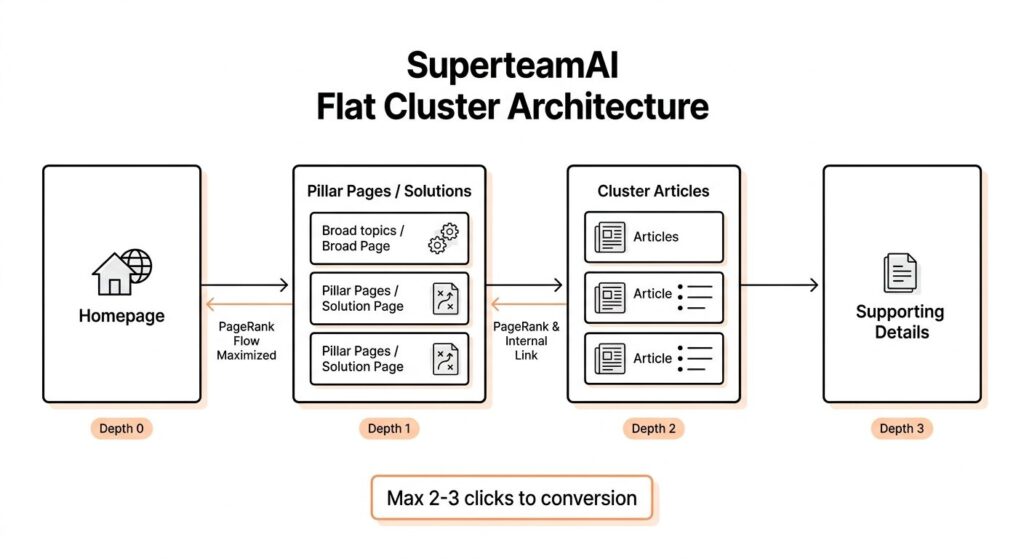
The architecture I implement in SuperteamAI engagements maps directly to the content cluster model. A pillar page sits at depth one from the homepage. Cluster articles sit at depth two, and supporting detail pages at depth three. This structure ensures every piece of content in the cluster receives PageRank from the pillar and from the homepage via internal linking. B2B companies that generate organic pipeline through well-structured topic clusters see organic leads close at 14.6 percent compared to 2 percent for outbound (HubSpot 2025). The best B2B SEO tools guide covers Screaming Frog as the crawl tool for mapping existing architecture before any restructuring begins.
Core Web Vitals: Where B2B Sites Lose Rankings They Earned
Core Web Vitals are confirmed ranking factors and a consistent source of invisible ranking loss in B2B. The three metrics are Largest Contentful Paint, Interaction to Next Paint, and Cumulative Layout Shift. B2B sites that meet Google’s recommended thresholds for all three see 24 percent lower bounce rates on average (Google 2025). Sites that fail, and many B2B sites do without realising it, lose rankings to competitors with technically equivalent content but faster pages.
In B2B, the failure sources I encounter consistently are third-party scripts. HubSpot tracking code, Calendly embed widgets, Intercom chat scripts, and bloated Google Tag Manager containers each add render-blocking requests that delay Largest Contentful Paint. My fix sequence is to run PageSpeed Insights on the five highest-traffic landing pages and identify the scripts contributing most to load delay. I then defer non-critical scripts and move CRM form scripts to load after main content renders. A clean Core Web Vitals report in GSC is a prerequisite before I recommend any content scaling in a new engagement.
Schema Markup for B2B Pipeline: Service, Organization, and FAQ
Schema markup is the translation layer between your content and both Google’s ranking systems and AI Overview citation logic. For B2B sites, three schema types deliver strong returns. Service schema on every solution page tells Google and AI systems what you offer, to whom, and in which market. Organization schema on the homepage establishes entity authority including name, service areas, and social profiles. FAQPage schema on every cluster article signals that the content answers specific buyer questions, which is the primary criterion for AI Overview citation. B2B solution pages with complete schema implementation are significantly more likely to appear in rich results and generative AI responses (Google 2025).
I implement all three schema types in week one of every SuperteamAI engagement. I use JSON-LD format directly in the page source rather than through a tag manager. Tag manager delivery delays schema rendering and reduces its reliability as a ranking signal. With 13 percent of Google queries now triggering AI Overviews (Semrush 2025), schema-eligible pages that are not currently cited are leaving direct pipeline contribution unclaimed.
Crawl Budget Management for Enterprise B2B
Crawl budget is the number of pages Google will crawl on a site within a given time window. For B2B sites with fewer than 500 pages, crawl budget is rarely a critical constraint. For enterprise B2B sites with thousands of pages, it is the difference between important pages being indexed promptly and sitting in the crawl queue for weeks.
A common crawl budget waster in B2B is marketing automation parameters appended to URLs by HubSpot, Marketo, and Pardot campaign tracking. These generate hundreds of parameter variations of the same page. Enterprise B2B sites commonly waste 30 to 40 percent of crawl budget on parameter-generated URL variants that serve no ranking value (Semrush 2025). Canonical tags or parameter handling in GSC resolve this. Thank-you pages after form fills, logged-in session pages, and internal search result pages are other sources of crawl waste that should be noindexed. I recommend log file analysis using Screaming Frog’s log analyser for enterprise sites to identify exactly which URLs are consuming budget before making blanket noindex decisions.
GEO Structure: How Technical Decisions Determine AI Overview Eligibility
GEO stands for Generative Engine Optimisation. As AI Overviews appear for an increasing share of B2B search queries, the technical structure of a page determines whether its content is citation-eligible. Pages that are slow, poorly structured, or lacking schema are passed over regardless of content quality. AI systems pull answers from pages that are fast, cleanly structured, and marked up with schema. A page that fails Core Web Vitals, lacks FAQPage schema, or buries its direct answers in mid-paragraph prose is less likely to be cited than a technically clean competitor page with equivalent content quality.
The three GEO-eligible technical signals I implement at production stage in every SuperteamAI article are FAQPage schema markup, direct-answer paragraph structure under each H2, and LCP under 2.5 seconds. These are not post-publication optimisations. They are built in at content creation, which is why the AI SEO Workforce produces GEO-structured content from article one rather than retrofitting after rankings plateau. The B2B SEO checklist covers the full 27-item GEO setup.
The B2B Technical SEO Audit Sequence
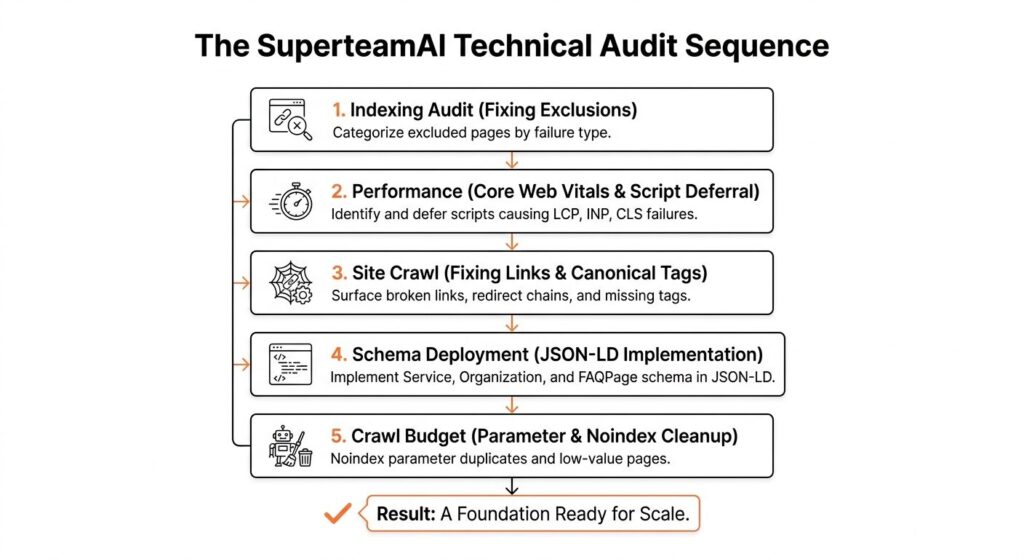
The correct audit sequence in b2b technical seo runs from most critical to least critical, based on which failures are actively suppressing pipeline. I run this sequence in week one of every SuperteamAI engagement before any content publishes.
First, the GSC indexing report: identify all excluded pages and categorise by failure type. Second, the Core Web Vitals report in GSC: flag any pages with poor LCP, INP, or CLS and run PageSpeed Insights to identify the specific scripts causing each failure. Third, a full site crawl using Screaming Frog: surface broken internal links, redirect chains, missing canonical tags, and duplicate title or meta description sets. Fourth, a schema audit: verify that Service, Organization, and FAQPage schema are implemented on all target pages in valid JSON-LD. Fifth, a crawl budget review for sites over 500 pages: identify parameter-generated duplicate URLs and noindex candidates.
EasyOps had no technical audit when we began the SuperteamAI engagement. After I ran the full audit sequence, fixed the indexation blockers, and implemented the complete attribution stack, organic traffic grew 626% from 4,200 to 30,500 monthly visitors. CEO Rajiv Mehta: “We were invisible in the market.” ReachInbox ran a parallel technical audit before deploying the AI SEO Workforce at 25 to 28 articles per month, and traffic grew 750% from 2,000 to 17,000 monthly visitors in 12 months. CEO Anup Sharma: “We went from 2,000 visitors to 17,000, and our conversion rates more than doubled.Run the AI SEO Workforce free for 14 days and I run the full technical audit in week one so every article published after that lands on a technically sound foundation.
Frequently Asked Questions
What is B2B technical SEO?
B2B technical SEO is the practice of optimising the crawlability, indexation, site architecture, page speed, and structured data of a business-to-business website so that search engines can efficiently discover and rank its content. It differs from technical SEO for consumer sites in that B2B sites involve JavaScript-heavy stacks, CRM and marketing automation integrations that generate crawl waste, and gated content that requires specific handling to avoid soft 404 signals. Technical SEO is the foundation that determines whether content and link-building investments produce compounding returns or plateau before reaching topical authority.
Which technical SEO factors matter most for B2B sites?
The highest-impact technical SEO factors for B2B sites are crawlability and indexation status, Core Web Vitals performance, site architecture depth, schema markup implementation, and crawl budget management for larger sites. B2B-specific issues that generic guides miss include CRM script load delay, marketing automation URL bloat, and gated content soft 404s. Fixing indexation blockers and Core Web Vitals failures delivers the highest-return ranking improvement relative to time invested in any b2b technical seo audit.
How do Core Web Vitals affect B2B SEO rankings?
Core Web Vitals directly affect B2B rankings as confirmed Google ranking signals. Sites meeting all three thresholds, LCP under 2.5 seconds, INP under 200 milliseconds, and CLS under 0.1, see 24 percent lower bounce rates on average (Google 2025). B2B sites most commonly fail Core Web Vitals because of third-party scripts from CRM tools, live chat widgets, and bloated tag manager containers. Deferring non-critical scripts and removing unused tags typically produces the clearest improvement in Core Web Vitals scores.
What schema markup should B2B companies implement?
B2B companies should implement Service schema on every solution page, Organization schema on the homepage, and FAQPage schema on all cluster content and solution pages. These three schema types cover commercial intent pages, entity establishment, and question-format content that AI systems use as the primary criterion for AI Overview citation. All schema should be in JSON-LD format in the page source rather than through a tag manager, which delays rendering and reduces reliability as a ranking signal.
How often should B2B companies run a technical SEO audit?
B2B companies should run a full technical SEO audit quarterly using Screaming Frog or a comparable crawler, with continuous monitoring via GSC for indexation changes and Core Web Vitals regressions. Sites publishing at high velocity, 20 or more articles per month, should monitor the GSC indexing report weekly because new pages can introduce redirect chains, duplicate canonicals, or missing schema that suppresses content before it has a chance to rank. A quarterly cadence catches structural issues before they compound across a growing content library.