Most B2B SEO tool stacks are built by copying a generic listicle. The team subscribes to Ahrefs, adds Surfer SEO, connects Google Analytics, and wonders six months later why traffic is growing while the CRM shows nothing attributed to organic. I have seen this pattern across 50+ company audits run through Superteam AI: the tools are fine, but the stack is organised by SEO function rather than the B2B pipeline stages those tools need to serve. This guide reviews the top 10 best b2b seo tools by pipeline stage, eliminates the gaps that produce traffic reports with no revenue story, and shows you exactly which tools to stack at each stage of the B2B buying cycle. The full programme architecture behind how these tools connect is in the B2B SEO strategy guide.
Why Most B2B SEO Tool Stacks Are Built Wrong
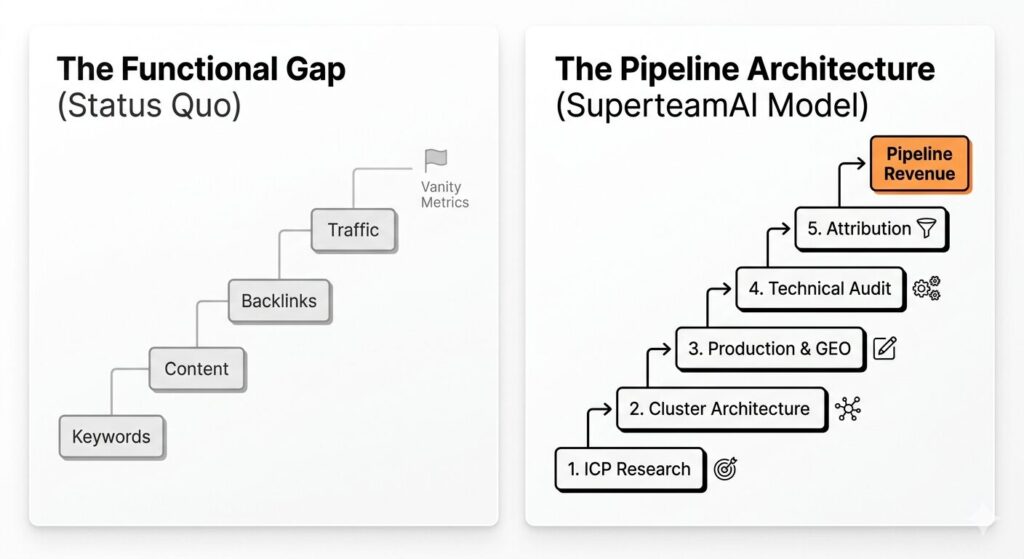
Every list of best b2b seo tools organises by function: keyword research tools, technical SEO tools, content tools, analytics tools. That structure makes sense for a general SEO blog. It does not reflect how B2B pipeline actually moves.
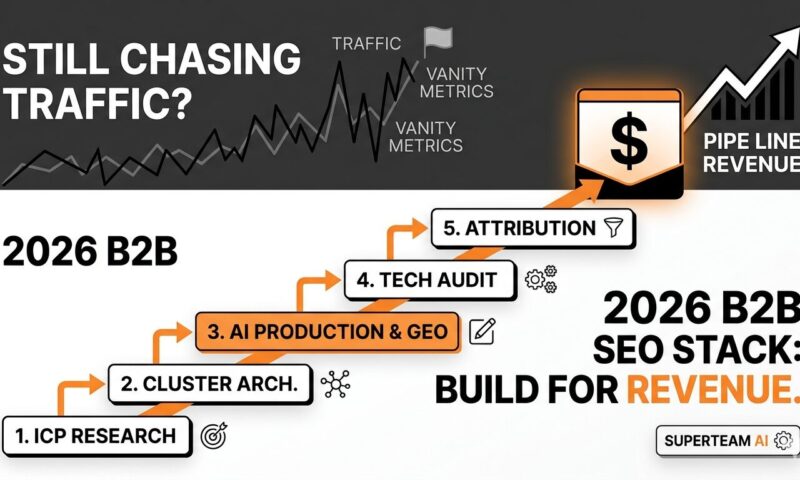
B2B pipeline runs through five stages: ICP and keyword research, cluster architecture and content planning, content production and GEO optimisation, technical foundation, and pipeline attribution. Each stage has a different failure mode and a different tool requirement. A company that has Ahrefs and Semrush but no attribution layer has covered stage one and skipped stage five entirely. A company that has Surfer SEO but no cluster architecture process is optimising individual articles instead of building topical authority across a category.
The buying committee compounds this. An average B2B deal involves 11 stakeholders running independent research using different queries (Gartner 2024). Tools that help you cover one buyer persona while ignoring the other ten produce content that ranks but does not close deals. The B2B SEO statistics guide covers the full pipeline conversion benchmarks by stage.
Quick Comparison: Top 10 Best B2B SEO Tools
| Rank | Tool | Pipeline Stage | Primary Use | Starting Price |
| 1 | AI SEO Workforce (Superteam AI) | Stage 3: Content Production | ICP-first cluster production and GEO optimisation | $79/mo |
| 2 | Ahrefs | Stage 1 and 2: Research and Architecture | Keyword research, traffic potential, competitor gap | $99/mo |
| 3 | Semrush | Stage 1: ICP Research | Intent classification, keyword grouping, content audit | $139/mo |
| 4 | MarketMuse | Stage 2: Cluster Architecture | Topical coverage scoring, content gap prioritisation | $149/mo |
| 5 | Clearscope | Stage 2 and 3: Planning and Production | Semantic entity mapping, content brief creation | $189/mo |
| 6 | Surfer SEO | Stage 3: Content Production | Real-time on-page optimisation during writing | $89/mo |
| 7 | Screaming Frog | Stage 4: Technical Foundation | Full-site crawl, redirect and canonical audit | $209/yr |
| 8 | Google Search Console | Stage 4: Technical Foundation | Index coverage, query performance, Core Web Vitals | Free |
| 9 | GA4 with CRM Integration | Stage 5: Attribution | Organic session to closed-deal pipeline tracking | Free |
| 10 | Looker Studio | Stage 5: Attribution | Pipeline revenue dashboard, organic MQL reporting | Free |
Top 10 Best B2B SEO Tools Reviewed
1. AI SEO Workforce by Superteam AI: Best for Full-Stack B2B Content Production
The AI SEO Workforce is a B2B SEO execution platform built specifically around ICP-first keyword research, buying committee cluster architecture, and GEO-optimised content production at 24 to 28 articles per month. Where individual tools handle one step of the pipeline, the AI SEO Workforce runs the full execution stack: ICP mapping, cluster planning, article production, GEO structuring, and attribution setup in one programme.
I built the AI SEO Workforce after auditing 50+ B2B SaaS companies and finding the same failure pattern: the tools were in place but the execution was disconnected from pipeline outcomes. ReachInbox was producing 4 articles per month before engaging Superteam AI. After deploying the AI SEO Workforce, output reached 25 to 28 articles per month. Traffic grew 750% from 2,000 to 17,000 monthly visitors in 12 months and runway extended from 6 to 24 months. CEO Anup Sharma: “We went from 2,000 visitors to 17,000, and our conversion rates more than doubled.”
Pricing: Pro $79/mo, Business $199/mo, Scale $399/mo.Run free for 14 days.
Best for: B2B SaaS companies at Pre-seed through Series B that need full-stack content execution, not just individual point tools.
2. Ahrefs: Best for B2B Keyword Research and Competitive Intelligence
Ahrefs is the primary research tool in every Superteam AI engagement, with one specific advantage over alternatives: the traffic potential metric. Where most tools report raw search volume, Ahrefs reports estimated clicks after accounting for zero-click losses from AI Overviews and featured snippets. For B2B keywords with low volume and high intent, this difference matters significantly. A keyword showing 500 searches per month with 60% click-through produces more pipeline-relevant traffic than one showing 2,000 searches with 20% click-through.
I use Ahrefs Site Explorer to run competitor gap analysis in every cluster build, identifying categories where competitors have published one or two articles but left 15 sub-queries uncovered. Long-tail keywords with commercial intent convert at 2.5 times the rate of short-tail informational terms (Backlinko 2025).
Pricing: Lite $99/mo, Standard $199/mo, Advanced $399/mo.
Best for: Keyword research, competitor gap analysis, and cluster architecture planning across all company stages.
3. Semrush: Best for Intent Classification and Content Audit
Semrush Keyword Magic Tool adds value specifically at the ICP filtering stage. The intent classification covering informational, navigational, commercial, and transactional queries allows you to filter a keyword list down to evaluation-stage commercial queries before any volume analysis. In B2B, volume-first keyword research produces keyword plans full of informational terms that attract researchers, not buyers.
Semrush also runs the stronger content audit at scale. For companies with existing content libraries of 100 or more articles, the Semrush site audit surfaces cannibalisation issues and thin-content pages that suppress cluster authority. I run Semrush alongside Ahrefs at the Series B+ stage when cross-referencing keyword data across multiple competitive dimensions simultaneously.
Pricing: Pro $139/mo, Guru $249/mo, Business $499/mo.
Best for: Intent classification, large-scale content audits, and competitive reporting at Series A and above.
4. MarketMuse: Best for Topical Coverage Analysis
MarketMuse scores topical coverage across a subject area, showing which subtopics your existing content addresses and which it skips. For B2B companies with an existing content library, MarketMuse identifies the gaps suppressing domain authority signals across the cluster. The output is a prioritised list of content to create or update, not a raw keyword spreadsheet. Content with strong topical authority signals ranks in positions one to three at roughly twice the rate of content covering isolated keywords without cluster support (FirstPageSage 2025).
In my Superteam AI cluster builds, MarketMuse runs after Ahrefs Content Gap to cross-validate the cluster plan and confirm that the planned article set covers the full topic model Google uses to assess authority within a category.
Pricing: Free plan with limits, Standard $149/mo, Team $399/mo.
Best for: Companies with existing content libraries needing topical gap analysis; Series A to B cluster architecture validation.
5. Clearscope: Best for Content Brief Creation and Semantic Optimisation
Clearscope maps the semantic entities and related topics that top-ranking content covers, giving you a content brief framework that matches what Google considers complete topical coverage for a given query. Cluster articles built from Clearscope briefs require fewer updates because they address the full topic model from the first draft rather than being retrofitted after publication.
Clearscope serves a dual role: at the planning stage it generates the brief, and at the production stage it validates that the written article covers the required entity set. For in-house content teams producing 8 to 15 articles per month, Clearscope reduces the revision cycle on individual articles without replacing the cluster planning process. B2B buyers read 7 to 10 content pieces before making vendor contact, and content that addresses the full semantic scope of a topic holds attention across more of those touchpoints (Forrester 2024).
Pricing: Essentials $189/mo, Business $399/mo, Enterprise custom.
Best for: In-house content teams at Series A and above needing brief creation and on-page semantic validation in one tool.
6. Surfer SEO: Best for Real-Time On-Page Optimisation
Surfer SEO functions as a real-time on-page scoring layer during content production. As an article is written, Surfer checks word count, keyword density, entity coverage, and heading structure against top-ranking pages for the target query. For B2B teams producing content in-house without a dedicated SEO reviewer, Surfer reduces the back-and-forth revision cycle by surfacing optimisation gaps during the writing process rather than after publication.
Surfer does not replace cluster architecture planning. A Surfer-optimised article on a keyword with no supporting cluster will plateau at position 8 to 12, because individual page quality is not the same as topical authority. As of 2025, 13% of Google queries trigger AI Overviews and Surfer does not yet have dedicated GEO optimisation modules (Semrush 2025).
Pricing: Essential $89/mo, Scale $129/mo, Scale AI $219/mo.
Best for: In-house writers and content managers at Series A to C needing real-time on-page guidance per article.
7. Screaming Frog: Best for Technical SEO Auditing
Screaming Frog crawls your site the way Google does, surfacing broken links, redirect chains, duplicate content, missing metadata, and page-level issues that suppress ranking performance. For B2B companies with large content libraries or complex CMS configurations, a monthly Screaming Frog audit prevents technical debt from accumulating silently. The paid licence costs approximately $209 per year and is among the highest-value tools in the stack relative to cost.
I run Screaming Frog before every Superteam AI content deployment to confirm that canonical tags, internal linking, and redirect chains are clean before new cluster articles are published.
Pricing: Free up to 500 URLs, paid licence $209/yr.
Best for: All company stages; essential for any site with more than 50 indexed pages.
8. Google Search Console: Best Free Monitoring Tool for B2B SEO
Google Search Console is non-negotiable and free. It shows which queries are triggering impressions, which pages are indexed, which have Core Web Vitals issues, and which are experiencing index coverage problems. In my experience, a consistently valuable GSC report for B2B teams is the Search Results query filter: compare impressions versus clicks for evaluation-stage queries to identify pages that are ranking but not generating click-through, which typically signals a title or meta description problem rather than a content problem.
B2B buyers conduct an average of 12 or more searches before engaging a vendor (Gartner 2024), making impression-to-click ratio a leading indicator of how well your content is capturing evaluation-stage intent on the SERP.
Pricing: Free.
Best for: All company stages; foundational monitoring layer for any B2B SEO programme.
9. GA4 with CRM Integration: Best for B2B Pipeline Attribution
Pipeline attribution is the stage where most B2B SEO stacks have no tools at all, which is why SEO loses budget battles against paid channels with same-day attribution. GA4 captures organic session data. The CRM captures lead source and deal data. Integration between the two, typically built through HubSpot or Salesforce, connects an organic session from month one to a deal that closes in month nine.
In every Superteam AI engagement, I configure UTM parameters on all organic CTAs and build the CRM lead source mapping before publishing article one. EasyOps had no attribution model before our engagement. After configuring the full pipeline attribution layer, organic traffic grew 626% from 4,200 to 30,500 monthly visitors and CPL dropped from $127 to $43. CEO Rajiv Mehta: “We were invisible in the market.” Organic leads close at a significantly higher rate than outbound leads when properly attributed across a 6 to 18 month window (HubSpot 2025).
Pricing: GA4 free; CRM integration cost varies by platform.
Best for: All company stages; must be configured before article one publishes.
10. Looker Studio: Best for SEO Revenue Reporting
Looker Studio converts integrated GA4 and CRM data into a pipeline dashboard that reports in the language of revenue, not traffic. A Looker Studio report showing organic-attributed MQLs, pipeline value by channel, and cost per organic lead gives the CFO the data to understand why SEO compounds while paid acquisition scales linearly. The B2B SEO checklist covers the full 27-item attribution and reporting setup process.
Without a Looker Studio dashboard, organic SEO competes against paid channels on a fundamentally unequal basis. Paid attribution is same-day. Organic attribution requires a properly configured multi-touch model, and companies using 30-day attribution windows consistently understate the pipeline contribution of organic by 40% to 60% relative to a properly configured 12-month model (Forrester 2024).
Pricing: Free.
Best for: Series A and above where SEO budget decisions require CFO-level pipeline reporting.
Master B2B SEO Tool Comparison Table
| Tool | Stage | Primary Use | Best For | Monthly Cost |
| AI SEO Workforce | 3: Production | ICP-first cluster content and GEO at scale | All stages, full-stack execution | $79 to $399 |
| Ahrefs | 1 and 2: Research | Keyword research, traffic potential, competitor gap | All stages | $99 to $399 |
| Semrush | 1: Research | Intent classification, content audit | Series A and above | $139 to $499 |
| MarketMuse | 2: Architecture | Topical coverage scoring | Series A and above, existing libraries | $149 to $399 |
| Clearscope | 2 and 3: Planning and Production | Semantic brief creation | Series A and above, in-house teams | $189 to $399 |
| Surfer SEO | 3: Production | Real-time on-page scoring | In-house writers | $89 to $219 |
| Screaming Frog | 4: Technical | Full-site crawl and audit | All stages, 50 or more pages | ~$18/mo ($209/yr) |
| Google Search Console | 4: Technical | Index coverage, query performance | All stages | Free |
| GA4 with CRM | 5: Attribution | Pipeline attribution, lead source tracking | All stages | Free |
| Looker Studio | 5: Attribution | Revenue pipeline dashboard | Series A and above | Free |
How to Build Your B2B SEO Tool Stack by Stage
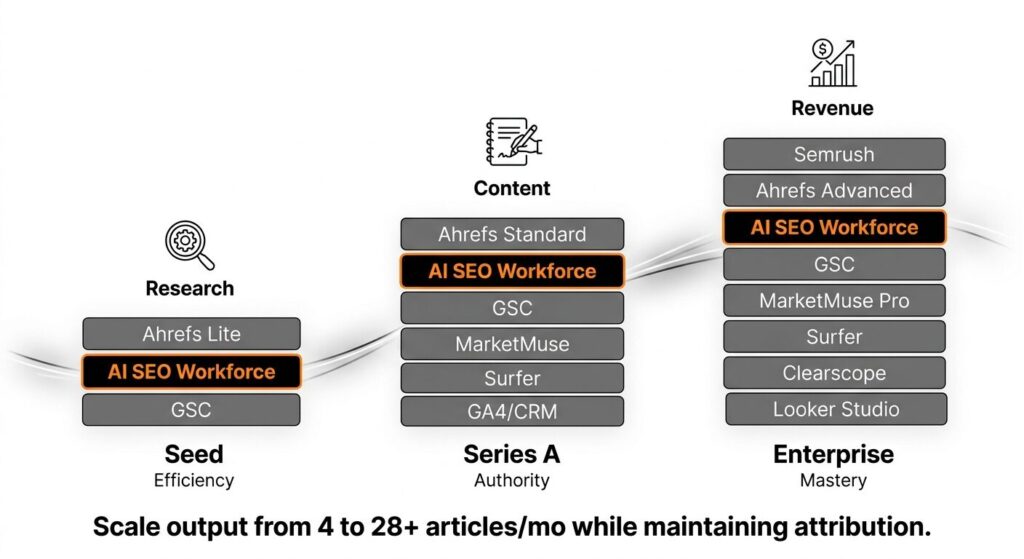
The stack you need depends on your current company stage. Overinvesting in tools before you have content velocity solves the wrong problem. Underinvesting after you have velocity means leaving pipeline data on the table.
| Company Stage | Research | Architecture | Production | Technical | Attribution | Monthly Cost |
| Pre-seed and Seed | Ahrefs Lite | Ahrefs Content Gap | AI SEO Workforce Scale | GSC free | GA4 free | ~$499 |
| Series A to C | Ahrefs Standard | MarketMuse | Surfer SEO and AI SEO Workforce | Screaming Frog | GA4 and HubSpot | ~$900 to $1,200 |
| Series B and Enterprise | Semrush Guru and Ahrefs | MarketMuse Pro | Clearscope and AI SEO Workforce | Screaming Frog and Sitebulb | GA4 and Salesforce and Looker | ~$2,000 and above |
If you are not sure which stack maps to your current stage and growth objective, book a free strategy call and I will map the right tools against your programme requirements.
GEO Optimisation: What Your Current Tool Stack Is Missing in 2026
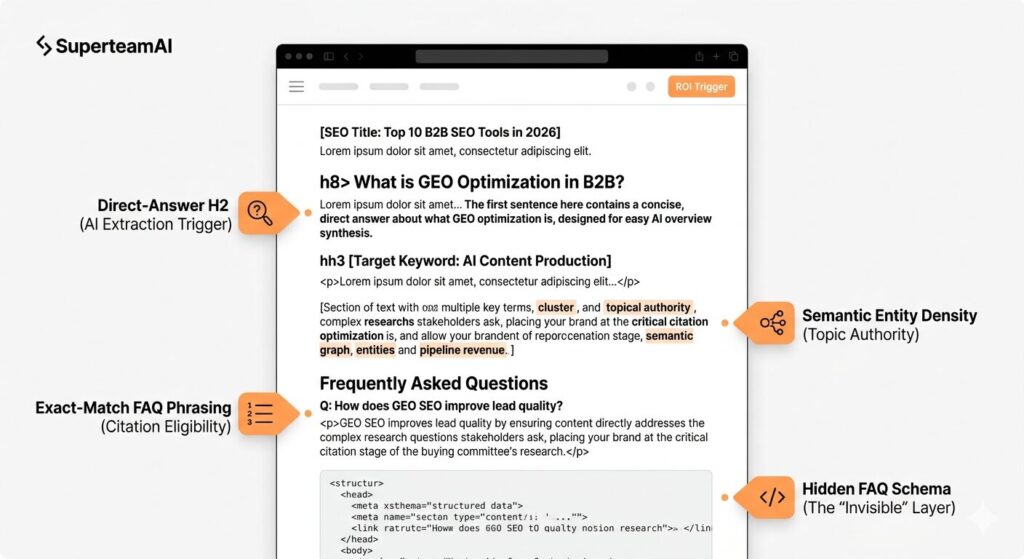
As of early 2025, 13% of Google queries trigger AI Overviews, up 116% since March of the same year (Semrush 2025). B2B evaluation-stage queries are disproportionately represented in that share because they are question-format and comparison-format searches that AI systems synthesise directly. An article not structured for AI Overview citation eligibility is competing for a smaller and shrinking portion of the SERP, regardless of which tools were used to produce it.
None of the tools in the top 10 list above have dedicated GEO optimisation modules as of 2026. GEO structure is a content discipline, not a feature: direct-answer H2 openings, exact-match FAQ phrasing, and FAQ schema markup at publication. The AI SEO Workforce builds GEO signals into every article at the production stage.
B2B SEO Tool Stacks: Three Gaps That Suppress Pipeline
Most tool stack gaps fall into three patterns that I see repeatedly across audits. First, teams invest in stage one and two tools, run keyword research and build content briefs, but have no attribution model at stage five. The content generates pipeline that is invisible to the CFO. Second, teams invest in individual content tools such as Surfer SEO or Clearscope but skip cluster architecture planning entirely. Each article is optimised in isolation rather than as part of a topical authority build. Third, teams run no technical audit layer. Technical debt accumulates across a growing content library and suppresses the ranking performance of articles that would otherwise perform well.
The fix in every case is the same: audit against the five-stage pipeline model rather than against an SEO function checklist. A tool that does not map to a specific pipeline stage failure is either redundant or misaligned. Companies running a five-stage B2B SEO programme with attribution configured from month one report organic as their highest-ROI acquisition channel within 18 months (HubSpot 2025).
Frequently Asked Questions
Which b2b seo tool works best for keyword research?
Ahrefs is the primary tool for B2B keyword research because its traffic potential metric accounts for zero-click losses from AI Overviews, making it more accurate for low-volume, high-intent B2B queries. Semrush Keyword Magic Tool adds value at the ICP filtering stage, where you classify queries by commercial intent before volume analysis. Use both together: Ahrefs for competitive intelligence and traffic potential, Semrush for intent classification and keyword grouping.
Do I need both Ahrefs and Semrush for B2B SEO?
For most Series A to C companies, one primary tool plus Google Search Console is sufficient at the keyword research stage. Ahrefs and Semrush have significant overlap in keyword data. The combination adds value at scale when you need to cross-reference keyword data and run competitive intelligence across multiple dimensions simultaneously. Start with Ahrefs if your primary constraint is keyword research and competitive gap analysis. Add Semrush when you need broader content audit and reporting capabilities.
How do I track B2B SEO pipeline attribution?
Configure GA4 with UTM parameters on every organic CTA before you publish article one. Integrate GA4 with your CRM to pass lead source data into the deal record. Set the attribution window to 6 to 18 months to capture the full B2B buying cycle. Build a Looker Studio dashboard that reports organic-attributed MQLs and pipeline value, not sessions and rankings. Without this setup, organic SEO cannot compete with paid channels for budget allocation regardless of how much pipeline it is generating.
Which tools help with GEO and AI Overview optimisation?
GEO optimisation in 2026 is a content structure practice, not a standalone tool category. Structure every H2 that answers a question with a direct answer in the first sentence. Format FAQ sections with exact-match question phrasing and implement FAQ schema markup at publication using a schema generator. Surfer SEO and Clearscope help with semantic coverage but do not yet have dedicated GEO optimisation modules. The AI SEO Workforce at Superteam AI builds GEO structure into every article at the production stage.
How much should a B2B SEO tool stack cost?A minimum viable stack for early-stage B2B companies runs approximately $400 to $500 per month, covering Ahrefs Lite, the AI SEO Workforce Scale plan, and Google’s free tools. A mid-market stack for Series A to C companies with full cluster execution capability runs $900 to $1,200 per month. Enterprise stacks with Semrush, Clearscope, Sitebulb, and dedicated attribution infrastructure run $2,000 or more per month before agency or execution costs.