Most articles on why SEO is important for B2B companies hand you a list of traffic benefits. This article makes a different argument: B2B SEO is important because of pipeline unit economics, not traffic volume. I have built AI SEO Workforces for 50+ B2B companies, and the decision to invest or not invest almost always comes down to one number: cost per qualified lead. This article gives you the business case, the ROI data, and an honest answer to when B2B SEO is not worth your time.
For the full definition and mechanics of how B2B SEO works, start with what is B2B SEO. This article focuses on the business case for investing in it.
The Real Reason B2B SEO Matters (It Is Not Traffic)
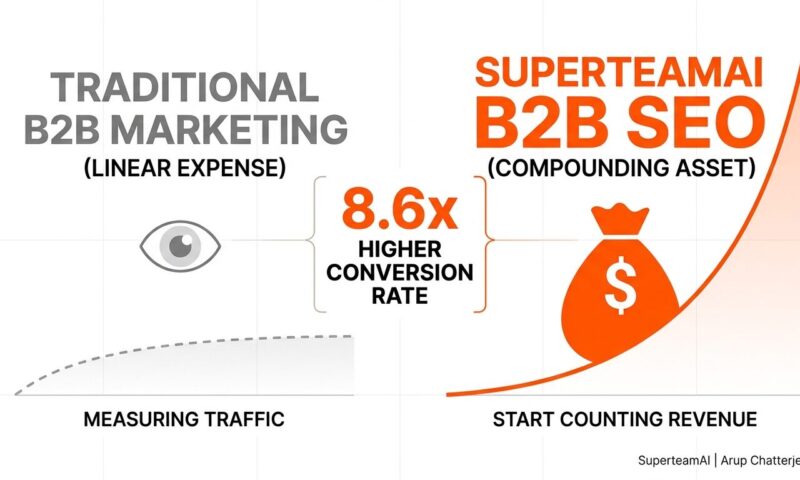
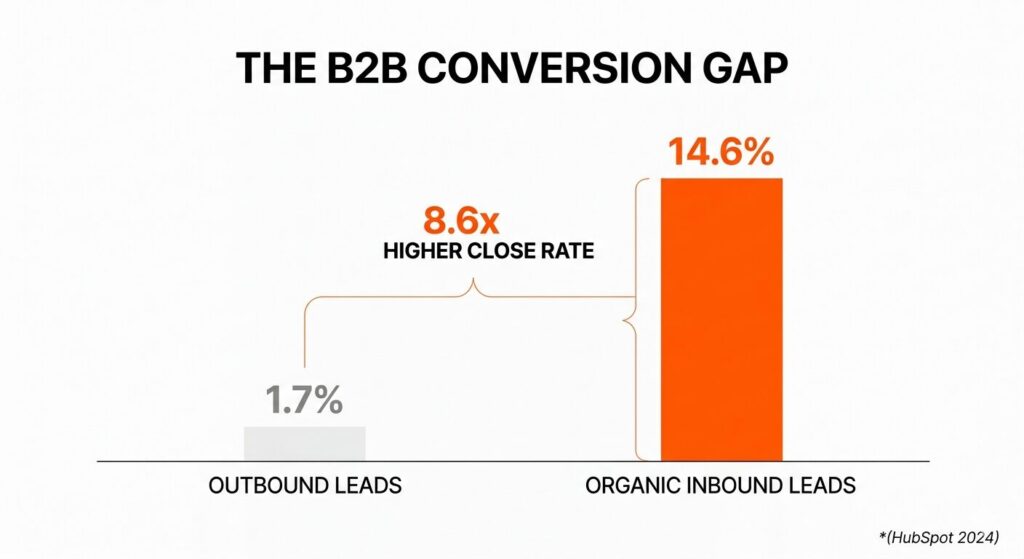
B2B SEO matters because organic leads close at 14.6% versus 1.7% for outbound (HubSpot 2024). That is an 8.6x close rate difference between an inbound lead who found you by searching for a solution to a specific problem and an outbound lead who received a cold email they did not request. The traffic number is secondary; the close rate differential is the business case.
Most B2B marketing teams measure SEO success by sessions and page views. In my experience, that is why they consistently underinvest in the channel. A team measuring sessions will always prefer paid ads, whose attribution is immediate and visible. A team measuring pipeline sourced from organic and CPL by channel will reach a different conclusion within 12 to 18 months of consistent SEO investment.
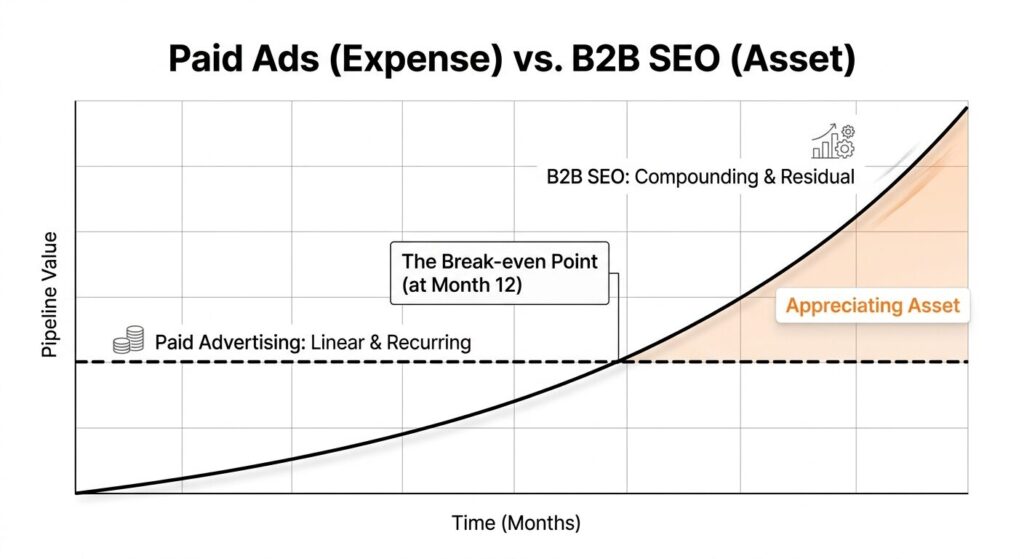
The frame that clarifies the real importance of B2B SEO is this: organic search is the one acquisition channel where the asset appreciates after you stop paying for it. Every other channel is a subscription. SEO is a balance sheet investment.
The 5 Business Reasons B2B SEO Is Important
B2B SEO is important for five distinct reasons, each with a measurable mechanism. In my experience, I have found that reason 3 is most consistently underestimated by B2B marketing teams.
1. Your buyers are already searching without you. 66% of B2B buyers use internet search when researching products they plan to purchase (Semrush 2024). If your company does not rank for the queries your ideal customer profile types during a vendor evaluation, two-thirds of your total addressable market is evaluating your competitors without ever seeing your product. Invisibility at this stage is not a neutral outcome; it is a loss to whoever ranks.
2. Organic leads convert at 8.6 times the rate of outbound. The 14.6% versus 1.7% close rate gap (HubSpot 2024) compounds directly into CPL economics. If you pay $200 per outbound lead and close at 1.7%, your cost per closed opportunity is $11,765. If organic CPL is $60 and close rate is 14.6%, your cost per closed opportunity is $411. B2B SEO is not a traffic exercise; it is a revenue efficiency exercise.
3. Eleven stakeholders are researching independently. The average B2B buying committee includes 11 people (Gartner 2024), each conducting their own research. They consume an average of 27 pieces of content before a final vendor selection. A company that ranks across the full topical cluster (awareness, consideration, decision) is present for all 27 touchpoints. A company with one or two articles is present for two. The committee-level coverage argument is why topical authority matters more in B2B than any other context.
4. The content asset base compounds over time. Paid acquisition is linear: spend $X, get Y leads; stop spending, get zero leads. A B2B SEO content library behaves differently. An article published today will rank for 3 to 5 years, generating leads monthly without incremental cost. FirstPageSage (2025) data shows the highest B2B SEO returns are observed at 24 to 36 months of consistent publishing, when the content base is large enough to cover every stage of the buying cycle for multiple ICP personas.
5. AI Overviews have made organic presence more valuable, not less. 13.14% of Google queries now trigger AI Overviews (Semrush 2025), more than doubling from 6.49% in January 2025. Visitors arriving via AI-referred links convert at 4.4 times the rate of standard organic visitors (BrightEdge 2025). Companies whose content is structured for AI citation (direct-answer H2 openings, exact-match FAQs, inline source attribution) are capturing a new conversion channel layered on top of existing organic traffic.
What B2B SEO Does to Your Cost Per Lead Over Time
B2B SEO reduces cost per lead progressively over 18 to 24 months. The timeline I see consistently across deployments follows four phases.
Months 1 to 6: Investment phase. Content is being published, clusters are being built, and no pipeline has arrived yet. Most B2B companies mistake this silence for failure. It is not; it is the latency period inherent to any compounding asset. The seeds are planted; the return has not started.
Months 6 to 12: First rankings and early pipeline. Articles begin ranking on pages 1 and 2. Demo requests start appearing with organic search as the lead source. CPL is still high relative to eventual steady state because the content base is not yet large enough to cover the full buying cycle.
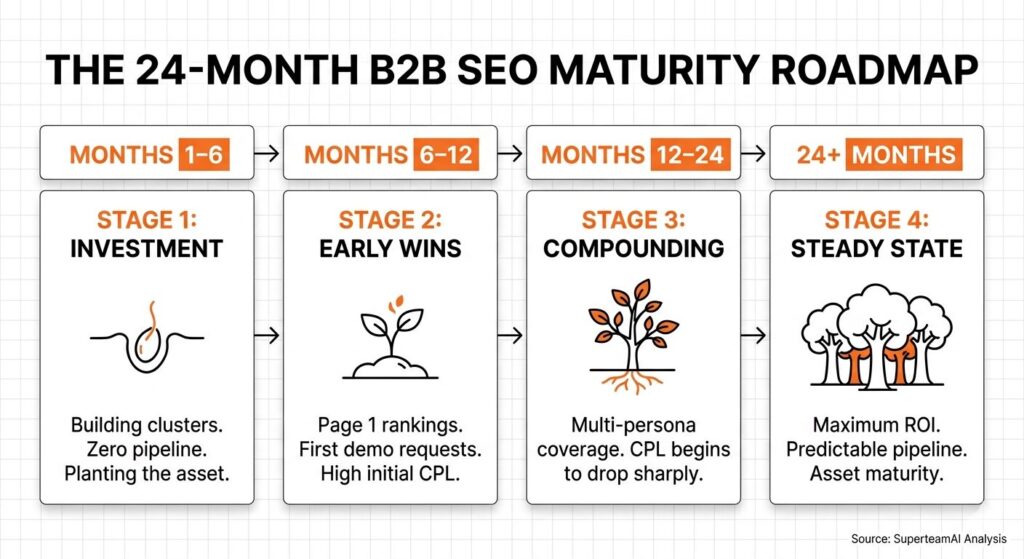
Months 12 to 24: Compounding begins. A growing library of ranked articles covers multiple stages of the buyer journey for multiple ICP personas. CPL falls as the number of ranking pages grows. Each new article adds to an existing foundation rather than starting from zero.
Months 24 and beyond: Steady-state organic pipeline. The content library produces consistent monthly pipeline contribution with no proportional increase in investment. EasyOps, a B2B SaaS inventory management platform, saw CPL fall from $127 to $43 (a 66% reduction) over 8 months of full-cluster deployment using the AI SEO Workforce. That is not an anomaly; it is what the compounding mechanism looks like with execution consistency.
When B2B SEO Is Not Important (The Honest Answer)
Three specific situations make B2B SEO investment premature or misplaced, and I find that acknowledging them directly is what gives this argument its credibility.
Your ICP has no search behaviour. Some enterprise B2B markets operate entirely through relationship-led sales, RFP processes, and analyst-influenced procurement. If your buyers do not use Google to evaluate vendors in your category, SEO will not generate qualified pipeline regardless of execution quality. Verify by checking keyword research data: if your core product category keywords have near-zero search volume, your buyers are not searching.
Your product category does not yet exist. If you are creating a new category, nobody is searching for it. The queries your buyers would use have not been established yet. In this scenario, brand content and community distribution are more important than search optimisation, because there is no existing demand to intercept.
You are pre-product or pre-PMF. Content investment before product-market fit is premature. The resources required to build topical authority belong in product validation, not content creation. B2B SEO is a growth channel, not a discovery channel.
If none of these three conditions apply, the answer to why SEO is important for B2B is unambiguous: it is the highest-ROI acquisition channel available at scale (FirstPageSage 2025). Every month without it is a month your competitors are building the content asset base that will compound against you for the next three years.
The Compounding vs. Linear Acquisition Comparison
A critical framing for any CFO or founder evaluating B2B SEO is the compounding versus linear acquisition comparison.
Paid advertising is a linear channel. You spend $10,000 per month and generate a predictable number of leads. The moment you stop spending, the leads stop. The channel produces no residual value; every month starts from zero. The asset you are building is the vendor’s revenue, not yours.
B2B SEO is a compounding channel. An article published in month 1 ranks in month 6 and generates leads in months 6 through 60. The second article adds to the first. The tenth article creates a cluster that ranks for all related queries. The fiftieth article makes the domain the topical authority in its category. The content library is an asset that belongs to your company and generates returns without proportional ongoing investment.
ReachInbox, a B2B SaaS cold email platform, shifted from paid-primary to SEO-primary acquisition using the AI SEO Workforce. In my deployment of their content programme, organic traffic grew from 2,000 to 17,000 monthly visitors (750% growth) over 12 months. The compounding effect extended runway from 6 to 24 months, a direct consequence of the CPL reduction as organic overtook paid as the primary lead source.
The CFO argument for B2B SEO is not about traffic. It is about converting a monthly expense into a compounding asset that produces returns long after the initial investment period.
How B2B Companies Measure Whether SEO Is Working
B2B SEO appears not to work for many companies because they are measuring the wrong things. Three metrics consistently produce the wrong conclusions.
Wrong metric 1: Sessions. Sessions measure content consumption, not pipeline contribution. A high-session article with zero demo requests is not a successful SEO asset; it is a traffic asset with no business impact.
Wrong metric 2: Bounce rate. A B2B buyer reading a 2,200-word decision-stage article in 4 minutes and then requesting a demo may technically bounce if they navigate directly to the contact page. Bounce rate says nothing about pipeline quality.
Wrong metric 3: Rankings alone. A first-position ranking for a keyword with no buyer intent generates impressions, not leads.
Three metrics I see consistently across deployments that produce accurate conclusions: pipeline sourced from organic (MQLs and SQLs with organic as first or last touch), CPL from organic versus other channels, and time-to-close for organic leads versus paid leads. For the practical execution framework, the B2B SEO tips article covers attribution setup and the specific reporting configuration required to measure these correctly.
Proof: What B2B SEO Importance Looks Like in Practice
Two B2B SaaS companies at different stages demonstrate what B2B SEO produces when the compounding mechanism is allowed to run.
EasyOps (inventory management SaaS) deployed the AI SEO Workforce across 3 complete topical clusters at 24 to 25 articles per month. CEO Rajiv Mehta: “We were invisible in the market. Our paid ads brought some traffic, but the costs were unsustainable.” Results in 8 months: organic traffic from 4,200 to 30,500 monthly visitors (626% growth), MRR from $50,000 to $200,000, CPL from $127 to $43. Unicommerce acquired EasyOps for $21.6 million at month 14. The acquisition was in part a function of the organic traffic asset and market visibility the SEO programme had built.
ReachInbox (cold email SaaS) deployed the same system with a focus on high-intent consideration and decision-stage content. CEO Anup Sharma: “We went from 2,000 visitors to 17,000, and our conversion rates more than doubled.” Results in 12 months: 2,000 to 17,000 monthly visitors (750%), runway from 6 to 24 months, MRR from $65,000 to $150,000.
Both companies are in different categories, at different stages, with different ICPs. I have run both programmes directly using the same cluster-first methodology. The outcome was consistent: qualified pipeline from organic at a CPL fraction of their previous paid acquisition costs. For the full methodology, see the B2B SEO solutions guide covering execution model options and cost comparisons.
The B2B SEO pillar covers the full cluster architecture and strategy framework if you are ready to build.
Frequently Asked Questions
Why is SEO important for B2B companies?
B2B SEO is important because organic leads close at 14.6% versus 1.7% for outbound, making organic search the highest-converting acquisition channel available to most B2B companies. 66% of B2B buyers use search during vendor evaluation (Semrush 2024), which means B2B companies without search visibility are invisible to the majority of their addressable market during the highest-intent phase of the buying cycle.
How long does B2B SEO take to show results?
B2B SEO typically shows first ranking movements in 3 to 6 months and measurable pipeline contribution in 6 to 12 months. The compounding return, where a growing content library generates increasing pipeline without proportional additional investment, becomes significant between 18 and 36 months of consistent publishing.
Is B2B SEO better than paid advertising?
Neither is categorically better. Paid advertising produces immediate, controllable lead volume with no latency. B2B SEO produces compounding returns that lower CPL over time but require an 18 to 24 month investment period before reaching steady state. High-performing B2B programmes run both channels and progressively shift budget toward organic as the content asset base matures and CPL differentials widen.
What is the ROI of B2B SEO?
ROI varies by category and publishing cadence, but the CPL reduction pattern is consistent across B2B deployments. EasyOps reduced CPL from $127 to $43 (66% reduction) in 8 months. FirstPageSage (2025) data shows B2B SEO programmes operating at 24+ months produce the highest ROI of any B2B digital marketing channel when measured by pipeline sourced per dollar invested.
When should a B2B company start investing in SEO?
The right entry point for most B2B companies is at or near $1M ARR, when there is enough product clarity and ICP definition to produce buyer-intent content with genuine specificity. Pre-product or pre-PMF investment in SEO is premature. Post-$1M, I recommend starting with one complete topical cluster at 4 to 8 articles per month to begin the compounding return cycle. The AI SEO Workforce executes this at Pro $79, Business $199, or Scale $399 per month, producing the publishing cadence required for topical authority without an internal SEO specialist.