AI agent development companies design, build, and deploy autonomous software systems that execute multi-step business workflows without constant human intervention. Services include workflow discovery, model selection, system prompt engineering, API integration, oversight design, and ongoing management. The right company depends on your industry, workflow complexity, data privacy requirements, and whether you need genuine custom development or platform configuration.
The market for AI agent development has grown significantly, with 79% of organizations reporting some level of agentic AI adoption in 2026 [VERIFY]. But the market has also grown crowded. Vendors selling n8n workflow templates describe themselves as AI agent development companies. No-code platform resellers use the same language as firms writing production-grade custom systems from scratch.
This guide provides a framework rather than a list. It covers the five types of AI agent development companies, the six criteria that separate good partners from poor ones, and which company type fits marketing agencies, real estate firms, and other SMB buyers specifically.
What an AI Agent Development Company Actually Does
An AI agent development company designs and builds software systems that can reason, plan, and act across tools and data sources to complete multi-step business tasks. The distinction from a traditional software development firm is the reasoning layer: agents use large language models to interpret context, make decisions, and execute sequences of actions based on goals rather than fixed rules.
The work spans discovery, architecture design, integration engineering, human oversight design, and ongoing management after the agent goes live.
The Five Services That Define a Full Development Partnership
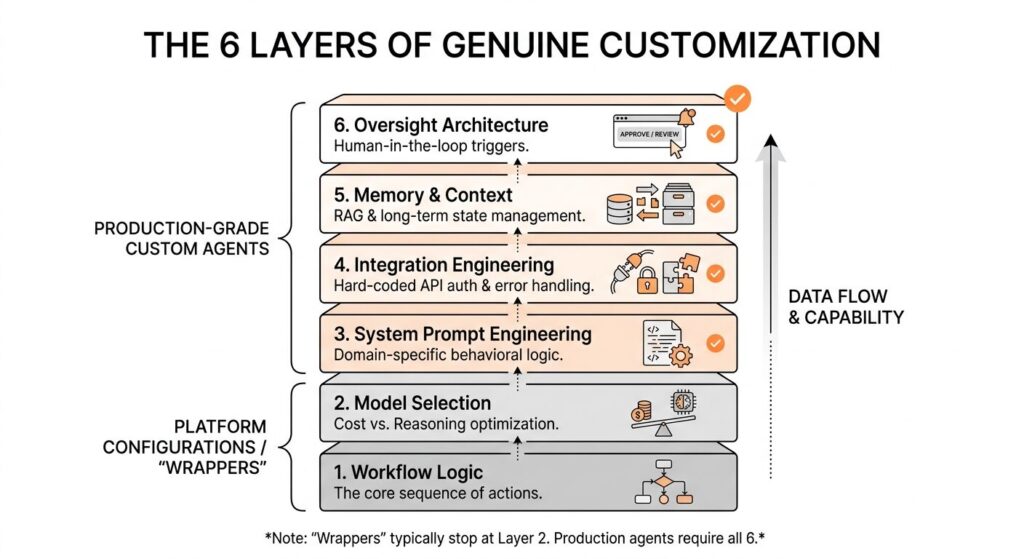
A genuine AI agent development partner covers five distinct service areas. Workflow discovery maps the target process before any code is written, documenting what triggers the workflow, what decisions the agent makes, and where human review is required. Model selection and system prompt engineering choose the underlying model based on the task’s latency, cost, and reasoning requirements, then design the behavioral architecture to fit the client’s domain. Integration development connects the agent to the client’s existing software systems via APIs, handling authentication, rate limiting, and error states. Oversight design defines the architecture for human review at high-stakes decision points. Ongoing management monitors performance, responds to integration failures as upstream platforms evolve, and iterates on the configuration as the business changes. Providers that cover only some of these five areas are not offering a complete AI agent development service.
Five Types of AI Agent Companies (And Which Fits Your Situation)
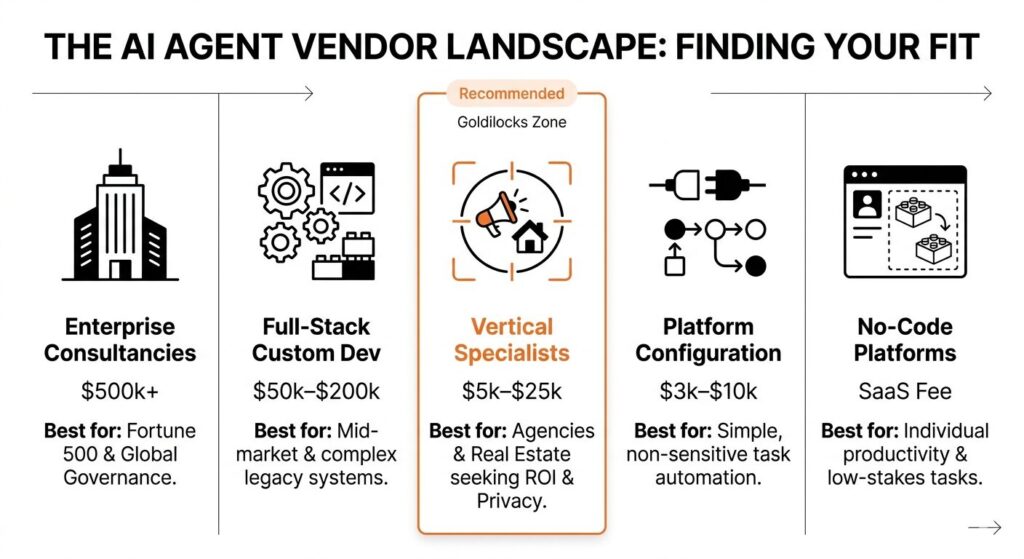
The phrase “AI agent development company” currently describes five meaningfully different types of provider. Knowing which category a vendor falls into is more useful than any ranking list.
Enterprise Consultancies
Accenture, Deloitte, IBM, McKinsey/QuantumBlack, and BCG all offer AI agent development services. These firms bring deep enterprise consulting capability, compliance expertise, and large delivery teams. Their engagements are designed for Fortune 500 environments: multi-region deployments, formal AI governance frameworks, complex legacy system integrations, and budgets starting at $500,000.
For a marketing agency or real estate firm evaluating AI agent partners, enterprise consultancies are the wrong category. Their scoping and discovery processes alone cost more than most SMB total project budgets. The workflows they specialize in bear no resemblance to campaign reporting automation or lead qualification for a field sales team.
Full-Stack Custom Development Firms
Companies like LeewayHertz, Master of Code Global, Appinventiv, and SoluLab build custom AI agents for mid-market businesses. They design architecture from scratch, handle complex multi-system integrations, and have documented experience across industries including retail, healthcare, and financial services. Engagement costs for this category typically fall in the $50,000 to $200,000 range for initial builds [VERIFY], with ongoing management retainers on top. These firms are the correct choice when the workflow is complex, the integration footprint spans multiple enterprise systems, and the client has the internal resources to manage a larger vendor relationship.
Platform Configuration Shops
A significant portion of the market describes itself as AI agent development but delivers platform configurations: n8n, Make, Zapier, or Lindy workflows configured to a client’s specifications. These vendors are faster and cheaper to engage, but the output is not custom. Platform-based agents are limited by the capabilities of the underlying platform, vulnerable to breaking when the platform changes its APIs or pricing, and cannot be built around the specific behavioral constraints of a client’s workflows. This category is appropriate for simple, rule-based automations with no data sensitivity and low reliability requirements.
No-Code and Low-Code Platforms
Zapier Agents, Relevance AI, Beam AI, and Dust allow non-technical teams to configure agents without writing code. These tools deliver real value for standard, narrow automations: routing, tagging, scheduling, and inbox management. They are the right choice for teams without technical resources who need to automate predictable, low-stakes tasks quickly. They are not the right choice for workflows involving contextual reasoning, client-facing outputs, or any process where an agent failure produces measurable downstream harm.
Vertical Specialists
Some AI agent development companies focus exclusively on one or two industries. This specialization means they understand the workflows, terminology, compliance requirements, and risk profile of the target industry before any discovery session begins. The result is agents designed around the actual edge cases of the industry rather than adapted from a generic template. For marketing agencies and real estate firms, vertical specialists are typically the correct category. The workflows are industry-specific enough that a generalist firm will spend significant engagement time learning what a vertical specialist already knows.
What to Look For When Evaluating Any AI Agent Development Company
Most evaluation guides focus on technical credentials and delivery track record. Those matter. But three criteria are almost universally missing from published frameworks, and they are the ones most likely to determine whether an agent performs in production.
Vertical Experience in Your Industry
The primary filter for any buyer evaluating an AI agent development company is documented experience in the specific industry. Ask for case studies showing deployed agents in your sector, not adjacent sectors. An agent built for healthcare claims workflows requires fundamentally different prompt engineering, integration logic, and oversight design than an agent built for marketing campaign reporting. A firm without hands-on experience in your industry will build an agent that is technically correct but operationally misaligned.
Genuine Custom Development vs. Platform Configuration
The question no standard evaluation guide tells buyers to ask: is this proposal genuine custom development, or a platform configuration sold as bespoke work? Signals of a platform configuration proposal include delivery of the proposal within 24 hours, flat-rate package pricing without workflow-specific variables, vague references to existing frameworks without naming specific architectural decisions, and no mention of a structured discovery process.
How to verify: ask which of the six customization layers the proposal addresses. Model selection, system prompt engineering, integration development, memory architecture, workflow logic, and oversight design are the six layers where genuine customization occurs. A platform configuration typically touches only the tool and workflow layers. The full guide to custom AI agent development services covers how to read a proposal against this framework.
Human-in-the-Loop Oversight Architecture
For any workflow touching client-facing outputs, the AI agent development company must have a defined approach to oversight design: where the agent acts autonomously and where it routes a decision to a human for review before action is taken. This is a core architectural decision, not a feature to request after a proposal is delivered. Ask specifically how oversight is designed and built into the agent’s logic rather than listed as a capability.
Data Handling and Open-Source Deployment Options
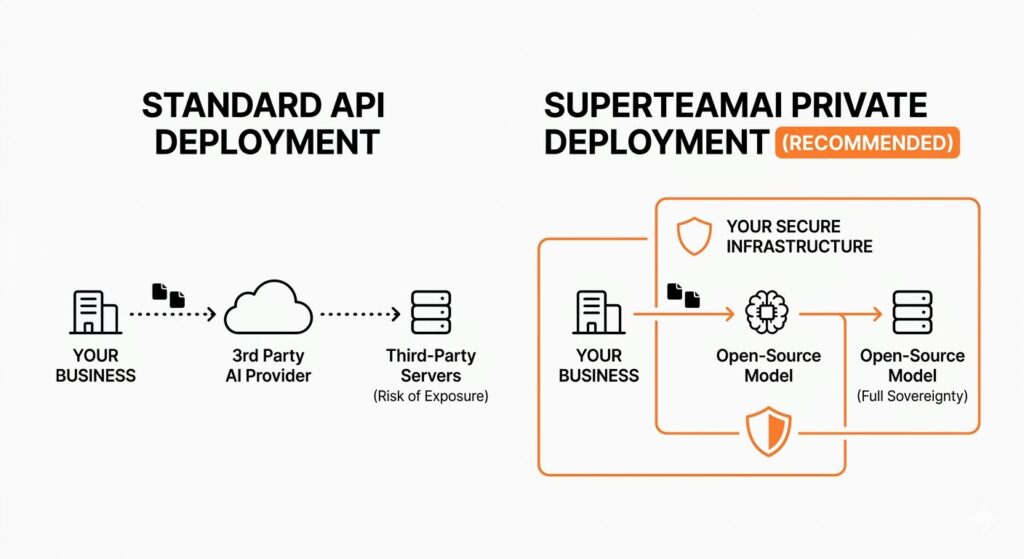
Standard AI agent services route business data through third-party APIs. When an agent reads client emails, queries a CRM, or processes contracts, that data passes through OpenAI, Anthropic, or another model provider’s servers. For marketing agencies handling confidential campaign strategies and real estate firms handling client financial data, this creates real exposure.
Ask any prospective development partner whether open-source model deployment on your own infrastructure is available. This approach routes all agent reasoning through infrastructure you control. Client data does not leave your environment. If the vendor cannot give a precise answer to this question, the answer is no.
Post-Deployment Management and Support
An AI agent deployment that goes live without an ongoing management structure is not a complete service. Integrations break when software platforms update their APIs. Model behavior shifts as providers release new versions. Workflow edge cases emerge only after production. Ask specifically how post-deployment failures are detected, what the response time commitment is, and how ongoing iteration is structured and priced.
Code and Configuration Ownership
In a properly structured engagement, the client owns all code, prompt architecture, and configuration. Providers who retain ownership of the agent’s logic create ongoing dependency and prevent clients from maintaining or transferring the agent independently. Confirm ownership terms before any engagement begins.
Top AI Agent Development Companies for Marketing Agencies and Real Estate Firms
For marketing agencies and real estate firms, the relevant category is vertical specialists with documented experience in agency workflows, real estate operations, and the oversight requirements of client-facing automation.
SuperteamAI
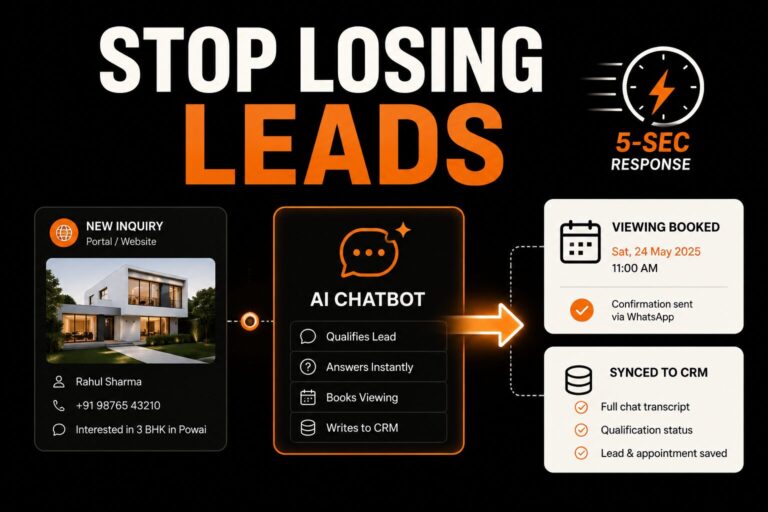
SuperteamAI builds and manages custom AI agent workforces exclusively for marketing agencies and real estate firms. Every engagement includes a structured workflow discovery process, deliberate model selection, system prompt engineering designed for the client’s domain and voice, integration development connecting to existing software, human-in-the-loop oversight architecture, and ongoing management through the full agent lifecycle.
SuperteamAI offers open-source model deployment for clients with data privacy requirements, routing all agent reasoning through the client’s own infrastructure rather than third-party APIs. One marketing agency client reduced manual reporting time by more than 60% within 90 days of deploying a custom campaign reporting agent [VERIFY].
Marketing agency or real estate firm evaluating AI agent development partners?Book a free 30-minute discovery call and we will map your highest-impact workflow before any commitment.
LeewayHertz
LeewayHertz is a full-stack AI development firm with documented real estate and marketing use cases. The company builds on platforms including Vertex AI and AutoGen Studio and offers multi-agent orchestration for complex workflow automation. Best for mid-market firms with complex multi-system integration requirements and formal governance needs, where a larger vendor relationship and higher initial investment are appropriate.
Master of Code Global
Master of Code Global has an established track record in conversational AI and customer-facing agent development across retail, financial services, and other industries. Their proprietary LOFT framework reduces setup time and suits businesses prioritizing omnichannel customer engagement. Best for firms where the primary agent use case involves external customer interaction rather than internal workflow automation.
What AI Agent Development Services Cost for Marketing Agencies and Small Businesses
Most published cost guides focus on enterprise deployments. For marketing agencies and real estate firms evaluating single-workflow agent builds, the relevant ranges are different.
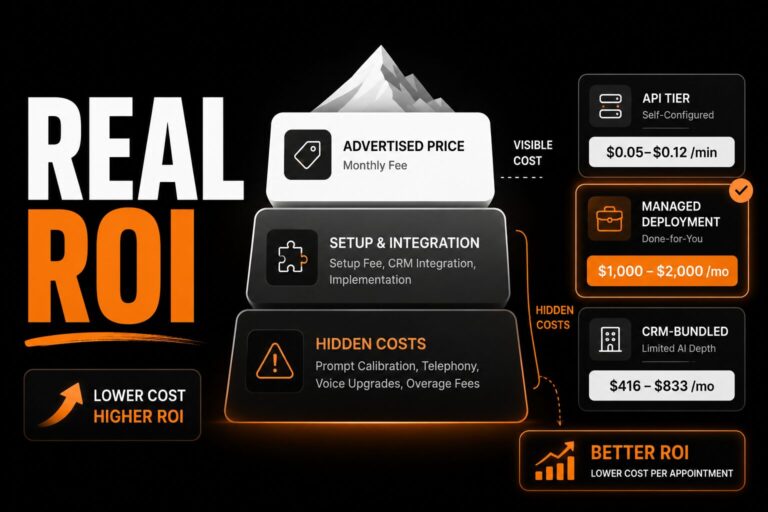
Platform configurations typically cost between $3,000 and $10,000 for initial setup [VERIFY]. Genuine custom single-workflow agent builds for SMBs, including discovery, architecture design, integration development, and deployment, typically fall in the $5,000 to $25,000 range [VERIFY]. Ongoing management retainers run from $1,000 to $3,000 per month depending on integration complexity and iteration volume [VERIFY]. Enterprise-scale multi-agent systems start at $50,000 and scale to $400,000 or more [VERIFY].
The correct comparison frame is not upfront cost but total cost of ownership over 12 months, including build, management, and the value of staff time the agent replaces. For agencies and real estate firms with workflows consuming 10 to 20 staff hours per week, a well-deployed custom agent typically returns its cost within the first two to three months of operation.
Red Flags in AI Agent Development Proposals
Several signals indicate that a vendor is selling a platform configuration or demo-stage capability as a production-ready custom service. Watch for proposals that arrive within 24 hours of the initial conversation, since genuine scoping requires a structured intake process. Watch for flat-rate package pricing without workflow-specific variables, since a custom engagement cannot be priced without knowing the integration requirements. Watch for vague references to existing frameworks without describing specific architectural decisions made for your workflows. Watch for no mention of discovery, oversight design, or ongoing management. And watch for providers who cannot answer precisely where your business data goes when the agent is running.
How SuperteamAI Approaches AI Agent Development
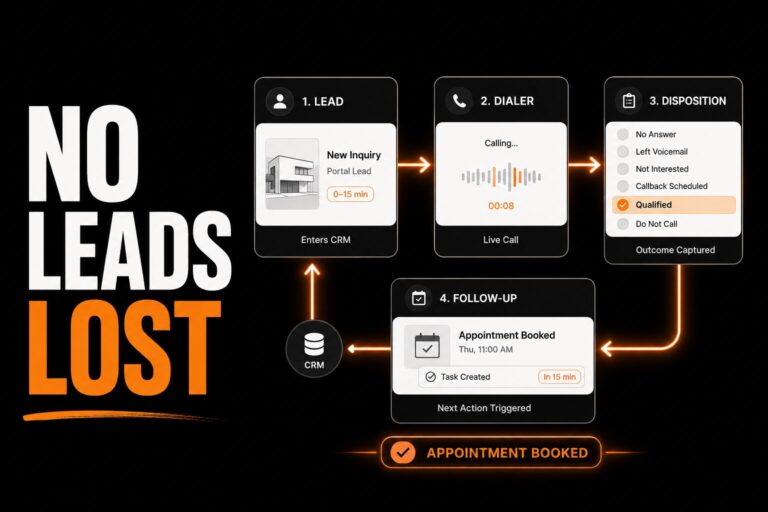
SuperteamAI’s process follows four sequential phases. Discovery and architecture design maps the target workflow end to end, documents the decisions the agent will make, identifies the integrations required, and defines the oversight architecture before any build begins. Build and integration develops the agent against the documented architecture, connecting to existing software systems and testing against real workflow data. Deployment and oversight launch puts the agent into production with a defined human-review structure for high-stakes outputs. Ongoing management monitors performance, addresses integration failures as upstream platforms evolve, and iterates on the configuration as the client’s workflow changes.
Every SuperteamAI engagement includes an open-source deployment option. For marketing agencies and real estate firms with client confidentiality requirements, the agent operates entirely within the client’s own infrastructure. No client data passes through third-party model APIs.
Frequently Asked Questions
What do AI agent development companies actually do? AI agent development companies design, build, and deploy autonomous software systems that execute multi-step business workflows. The full service scope includes workflow discovery, model selection, system prompt engineering, API integration development, human oversight design, and ongoing management through the agent’s operational lifecycle.
How much do top AI agent development companies charge? Costs range from $3,000 to $10,000 for platform configurations up to $400,000 or more for enterprise multi-agent systems [VERIFY]. For marketing agencies and real estate firms commissioning genuine custom single-workflow agents, the typical range is $5,000 to $25,000 for initial build, with $1,000 to $3,000 per month for ongoing management [VERIFY].
How long does AI agent development take? A single-workflow custom agent typically takes two to six weeks from discovery through deployment. More complex builds involving multiple integrations or multi-agent orchestration take six to twelve weeks. Timeline is driven primarily by integration complexity and the number of edge cases that require custom handling during testing.
What is the difference between a custom AI agent development company and a platform configuration shop? Custom companies design agent architecture from scratch, making deliberate decisions at the model, prompt, integration, memory, workflow, and oversight layers. Platform configuration shops adapt pre-built workflow tools to client specifications and position the output as bespoke work. The practical difference is in reliability, data handling, and how the agent performs on edge cases that represent a significant share of real workflow volume.
Do I need a vertical specialist or will a generalist firm work? If your workflow involves industry-specific terminology, compliance requirements, or client-facing outputs where an agent failure has measurable impact, a vertical specialist will produce a more reliable agent. Generalist firms spend discovery time learning what a vertical specialist already knows, which increases cost and reduces the quality of the initial build.
What is human-in-the-loop oversight and why does it matter? Human-in-the-loop oversight is the architectural decision about where an AI agent acts autonomously and where it routes a decision to a human for review before taking action. For client-facing workflows, it is not optional. It is what separates a reliable operational tool from a liability.
How do I verify data privacy in an AI agent engagement? Ask the provider specifically where your business data goes when the agent is running. Most services route data through third-party model APIs. Open-source deployment on your own infrastructure keeps all data within your environment. For businesses with client confidentiality obligations, this is a filtering criterion before any other evaluation begins.What makes SuperteamAI different from other AI agent development companies? SuperteamAI focuses exclusively on marketing agencies and real estate firms. Every engagement includes structured workflow discovery, open-source model deployment for data privacy, human-in-the-loop oversight design built into the agent architecture, and ongoing management through the full agent lifecycle. Vertical focus means the team understands each client’s workflows and risk profile before the first discovery session begins.