
An AI lead generator is an automated system that identifies, scores, and engages potential buyers without manual input at each step. It combines signal capture, predictive scoring, data enrichment, and outreach sequencing into a pipeline that runs continuously. Unlike a collection of individual tools, a generator produces qualified leads as ongoing output rather than through repeated manual campaigns.
Most firms that search for an AI lead generator find lists of AI lead generation tools. The two are not the same thing. A tool requires a person to operate it at each step. A generator runs the sequence automatically and surfaces output for human review at the point where judgment is required. Building one requires understanding what connects the components, not just what the components are.
This guide covers the anatomy of a working AI lead generator, the configuration requirements that precede reliable output, and the failure modes that cause most generators to degrade within two months of deployment.
What an AI Lead Generator Actually Is
The Difference Between a Generator and a Collection of AI Tools
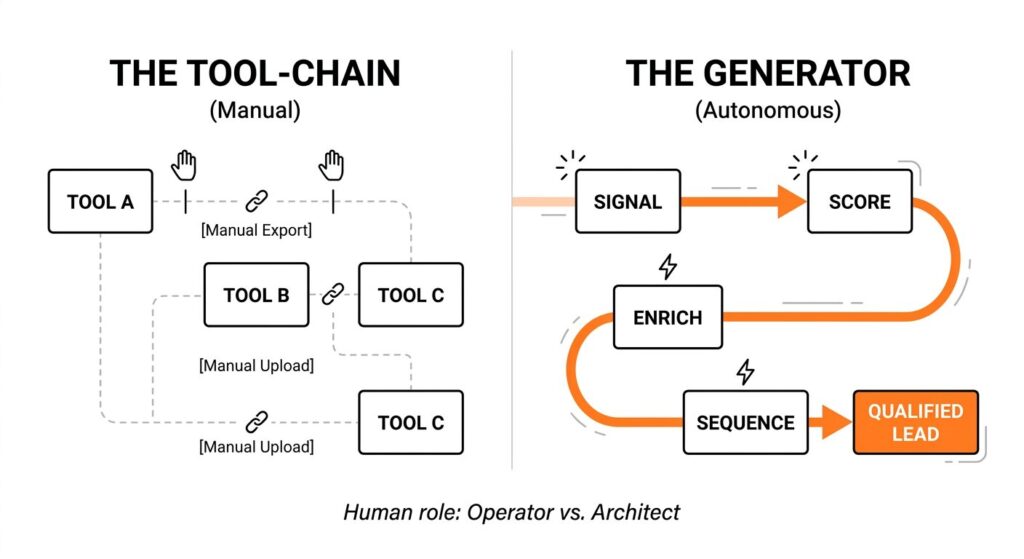
A collection of AI lead generation tools requires a person to move data between stages. You pull intent data from one platform, upload it to your scoring model, enrich the output in a third platform, and manually trigger outreach sequences. Each step is assisted by AI, but the workflow depends on human initiation at every handoff.
An AI lead generator eliminates those manual handoffs. When a qualifying signal fires, the system automatically routes the contact through scoring, enrichment, and outreach without waiting for a person to initiate the next step. The human role shifts from operating the workflow to reviewing its output and handling responses that require judgment.
The distinction matters because most buyers assume purchasing an AI lead generation platform is equivalent to having a generator. It is not. A platform provides the components. A generator is what you build when those components are connected with trigger logic that fires automatically. [VERIFY: most AI prospecting workflows still require three to five manual handoff points per lead before outreach fires, even when using platforms marketed as fully automated]
What “Automated” Means in Practice
Automation in a lead generator does not mean zero human involvement. It means the system handles the operational steps between signal detection and outreach without manual intervention. A human still defines the ICP, reviews qualification criteria, monitors output quality, and handles replies that fall outside the expected response patterns.
The practical boundary of automation is the handoff trigger: the point at which a lead has been scored, enriched, and sequenced, and a human needs to take over the conversation. A well-configured generator makes this handoff precise and timely. A poorly configured one either hands off too early (before qualification is complete) or too late (after the prospect has moved on).
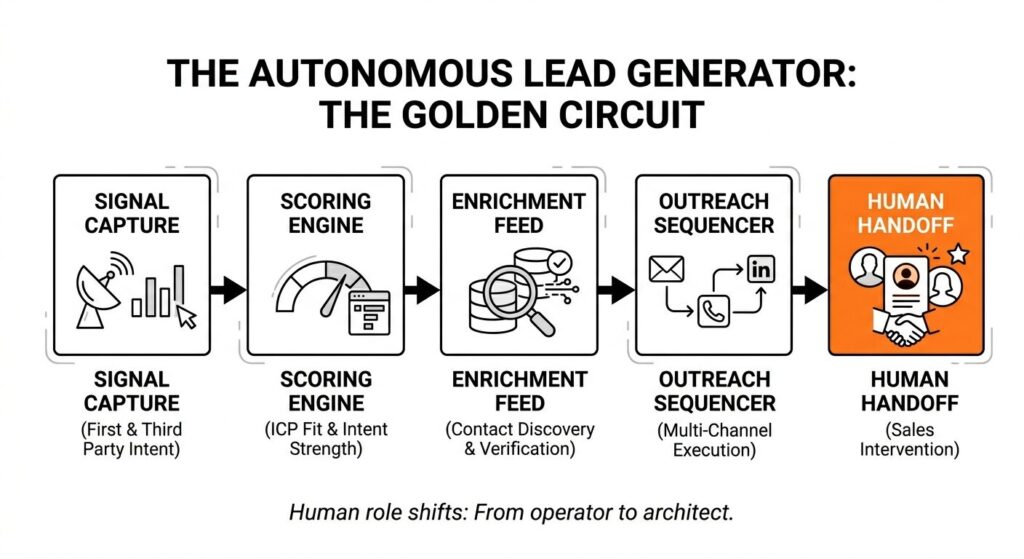
The Anatomy of an Autonomous Lead Generator: Five Required Components
Signal Capture and Scoring: The Intake and Evaluation Layers
Signal capture is the first layer. It collects behavioral and firmographic data about prospects: page visits, content downloads, email opens, company attributes, and third-party intent signals from publisher networks. Without a functioning signal capture layer, the generator has no inputs to process. [VERIFY: first-party behavioral signals resolve to identified contacts at 20 to 40 percent of site visits; third-party intent data platforms report match rates of 40 to 80 percent depending on methodology and market segment]
The scoring engine sits immediately downstream. It takes the signals produced by the capture layer and assigns each contact a qualification score based on conversion likelihood. The scoring model determines which contacts advance to enrichment and outreach and which are routed to a nurture sequence or discarded. Without a scoring layer, every signal triggers outreach indiscriminately, which produces high send volume and low reply rates.
Enrichment and Outreach: The Action Layers
Enrichment fills in the contact record gaps that signal capture leaves incomplete. If the scoring model flags a company as high-priority but the record lacks a direct contact, job title, or verified email, the enrichment layer adds those fields automatically before the outreach sequencer fires. [VERIFY: top enrichment platforms claim 80 to 95 percent match rates on B2B contacts in primary markets, with lower rates in niche verticals and secondary geographies]
The outreach sequencer uses the enriched record to generate and send personalized messages across the configured channel mix: email, LinkedIn, or phone depending on the contact attributes and sequence design. The sequencer does not require a human to draft each message. It pulls from templates parameterized with contact-specific data and fires based on trigger logic tied to the scoring output.
Human Handoff: Where the Generator Ends and the Sales Team Begins
The handoff trigger is the most frequently misconfigured component. It determines when a lead exits the automated pipeline and enters active human management. Set the threshold too low and sales receives leads that have not been sufficiently qualified, producing wasted follow-up effort. Set it too high and the system holds leads in automation past the point of optimal timing.
The handoff trigger should fire on a combination of engagement signal (reply, meeting booked, or page revisit following outreach) and score threshold. A lead that replies positively but scores below threshold is worth reviewing. A lead that scores above threshold but has not engaged with outreach is not yet ready for direct human contact. [VERIFY: leads contacted by a human within five minutes of a qualifying engagement signal convert at significantly higher rates than those contacted after 24 hours, with some studies citing a 100x conversion rate difference at the five-minute vs. 30-minute mark]
Signal Capture: The Input Layer That Feeds the Generator
Intent data inside a generator comes from two sources. First-party signals are actions your known and anonymous visitors take on your own properties: the pages they visit, the content they download, and the emails they open. Third-party signals come from external data cooperatives: topic-level intent from publisher networks indicating that a company or contact is researching your category elsewhere on the web.
Both signal types are necessary. First-party signals are high-confidence because they represent direct engagement with your brand. Third-party signals extend your reach to prospects who have not yet engaged with your content but are actively evaluating your category. A generator that relies only on first-party signals captures a fraction of the available intent pool.
What Happens When the Input Layer Is Weak
A weak signal capture layer is the most common reason an AI lead generator produces disappointing output from day one. If your website is not instrumented to capture page-level behavioral data, if your email sequences are not tracking individual opens and clicks, or if your intent platform has low match rates in your target market, the scoring engine receives too few inputs to produce meaningful prioritization.
The symptom is a small pool of scored leads that does not grow as expected. The cause is usually that the capture layer is only collecting a subset of the available signals, often because CRM integration was not completed correctly or because third-party intent coverage for the target market is narrower than the vendor claimed.
Scoring and Qualification: How the Generator Decides What to Do
Rule-Based vs. Predictive Qualification Inside a Generator
The scoring engine determines every routing decision the generator makes. It is also the layer where most generators underperform relative to expectations.
Rule-based scoring assigns fixed weights to predefined criteria and produces a composite score. It is transparent and configurable, but it does not learn from outcomes. A rule-based engine scores a lead the same way on day one as it does on day 300, regardless of what the pipeline data has shown about which signals actually precede conversion in your market.
Predictive scoring uses historical pipeline outcomes to train a model that identifies which combinations of signals correlate with closed deals. The output is more accurate over time, but it requires sufficient training data before the model produces reliable results. [VERIFY: predictive scoring models require a minimum of 500 to 1,000 historical leads with defined conversion outcomes before producing output that correlates reliably with actual pipeline results]
The Threshold Problem Before the Model Has Data
Every generator must be configured with a qualification threshold before it has enough outcome data to calibrate that threshold accurately. This creates a tension: set the threshold too high and the generator withholds leads that would have converted; set it too low and it surfaces leads that waste sales capacity.
The practical approach is to start with a conservative threshold based on known ICP criteria and adjust it downward as the model accumulates conversion data. The implementation sequence covers the data accumulation phase in detail, including the minimum dataset required before threshold calibration produces reliable scoring outputs.
Automated Outreach: Where the Generator Acts on Scored Leads
Sequence Trigger Logic: What Fires the Outreach and When
Trigger logic connects the scoring output to the outreach sequencer. When a contact crosses the qualification threshold, the trigger logic fires the first step of the outreach sequence automatically. The sequence continues based on engagement responses: a non-reply triggers a follow-up at a defined interval; a positive engagement triggers the handoff sequence; a negative engagement or unsubscribe removes the contact from the active pipeline.
Trigger logic must account for timing. An outreach step that fires immediately after a qualifying signal performs significantly better than one that fires on a batch schedule. [VERIFY: AI-triggered outreach sent within one hour of a qualifying intent signal fires at three to five times the reply rate of batch-scheduled sends targeting the same contacts] Batch scheduling is a carryover from traditional email marketing that most generator configurations inherit by default without questioning whether it is appropriate for intent-driven outreach.
Channel Selection Inside an Automated Generator
Channel selection determines whether the generator contacts a lead by email, LinkedIn message, or phone sequence based on contact attributes and the nature of the qualifying signal. A contact who engaged with a LinkedIn post is more likely to respond to a LinkedIn follow-up than a cold email. A contact who visited your pricing page and whose record includes a verified direct phone number may be a strong candidate for a call sequence rather than a written sequence.
Effective channel selection requires that the enrichment layer has populated the relevant contact attributes before the outreach sequencer fires. A generator that selects channels without complete contact data defaults to email for every lead, which produces suboptimal results for contacts who would respond better to other channels. The full breakdown of how AI lead generation tools handle channel selection across different pipeline configurations is covered separately.
SuperteamAI configures the full generator pipeline, from signal capture through outreach trigger logic, so your team receives qualified leads rather than managing another set of tools.Talk to the team
Configuration Requirements Before a Generator Produces Reliable Output
ICP Definition as a Prerequisite, Not a Configuration Step
The most common configuration error is treating ICP definition as part of the generator setup process. Firms sit down to configure their scoring model and realize they have not agreed on which company sizes, industries, job titles, and behavioral attributes define a qualified lead. The generator gets configured around a rough approximation of the ICP, and the scoring output reflects that approximation throughout its operational life. [VERIFY: fewer than 40 percent of firms deploying an AI lead generator have a documented ICP with both firmographic and behavioral criteria defined before deployment begins]
ICP definition requires input from sales and marketing together and should be grounded in closed-won deal analysis: which attributes are shared by your best customers? The AI lead generation overview covers ICP development as part of the broader pipeline architecture. Building the ICP definition before configuring the generator ensures the scoring model is optimizing for the right outcome from day one.
Data Readiness: What Needs to Exist Before Automation Starts
A generator cannot produce reliable output from a CRM with incomplete records, inconsistent field values, or insufficient historical pipeline data. The scoring model trains on historical outcomes. If those outcomes are not recorded, if lead sources are inconsistently tagged, or if deal stage progression was not tracked through to close, the model has no reliable pattern to learn from.
Before configuring the generator, audit four datasets: historical closed-won and closed-lost records with source attribution, field completion rates on ICP criteria attributes, existing intent signal coverage in your target market, and enrichment platform match rates for your contact universe. If any of these are materially weak, address the data quality problem before deploying automation. Running an automated generator on poor data produces confident-looking outputs that do not correlate with conversion.
Why AI Lead Generators Degrade: The Failure Modes Buyers Do Not Anticipate
Signal Drift and Model Staleness
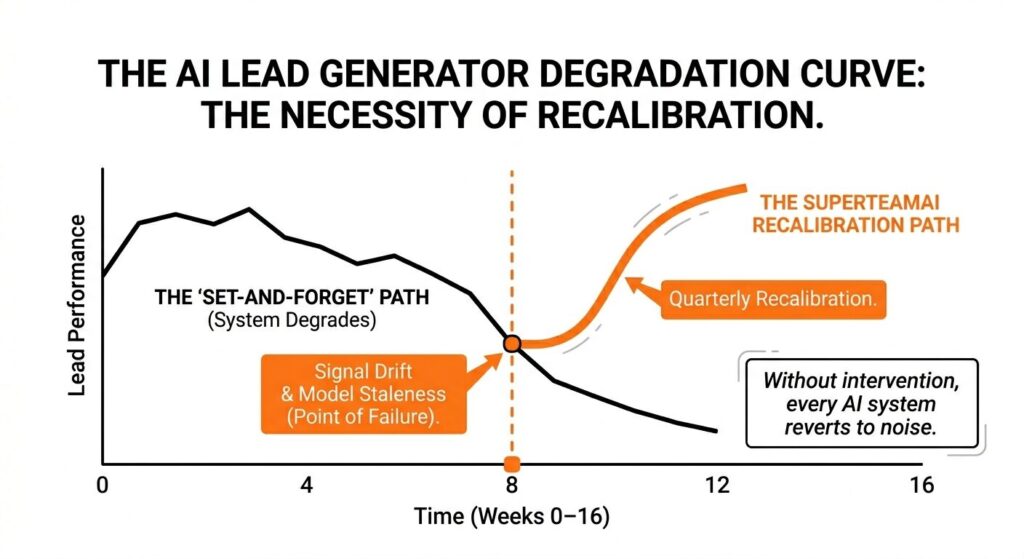
Most generators that underperform after an initial productive period are experiencing signal drift: the input signals the generator was configured to capture are no longer reflecting the intent patterns that precede conversion in the current market. Buyer behavior shifts. The content that attracted high-intent prospects six months ago now attracts a different audience. The third-party intent taxonomy the platform uses may have been updated in ways that change what the signals mean. [VERIFY: most AI lead generators show measurable output decline between weeks eight and twelve of deployment without signal taxonomy review and scoring recalibration]
Signal drift is diagnosable by comparing the firmographic and behavioral profile of leads the generator is surfacing against the profile of recently closed deals. If the two profiles have diverged, the capture and scoring configuration needs review.
The Recalibration Cadence Most Generators Skip
Recalibration involves reviewing the scoring model against recent conversion data, updating the signal taxonomy to reflect current intent patterns, and adjusting the qualification threshold based on what the pipeline data now shows about conversion likelihood.
Most teams configure a generator at deployment and do not revisit the configuration until output has already degraded significantly. By that point, the pipeline has accumulated weeks of low-quality leads that have consumed sales capacity without producing results. Building a quarterly recalibration review into the generator’s operating cadence prevents degradation from accumulating. Firms working with AI agent development partners typically include recalibration as part of the ongoing service agreement rather than treating it as a one-off deployment task.
If your AI lead generator has stopped producing consistent output, SuperteamAI diagnoses the failure layer and rebuilds the configuration around your current pipeline data.See how the rebuild works
Frequently Asked Questions
What is the difference between an AI lead generator and an AI lead generation tool?
An AI lead generation tool performs one function in the pipeline: it captures intent signals, scores leads, enriches contact records, or sequences outreach. An AI lead generator connects those functions with automated trigger logic so the pipeline runs without manual handoffs between steps. Most platforms provide the tools; building a generator requires configuring the connections between them.
How long does it take to build an AI lead generator?
A basic generator using an all-in-one platform can be configured in two to four weeks, assuming ICP definition and CRM data readiness have been addressed beforehand. A custom-built generator using specialized tools and proprietary scoring models typically requires eight to twelve weeks for initial deployment. Both timelines assume sufficient historical pipeline data exists to configure the scoring layer.
Does an AI lead generator replace the sales team?
No. A generator automates the identification, qualification, and initial outreach phases of the pipeline. The sales team handles responses, qualification conversations, and closing. The generator is designed to produce a higher volume of well-qualified leads for the sales team to work, not to remove human judgment from the sales process.
Why do most AI lead generators underperform after the first few months?
The most common causes are signal drift (the input signals no longer reflect current buyer intent patterns), model staleness (the scoring model has not been recalibrated against recent conversion data), and ICP configuration that was approximate at deployment and has never been refined. A quarterly recalibration review addresses all three.
What is the minimum data requirement to build a working AI lead generator?
You need sufficient historical pipeline data to configure the scoring layer: at minimum 500 to 1,000 historical leads with defined conversion outcomes, field completion rates above 70 percent on ICP criteria attributes, and reliable source attribution on closed deals. Without this baseline, the scoring model produces outputs that do not correlate with how leads actually convert in your pipeline.


