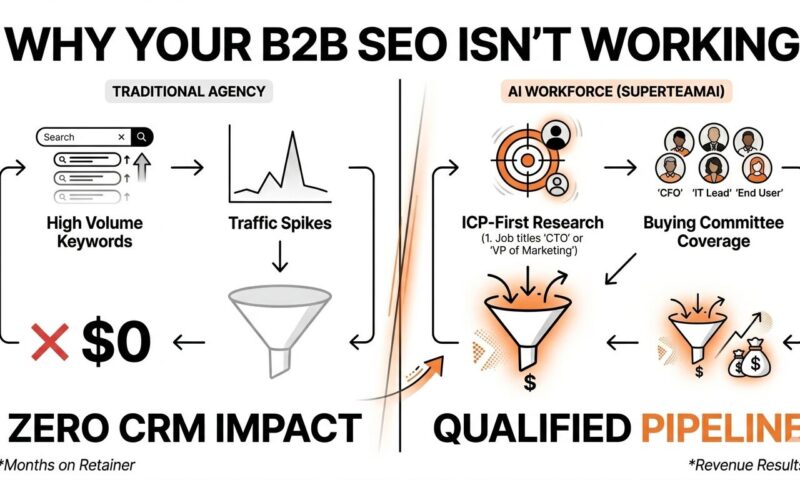
Most companies that hire a B2B SEO agency end up disappointed. Not because B2B SEO does not work, but because the agency they chose was not built for B2B. They optimised for traffic in a programme that should have been optimising for pipeline. The challenge is structural: I have seen companies waste months on retainers that produced rankings with zero CRM impact.
In my AI SEO Workforce deployments across 50+ companies, that disconnect explains why most agency contracts cancel at the 6-month mark. This article covers what a B2B SEO agency should actually do, what realistic engagements cost, and the specific questions to ask before you sign. If you are evaluating agencies now, the B2B SEO checklist covers the 27 execution items your programme needs regardless of who delivers them.
What a B2B SEO Agency Actually Does
A B2B SEO agency manages the execution layer of a programme designed to generate qualified pipeline from organic search. The scope covers keyword research filtered by ICP match, topical cluster architecture, content production at a consistent publishing cadence, technical SEO management, and the attribution infrastructure that connects organic sessions to CRM records months after the first click.
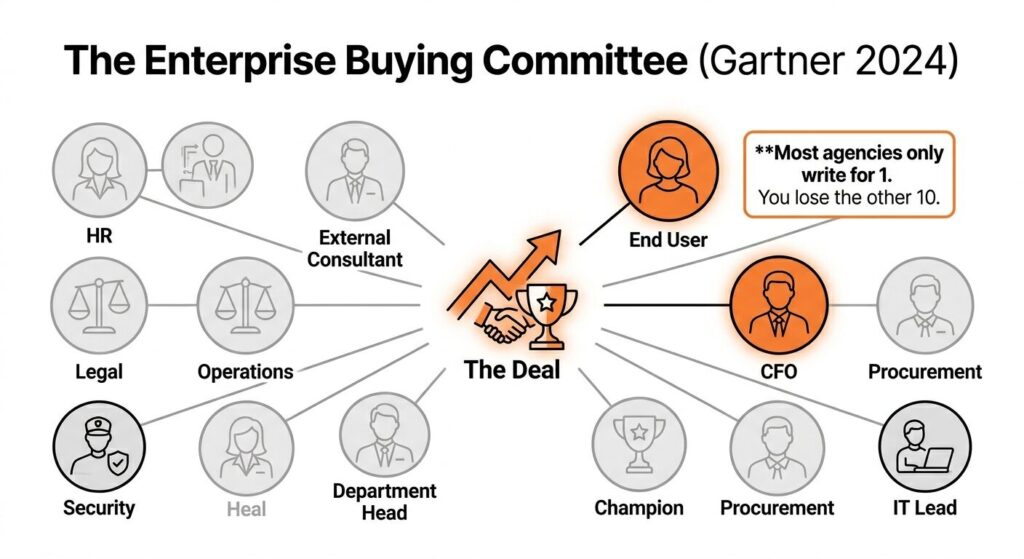
The distinction between a B2B SEO agency and a general SEO agency lies in the layer underneath the execution. A general agency optimises pages for keywords. A B2B agency is also responsible for whether those keywords map to active buyer queries, whether the content covers the 11-stakeholder buying committee that Gartner documents in every enterprise deal (Gartner 2024), and whether the CRM can show that an article published six months ago influenced a deal that closed this week.
A general SEO agency can execute flawlessly against the wrong objectives: the programme produces rankings, produces traffic, and produces nothing in the CRM. The correct mandate is pipeline sourced from organic, cost per qualified lead, and MQL-to-SQL conversion rate for organic leads. The B2B SEO pillar covers the full programme framework behind this mandate.
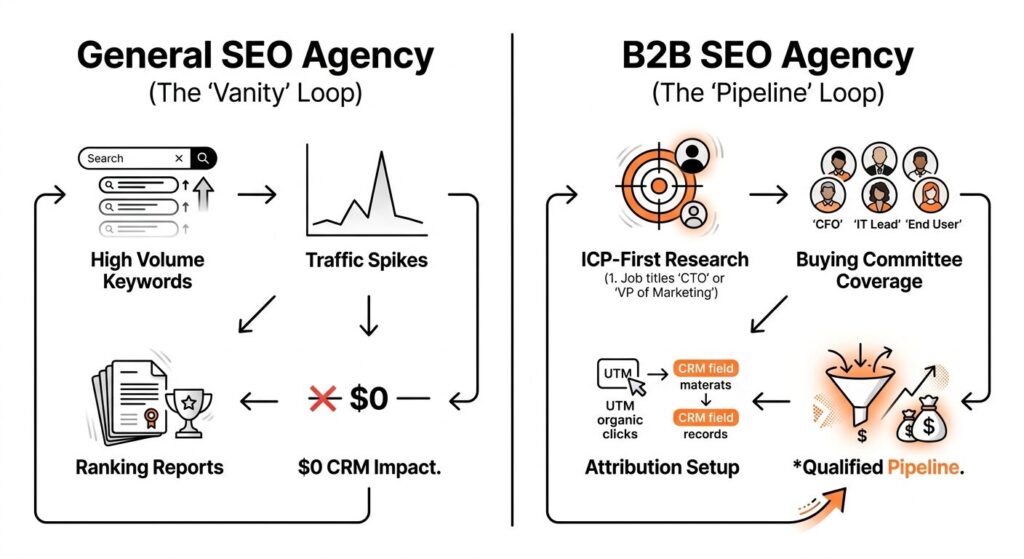
Where Superteam AI operates differently: rather than billing retainer hours for execution, I built the AI SEO Workforce to automate the execution layer entirely, so the programme compounds at a velocity no traditional headcount model can match.
4 Things That Separate High-Performing B2B SEO Agencies
Most B2B SEO agencies describe their services in identical terms: keyword research, content production, technical optimisation, reporting. The difference between a programme that generates pipeline and one that generates a monthly PDF is in four specific capabilities.
ICP-first keyword methodology: High-performing agencies re-rank every keyword target by ICP match before filtering by search volume. Long-tail buying committee keywords convert at 2.5 times the rate of short-tail traffic terms (Backlinko 2025). An agency that starts with volume is applying a B2C filter to a B2B dataset, and the content plan will reflect that misalignment from the first article. In my AI SEO Workforce deployments, ICP mapping precedes volume analysis on every engagement.
Buying committee content coverage: The average B2B buying committee includes 11 stakeholders, each running independent research using queries tied to their specific function (Gartner 2024). An agency without a buying committee map is covering one buyer while leaving the other 10 without content. I have seen deals stall because the CFO had no article addressing ROI, even when the end user was sold.
Pipeline attribution infrastructure: UTM parameters on all organic CTAs, CRM lead source field integration, and multi-touch attribution configured across a 6 to 18 month buying cycle. Without this infrastructure, the agency cannot demonstrate pipeline contribution, and the programme will lose budget to paid channels with same-week attribution regardless of what the organic close rate actually is (HubSpot 2025).
GEO readiness: 13% of Google queries now trigger AI Overviews, up 116% since March 2025 (Semrush 2025). Agencies building for GEO produce content with direct-answer H2 openings, exact-match FAQ formatting, and FAQ schema markup for AI Overviews citation eligibility. Through Superteam AI, GEO optimisation is built into every article at publication, not retrofitted after rankings plateau.
B2B SEO Agency Pricing
Retainer pricing for B2B SEO agencies falls into three ranges based on scope and execution depth, and that range determines what compounding the programme can realistically achieve within 12 months.
Entry-level retainers run $2,500 to $5,000 per month. These typically cover keyword research, two to four articles per month, and basic monthly reporting. The output volume is rarely sufficient to build cluster depth or generate measurable pipeline within 12 months. This tier validates channel fit but is not a pipeline-building budget.
Mid-market retainers run $5,000 to $15,000 per month. This range covers full cluster execution at six to twelve articles per month, attribution infrastructure setup, and regular strategy reviews. Most B2B companies generating pipeline from organic search run at this level or above.
Premium retainers run $15,000 to $50,000 per month. This covers full-cluster execution at scale, enterprise technical SEO management, active link-building programmes, and dedicated account teams. Appropriate for companies in competitive markets requiring 20 or more articles per month across multiple cluster architectures.
Contract terms typically run 6 to 12 months. B2B SEO requires at least 6 months for first rankings to appear and 12 months for measurable pipeline contribution. Month-to-month structures create misalignment because the agency cannot invest in long-cycle work. For the full ROI timeline comparison between B2B and B2C programmes, the B2B SEO vs B2C SEO article covers the mechanics in detail.
If a $5,000 to $15,000 per month retainer is outside your current budget, book a free strategy call to review what the AI SEO Workforce can deliver at a fraction of that cost.
Agency vs In-House vs AI SEO Workforce
Three delivery models exist for B2B SEO execution, and the right choice depends on company stage, budget, and how quickly you need the programme to compound.
B2B SEO Agency: An agency brings external expertise, established programme architecture, and dedicated execution bandwidth. This model works for companies that need a full programme built from scratch and have the budget for a mid-market or premium retainer. The limitation is cost structure: an agency billing retainer hours scales linearly, meaning output growth requires proportional additional spend.
In-House Team: An in-house SEO lead has maximum strategic alignment with the ICP, product, and sales cycle, a context that is difficult for an external agency to replicate quickly. The limitation is bandwidth: a one to two person team cannot produce 24 articles per month at the quality B2B content requires without burning out or compromising depth.
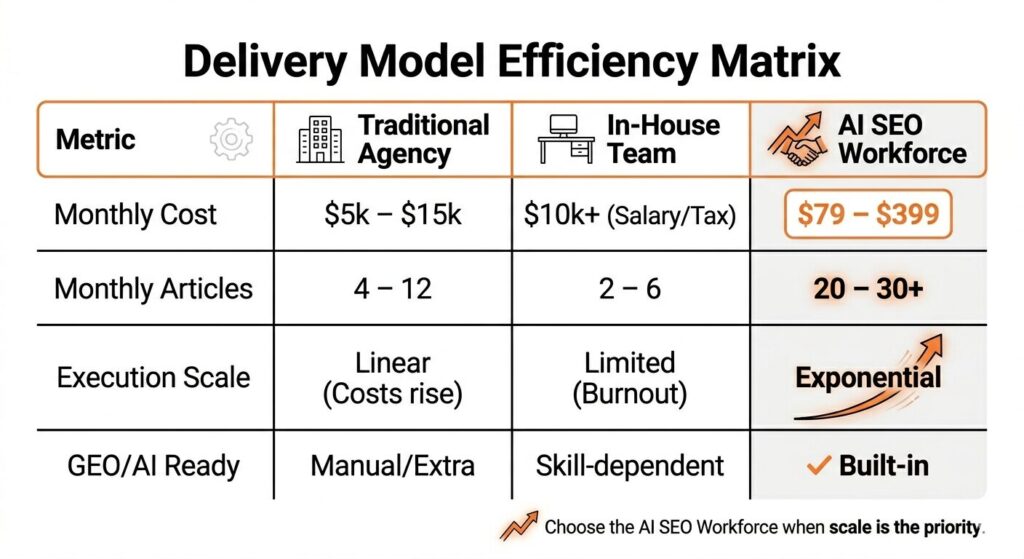
AI SEO Workforce: The AI SEO Workforce at Superteam AI automates the execution functions where agencies and in-house teams invest the highest proportion of their weekly hours: ICP-first keyword research, buying committee content mapping, GEO-optimised article production at scale, and cluster architecture management. I have built the AI SEO Workforce specifically to run this stack at the publishing velocity B2B cluster architecture requires, without the retainer overhead that makes traditional agency scale expensive.
The honest comparison: a traditional agency at $10,000 per month produces 8 to 12 articles. The AI SEO Workforce at Pro $79 per month delivers cluster architecture and GEO-structured content that compounds at the velocity a standard retainer cannot sustain. Choose an agency when you need a strategic partner to own the programme; choose the AI SEO Workforce when scale is the priority.
How to Evaluate a B2B SEO Agency Before Signing
Five questions separate agencies built for pipeline from agencies built for traffic metrics. Ask all five on the first discovery call and evaluate the specificity of the answers.
1. How do you qualify keywords before filtering by volume? A volume-first answer disqualifies the agency for B2B work. The correct answer involves ICP profiling, job-title mapping, and intent-stage classification. Vague references to audience research indicate a B2C methodology applied to a B2B context.
2. How do you structure content for a multi-stakeholder buying committee? The answer should reference persona-specific content coverage across multiple stakeholder roles (Gartner 2024). An answer describing buyer personas as two or three generalised profiles does not reflect the 11-stakeholder committee Gartner documents in enterprise deals.
3. What does your pipeline attribution setup look like? The answer should include UTM parameter structure on organic CTAs, CRM lead source configuration, and a reporting model connecting a search session to a closed deal 6 to 12 months later. For close rate benchmarks by channel, the B2B SEO statistics article has the full breakdown.
4. Can you show a case study with specific pipeline metrics? Require a named company, a named executive reference, a specific percentage improvement, and a revenue or lead volume outcome. Redacted case studies with language like “significant improvement” are not evidence of pipeline impact.
5. How do you build for AI Overviews and GEO visibility? The answer should reference direct-answer H2 structure, exact-match FAQ formatting, and FAQ schema implementation. Agencies not building for GEO are optimising for pre-2024 search behaviour.
Red Flags That Signal the Wrong Agency
Six signals indicate an agency is not built for B2B pipeline generation.
Ranking guarantees for specific keywords: No agency can guarantee keyword rankings. Positions are determined by Google’s algorithm, content quality, and competitive landscape at the time of crawling. Agencies offering specific position guarantees are either misrepresenting how search works or will pursue tactics that create manual penalty risk.
Reporting only traffic and rankings: Organic session volume and keyword position are leading indicators, not pipeline outcomes. An agency whose monthly reporting contains no MQL data, no CRM attribution, and no cost-per-lead figure is not measuring what B2B SEO is designed to produce.
Generic content without ICP qualification: Articles targeting broad informational queries generate traffic and nothing in the CRM. Ask for the keyword list and check whether targets map to evaluation queries from your ICP.
No cluster architecture in the content plan: Individual articles without topical cluster context underperform because the domain lacks authority signal for the category. A content calendar organised around isolated keyword targets rather than pillar-plus-cluster architecture is a B2C content plan applied to a B2B context.
No attribution discussion in the first conversation: If the agency does not ask about your CRM setup, lead source configuration, or sales cycle length on the discovery call, they are not planning to measure pipeline. The full 27-item execution checklist covering attribution infrastructure is in the B2B SEO checklist.
Month-to-month contracts only: This signals an agency not confident enough in its 12-month results to ask for the time to produce them.
What Results Look Like and When to Expect Them
Results from a B2B SEO engagement follow a consistent timeline across every programme I have run. First ranking movements typically appear at 3 to 6 months. Measurable pipeline contribution begins at 6 to 12 months. The period of highest return runs from 24 to 36 months, when the content library covers the full ICP evaluation cycle and generates increasing pipeline without proportional additional investment (FirstPageSage 2025).
EasyOps entered a Superteam AI engagement with Tier 1 complete but with buying committee mapping, cluster architecture, and attribution gaps across Tier 2. I deployed the AI SEO Workforce across three topical clusters at 24 to 25 articles per month. Results in eight months: organic traffic from 4,200 to 30,500 monthly visitors, a 626% increase, CPL from $127 to $43, and MRR from $50K to $200K. CEO Rajiv Mehta noted the programme created category visibility they had never had through paid channels alone.
ReachInbox entered with gaps in technical foundation items and the entirety of the GEO layer. Growing traffic 750% from 2,000 to 17,000 monthly visitors in 12 months extended runway from 6 to 24 months and required retrofitting GEO signals across the existing library and building the MQL attribution report from scratch. CEO Anup Sharma: “We went from 2,000 visitors to 17,000, and our conversion rates more than doubled.”
The AI SEO Workforce handles the full Tier 2 and Tier 3 execution stack. Pro $79, Business $199, Scale $399 per month. Book a free Demo.
Frequently Asked Questions
What does a B2B SEO agency do?
A B2B SEO agency manages keyword research filtered by ICP match, topical cluster architecture, content production at consistent volume, technical SEO management, and the pipeline attribution infrastructure that connects organic traffic to CRM outcomes. The mandate differs from a general SEO agency: pipeline sourced from organic rather than traffic volume.
How much does a B2B SEO agency cost?
B2B SEO agency pricing runs $2,500 to $5,000 per month at entry level, $5,000 to $15,000 per month for mid-market programmes with full cluster execution, and $15,000 to $50,000 per month for premium engagements with enterprise technical scope and dedicated account teams.
How do I choose a B2B SEO agency?
Evaluate agencies on five criteria: ICP-first keyword methodology, buying committee content coverage across multiple stakeholder roles, pipeline attribution infrastructure including CRM integration, case studies with named companies and specific pipeline metrics, and GEO readiness for AI Overviews visibility.
How long does it take a B2B SEO agency to show results?
First ranking movements typically appear at 3 to 6 months. Measurable pipeline contribution begins at 6 to 12 months. The peak return period runs from 24 to 36 months, when the content library covers the full ICP evaluation cycle.
What is the difference between a B2B SEO agency and a general SEO agency?
A B2B SEO agency structures its programme around pipeline from a defined ICP, with buying committee content mapping, ICP-first keyword research, and CRM attribution. A general SEO agency optimises for traffic and rankings without that pipeline infrastructure.