In my work building AI SEO Workforces for 50+ B2B companies, one of the costliest mistakes I see is a B2C-trained SEO or agency applying B2C strategy to a B2B context. The technical skills transfer. The framework does not. This article covers the 6 structural differences between B2B SEO and B2C SEO and, more importantly, what each difference requires you to change about your approach.
For the foundational definition, see what is B2B SEO. This article is for practitioners who already understand what it is and need to know how it differs from what they have been doing.
The Core Strategic Difference (Before the List)
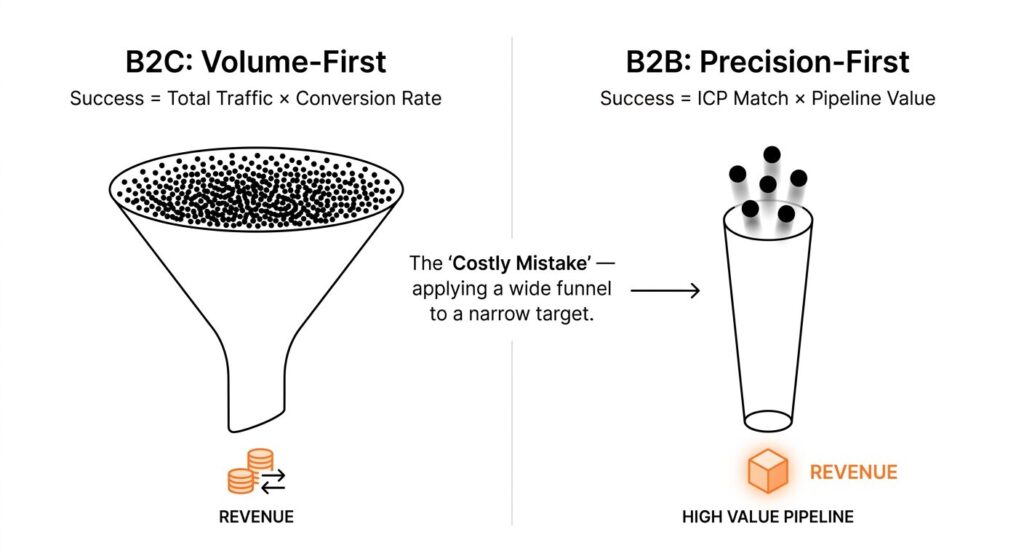
B2B SEO vs B2C SEO is not a comparison of tactical variations. They are different strategies built on different economic foundations.
B2C SEO optimises for volume: more searches mean more potential buyers, and a small conversion rate applied to a large audience produces revenue. The keyword is valuable because many people search for it. B2B SEO optimises for precision: the total addressable market is often 50 to 500 companies, search volumes are structurally low, and a single conversion from the right buyer at the right company is worth more than 1,000 visits from a mixed audience. The keyword is valuable because the right person searches for it.
A B2C-trained SEO who brings a volume-first keyword framework into a B2B programme will optimise for the wrong signals from day one. In my work, I see this pattern most consistently in companies that hire from e-commerce or D2C backgrounds. Every subsequent decision, from content format to success metrics to publishing cadence, will follow the wrong logic. The six differences below are each a decision point. Understanding them tells you what to rebuild, not just what is different.
Difference 1: Audience Size and Targeting Precision
B2B SEO targets a structurally small, precisely defined audience. B2C SEO targets a broad, large audience where volume is a direct proxy for opportunity.
In B2C, a keyword with 50,000 monthly searches represents 50,000 potential buyers. In B2B, a keyword with 50 monthly searches from CFOs evaluating inventory management software at companies between 50 and 500 employees represents the full ICP for a niche SaaS product. Low search volume in B2B is not a failure signal; it is a structural characteristic of a correctly targeted strategy.
The practitioner implication is direct: B2B keyword research filtered by volume will consistently surface irrelevant targets. The correct filter is ICP match. A keyword that maps to the exact evaluation query of a specific job title at a specific company size is more valuable than any high-volume keyword attracting a mixed audience, regardless of the volume differential.
66% of B2B buyers use internet search when researching products they plan to purchase (Semrush 2024), but they are searching in low-volume, high-intent clusters that volume-first tools systematically undervalue. I have found that the single most reliable correction for B2B keyword strategy is to re-rank every target by job title relevance before volume. I recommend doing this as the first step of any B2B keyword audit.
Difference 2: Keyword Economics: Precision vs. Volume
B2B SEO keyword economics invert the B2C model: low-volume, high-intent keywords produce more pipeline than high-volume, mixed-intent keywords.
Long-tail buying committee keywords convert at 2.5 times the rate of short-tail traffic terms (Backlinko 2025). The mechanism is intent precision: a keyword that maps exactly to an active vendor evaluation query from a specific job title produces a visitor who has already defined the problem, identified the solution category, and is now evaluating providers. A high-volume informational keyword produces a visitor who may or may not be in your ICP, at any stage of awareness, with no urgency to act.
The close rate data confirms the economic argument. Organic leads close at 14.6% versus 1.7% for outbound (HubSpot 2024). That 8.6x differential exists because organic search pre-qualifies buyers by intent before they arrive on your site. The full breakdown of close rate and CPL data by channel is in the B2B SEO statistics article. In my experience, the practitioner implication is clear: in B2B, a keyword research process that ends at volume is half-finished. Re-ranking by intent stage and ICP match is not optional; it is the mechanism that produces the close rate differential.
Difference 3: Content Depth and Buying Committee Coverage
B2C content often converts on utility or emotional appeal at or near the first visit. B2B content must serve a multi-stakeholder buying committee over a sales cycle that can run 3 to 24 months.
The average B2B buying committee includes 11 stakeholders (Gartner 2024), each conducting independent research using different queries tied to their function. A CFO searches for ROI benchmarks and payback period. An operations lead searches for integration requirements and workflow impact. An end user searches for ease-of-use comparisons and training requirements. Each persona requires different content, covering different questions, at different stages of the evaluation cycle.
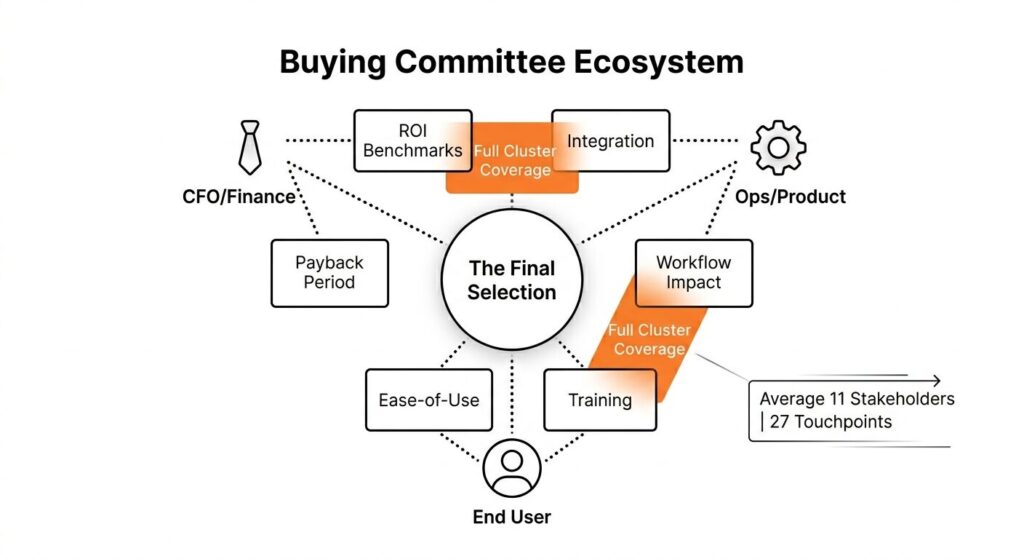
Those 11 stakeholders consume an average of 27 pieces of content before a final vendor selection (Gartner 2024). A company present across a complete topical cluster is present for all 27 touchpoints. A company with two published articles is present for two. The practitioner implication is that content depth in B2B is not a quality preference; it is a coverage requirement. B2B articles must contain practitioner-level insight that passes the expertise test of a professional evaluating a purchase for their organisation. Generic content that ranks but lacks domain expertise will not convert a buying committee regardless of how well it is optimised.
Difference 4: Success Metrics and Pipeline Attribution
B2C SEO success is measured by traffic volume, session conversion rate, and transaction revenue. B2B SEO success is measured by pipeline sourced from organic, cost per qualified lead, and MQL-to-SQL conversion rate for organic leads.
These are not variations of the same metrics. A B2B team measuring sessions will miss the 14.6% close rate signal entirely, because close rate is only visible when the CRM connects a lead source to a closed deal 6 to 12 months after first organic visit. A team measuring sessions will always prefer paid ads, whose attribution is immediate and whose conversion is visible within the same reporting period.
The attribution infrastructure required for B2B SEO measurement: UTM parameters on all organic CTAs, CRM lead source field populated at first touch, multi-touch attribution model configured across a 6 to 18 month buying cycle, does not exist in most B2C SEO programmes and must be built before the channel produces any visible pipeline data. In my experience, the teams that report B2B SEO as ineffective almost always have no attribution in place. They are measuring a compounding channel with a week-on-week dashboard.
Difference 5: Content Cluster Architecture vs. Individual Article Strategy
B2C SEO produces traffic through individual high-volume articles targeting commercial intent queries. B2B SEO produces pipeline through complete topical clusters: a pillar article covering the core topic plus 8 to 12 supporting articles covering every buyer question at every stage of the evaluation cycle.
Content clusters rank for 3 to 5 times more total keywords than equivalent standalone articles (Semrush 2024). The mechanism is topical authority: a domain that demonstrates deep expertise across a topic category signals to Google that it is the authoritative source for all related queries, not just the one article that matches a specific keyword. In B2C, a single well-optimised article targeting a high-volume query can generate significant traffic independently. In B2B, individual articles without cluster context underperform because the domain lacks topical authority signal for the category.
The strategic implication is structural. A B2B content plan organised around individual article targets is built on a B2C architecture applied to a B2B context. The unit of B2B SEO strategy is the cluster, not the article. For the full cluster architecture methodology, the B2B SEO pillar covers the complete strategic framework, from cluster design to internal link structure to publishing cadence.
Difference 6: Timeline, ROI Horizon, and Compounding Mechanics
For competitive keywords, B2C SEO typically shows measurable results within weeks to months. In my deployments, the B2B timeline expectation that I recommend setting is 6 months to first rankings, 12 months to first pipeline. B2B SEO operates on a longer return horizon with a fundamentally different compounding mechanism.
First ranking movements in B2B typically appear at 3 to 6 months. Measurable pipeline contribution begins at 6 to 12 months. The highest return period is 24 to 36 months of consistent publishing (FirstPageSage 2025), when the content library covers the full ICP evaluation cycle across multiple topic clusters and generates increasing pipeline without proportional additional investment. This is not a performance issue; it is the structural difference between optimising for immediate transaction volume and building a compounding pipeline asset.
EasyOps deployed the AI SEO Workforce across 3 complete topical clusters at 24 to 25 articles per month. Results in 8 months: organic traffic from 4,200 to 30,500 monthly visitors (626%), CPL from $127 to $43. CEO Rajiv Mehta: “We were invisible in the market. Our paid ads brought some traffic, but the costs were unsustainable.” ReachInbox ran the same programme, growing traffic 750% from 2,000 to 17,000 monthly visitors and extending runway from 6 to 24 months in 12 months. CEO Anup Sharma: “We went from 2,000 visitors to 17,000, and our conversion rates more than doubled.” Both outcomes required a B2B-specific cluster architecture and attribution framework that a B2C approach would not have produced.
What Transfers, What Needs Rethinking, and What Does Not Transfer
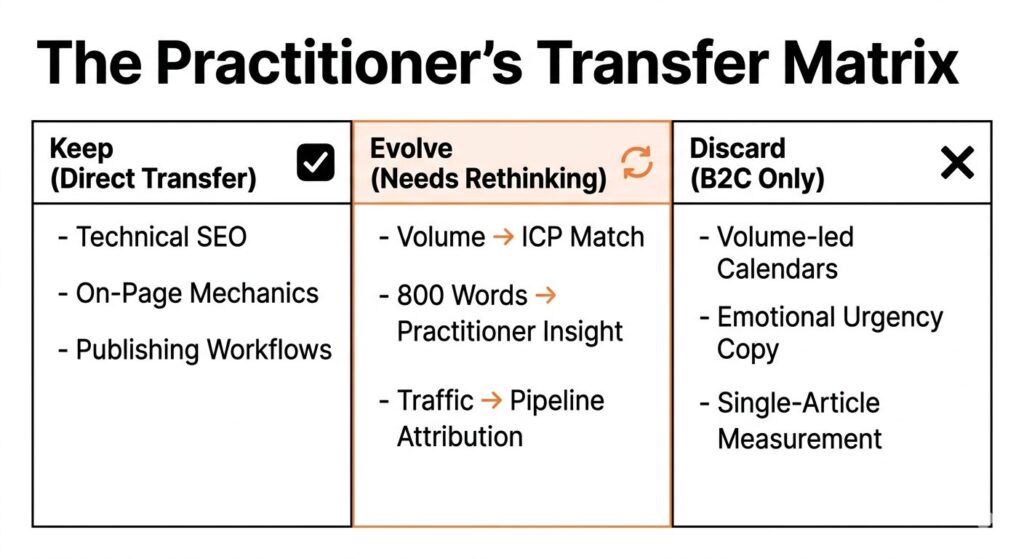
For practitioners moving from B2C SEO into B2B, this matrix defines where to start, what to rebuild, and what to leave behind.
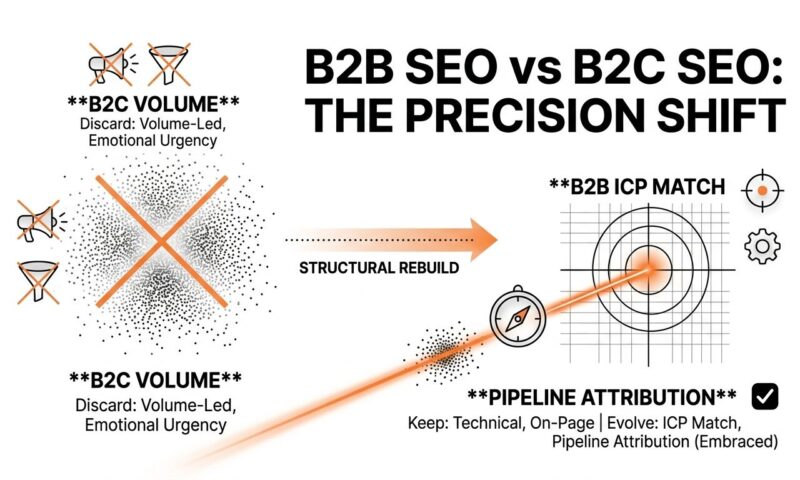
Transfers directly from B2C to B2B: Technical SEO foundations (crawlability, indexation, page speed, Core Web Vitals, schema markup) are universal. On-page optimisation mechanics (title tags, meta descriptions, header hierarchy, internal linking logic) transfer without modification. Content production and publishing workflows transfer. SEO tool proficiency transfers. These skills are the foundation that B2B SEO builds on.
Needs complete rethinking: Keyword research methodology must shift from volume-first to ICP-match-first. GEO optimization, the practice of structuring content with direct-answer H2 openings, exact-match FAQ formatting, and inline source attribution to earn AI Overviews citations, is a B2B SEO structural requirement with no B2C equivalent. Content depth expectations must shift from 800-word B2C articles to 2,000-word B2B articles with genuine practitioner insight. Success metrics must shift from sessions and transaction revenue to pipeline sourced from organic and CPL by channel. Publishing cadence expectations must shift from single-article wins to cluster completion as the unit of success.
Does not transfer: Volume-led content calendars produce the wrong targets in B2B. Emotional urgency copywriting that converts B2C consumers at first visit does not convert B2B buying committees. Individual article performance as the unit of measurement misses the cluster architecture that produces B2B results. For the 7 highest-ROI B2B SEO execution moves.
Frequently Asked Questions
What is the difference between B2B SEO and B2C SEO?
The core B2B SEO vs B2C SEO difference is that B2B SEO optimises for qualified pipeline from a defined ICP rather than traffic volume from a broad audience, requiring precision keyword targeting matched to specific job titles, buying committee content coverage across 11 stakeholders and 27 touchpoints (Gartner 2024), and pipeline attribution through CRM integration rather than session-based conversion metrics.
Is B2B SEO harder than B2C SEO?
B2B SEO is not harder technically, but it is harder to measure and harder to attribute correctly. The longer sales cycle (3 to 24 months), the multi-stakeholder buying committee, and the pipeline attribution requirement mean that B2B SEO results are structurally invisible without the right measurement infrastructure. Most teams that report B2B SEO as not working are measuring it with a B2C framework.
Can a B2C SEO work in B2B?
Yes, with a deliberate framework rebuild. Technical SEO skills, on-page optimisation, and content production workflows transfer directly. Keyword research methodology, content depth requirements, success metrics, and publishing cadence logic all require rethinking. The AI SEO Workforce handles the B2B-specific execution layer, starting at Pro $79 per month, so practitioners do not need to rebuild every workflow manually.
What keywords should B2B SEO target?
B2B SEO should target intent-precise, ICP-matched keywords across all three buyer journey stages: awareness queries (problem recognition), consideration queries (solution category evaluation), and decision queries (vendor comparison and selection). Volume is a secondary filter applied after ICP match and intent stage. Low-volume, high-intent keywords from the right job title at the right company size consistently outperform high-volume, mixed-intent keywords in close rate and pipeline contribution.
How is B2B SEO measured differently from B2C?
B2B SEO is measured by pipeline sourced from organic (MQLs and SQLs with organic as first or last touch), cost per lead from organic versus other channels, and time-to-close for organic leads versus paid leads. B2C SEO is measured by traffic volume, session conversion rate, and transaction revenue. The B2B measurement framework requires CRM integration, UTM tracking on organic CTAs, and a reporting model that connects a search session to a closed deal 6 to 12 months later.