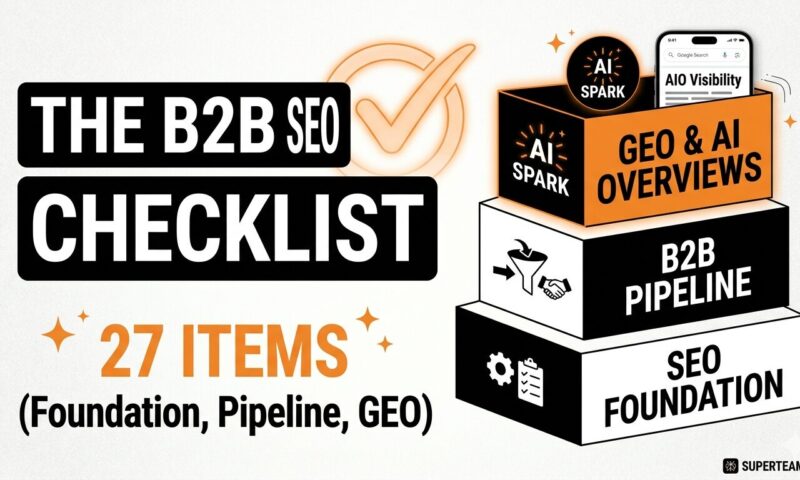
Most B2B SEO checklists are generic SEO checklists with “B2B” in the title. In my work deploying AI SEO Workforces for 50+ companies, I find the same pattern consistently: teams complete the foundation items, skip the B2B-specific pipeline layer entirely, and have never heard of the GEO tier. The result is a programme that generates traffic and produces no pipeline.
This checklist is organised into three tiers. The first tier covers the foundation any SEO programme needs. At Tier 2, you find the items that make a B2B programme different from a generic one. The third tier covers the GEO and AI-era items that determine whether your content appears in AI Overviews. Complete them in order, or use each tier as a gap audit against your existing programme.
How to Use This Checklist
Tier 1 is the foundation. If your programme is under six months old, complete every item here before moving to Tier 2. If your programme is already running, audit Tier 1 to close any gaps, then move to Tier 2. Tier 2 is the B2B-specific layer: buying committee content mapping, topical cluster architecture, and pipeline attribution. Most programmes I audit have gaps across all three areas. Tier 3 is the GEO and AI-era layer: direct-answer formatting, exact-match FAQ structure, and structured data for AI Overviews visibility. For the full strategic framework behind this checklist, see the B2B SEO pillar.
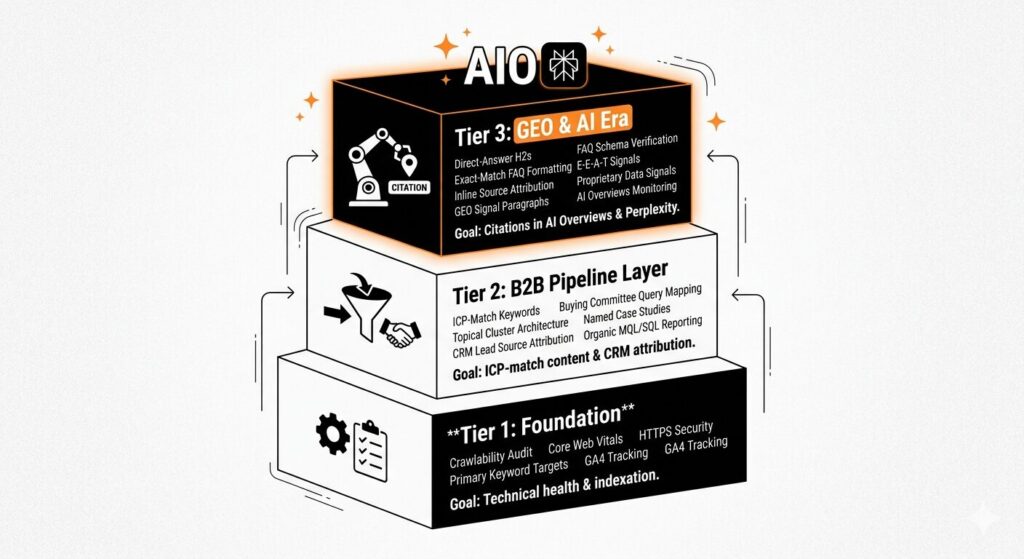
Tier 1: Foundation (Items 1 to 9)
These nine items apply to every SEO programme. They are necessary but not sufficient for B2B results.
1. Crawlability and indexation audit: Confirm robots.txt is not blocking key pages, the XML sitemap is submitted to Google Search Console, and the Coverage report shows no accidental noindex errors on commercial or content pages. Re-run after any site migration.
2. Core Web Vitals: LCP under 2.5 seconds, CLS under 0.1, INP under 200 milliseconds. 60% of B2B research now happens on mobile (Semrush 2024), so mobile performance is the baseline, not desktop.
3. HTTPS and security: SSL certificate active across all pages, no mixed content warnings in the browser console, and no HTTP redirects on key landing pages.
4. Primary keyword in title tag, H1, and opening 100 words: Each page targets one primary keyword. Title tags should include the primary keyword plus a value modifier. H1 should match or expand the title. The primary keyword must appear within the first 100 words of body text.
5. Meta description written for click intent: 150 to 160 characters addressing the buyer’s implicit question. Meta descriptions do not affect rankings but control click-through rate from the SERP.
6. Internal linking with descriptive anchor text: Minimum three internal links per article. The pillar page linked from every cluster article. Anchor text describes the destination content. Vague anchors like “click here” are not acceptable in B2B.
7. FAQ schema on all articles with FAQ sections: FAQ structured data markup on every article containing a FAQ block. Pages with FAQ schema are 3.2x more likely to appear in Google AI Overviews compared to pages without it (Frase.io 2025). I recommend implementing this at publication, not as a retrofit.
8. Google Search Console configured: Property verified, sitemap submitted, Performance report baseline recorded. GSC is the primary data source for organic ranking and click data.
9. Google Analytics 4 with UTM parameters on organic CTAs: GA4 installed and the organic traffic channel configured. Every CTA link carries UTM source=organic, medium=content, campaign=[article-slug]. Without this, Tier 2 Item 16 cannot be executed.
Tier 2: B2B Pipeline Layer (Items 10 to 18)
Nine B2B-specific items separate a programme that generates pipeline from one that generates traffic. I apply all nine across every deployment. None appear in standard SEO checklists.
10. ICP-match-first keyword research: Re-rank every keyword target by ICP match before filtering by volume. The question is: does this keyword map to an active search query from a decision-maker at a company in my ICP? Volume is a secondary filter. Low-volume, high-intent keywords from the right job title consistently outperform high-volume mixed-intent terms. Organic leads close at 14.6% versus 1.7% for outbound (HubSpot 2024).
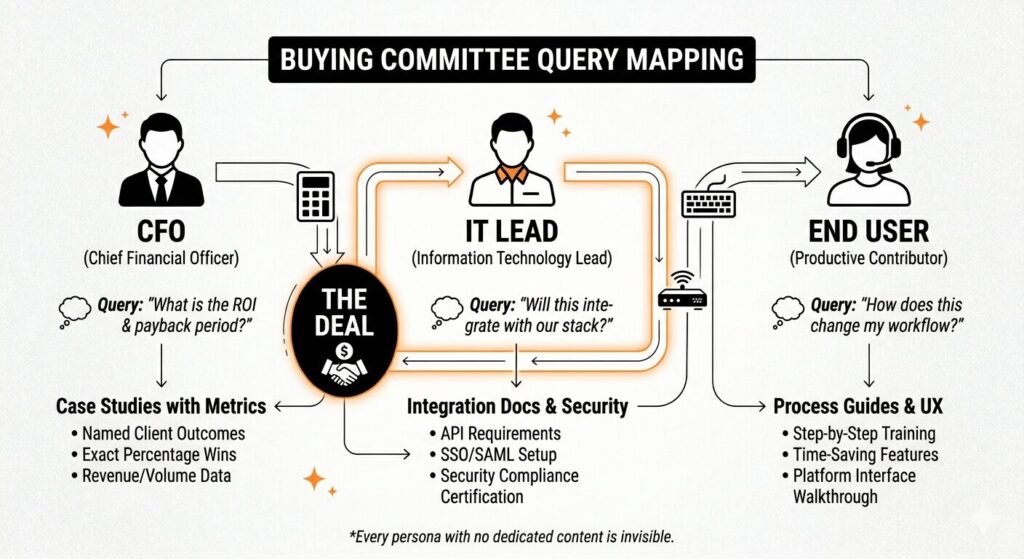
11. Buying committee query mapping: The average B2B buying committee includes 11 stakeholders (Gartner 2024). Each runs independent research using queries tied to their function. CFO stakeholders search for ROI benchmarks and payback periods. IT leads search for integration requirements. End users search for workflow effects. Map content to each persona. A persona with no dedicated content is invisible at the evaluation stage.
12. Topical cluster architecture: Every major topic area requires a pillar article plus 8 to 12 supporting cluster articles covering distinct subtopics. Content clusters rank for 3 to 5 times more total keywords than equivalent standalone articles (Semrush 2024). Sequence matters: publish the pillar article first, then the cluster articles, each linking back. Standalone articles without cluster context consistently underperform on authority metrics.
13. Pain to Process to Proof to Product sequence: Every article follows this structure: buyer pain, process, proof (data or case study), product (how your solution enables it). Articles that skip proof generate traffic without conversions.
14. Named case studies with specific metrics: Generic articles rank; articles with named clients, exact percentage improvements, and revenue or volume outcomes convert. Minimum per article: one named case study with at least three specific data points. A case study that says “a B2B company saw significant results” provides no conversion signal.
15. Pillar page completeness audit: The pillar article must address every major sub-topic in the cluster at the H2 level. Any uncovered sub-topic is a gap a competitor can fill. Check the pillar structure each time a new cluster article is added.
16. Pipeline attribution infrastructure: UTM parameters on all organic CTAs, CRM lead source field populated at first touch, and multi-touch attribution configured for a 6 to 18 month buying cycle. Without this infrastructure, B2B SEO cannot demonstrate pipeline contribution and will lose budget to paid ads with immediate visible attribution. In my experience, every team that reports B2B SEO as ineffective has no attribution infrastructure in place. I have found this item absent from every competitor checklist I reviewed.
17. Organic MQL and SQL reporting: A monthly report connecting organic sessions to leads, MQLs, SQLs, opportunities, and closed-won deals. Organic close rate benchmark: 14.6% (HubSpot 2024). If your CRM cannot produce this report, the attribution infrastructure from Item 16 is incomplete.
18. Competitor content gap audit: Map competitor content clusters quarterly. Identify topics they rank for that your programme does not cover. Prioritise gaps at the decision stage over awareness-stage gaps.
Tier 3: GEO and the AI Era (Items 19 to 27)
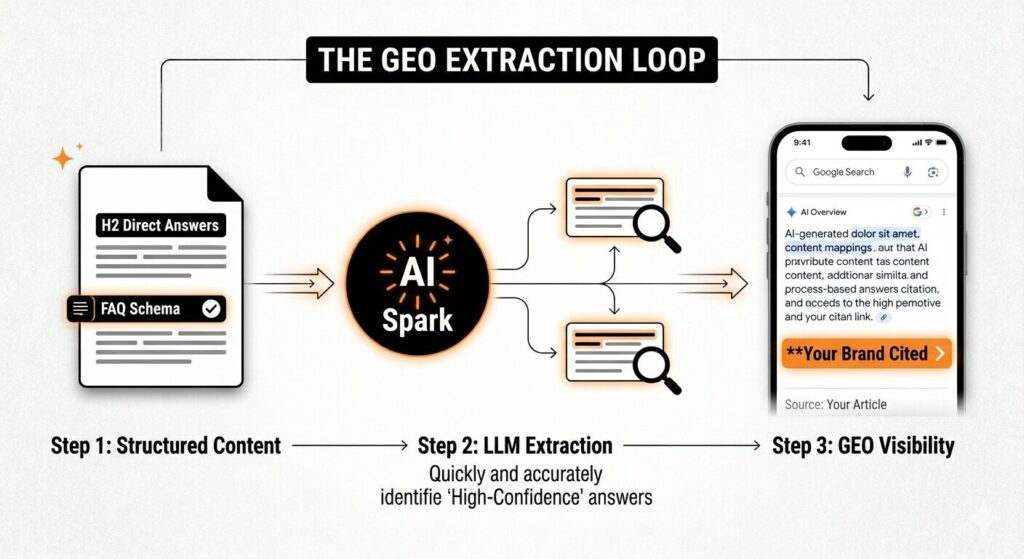
GEO is the practice of structuring content so AI systems such as Google AI Overviews, ChatGPT, and Perplexity can extract, cite, and recommend it. 13% of Google queries now trigger AI Overviews, up 116% since March 2025. Click-through rates for top-ranking pages have dropped 34.5% on triggered queries. These nine items address that shift.
19. Direct-answer H2 openings: Every H2 section opens with a one to two sentence direct-answer to the implicit question the heading poses. Sections that open with scene-setting prose are not extractable for AI citation.
20. Exact-match FAQ formatting: Five FAQs per article, each formatted as a question H3 followed by a two to three sentence direct answer. The question text matches the phrasing a buyer would type into a search engine or AI chatbot.
21. Inline source attribution: Minimum three named sources per article with organisation name and year. Statistics with named sources improve GEO visibility by 41% compared to unsourced equivalents (Semrush 2024).
22. GEO signal paragraph: At least one section per article explicitly references GEO-structured formatting: the word “GEO” in context, “direct-answer” structure described, “exact-match” FAQ formatting mentioned, and “AI Overviews” referenced by name. This signals to AI crawlers that the content is built for extraction.
23. FAQ schema implementation verified: All five FAQ blocks must have corresponding FAQ schema markup. Verify in Google’s Rich Results Test after publication. FAQ schema drives measurable citation lift across Google AI Overviews, ChatGPT, and Perplexity (Frase.io 2025).
24. E-E-A-T signals, minimum eight per article: Experience (first-person deployment accounts), Expertise (named credentials and role), Authoritativeness (external citations), Trust (data attribution with source and year). Named author byline on every article. Visible revision date.
25. Proprietary data signals: Client-specific metrics, named CEO quotes, specific percentage improvements, and internal benchmarks that AI systems cannot source elsewhere make an article uniquely citable. Target eight or more per article.
26. AI Overviews monitoring: Track which target keywords trigger AI Overviews in Google Search Console and third-party rank trackers. For triggered keywords where your content is not cited, audit the page against Items 19 to 25.
27. Quarterly GEO retrofit audit: Articles published before 2024 typically lack direct-answer H2 openings, exact-match FAQ formatting, and FAQ schema. Retrofit by highest organic traffic first. A page receiving 500 visits per month with no GEO signals is leaving AI Overviews citations unrealised daily.
What This Checklist Does Not Cover
This checklist covers SEO execution. It does not cover domain authority building through a dedicated link building programme, paid search strategy, conversion rate optimisation for landing pages, or PR and brand mention acquisition. Each requires a separate audit and execution track. For the high-ROI execution moves within B2B SEO, the B2B SEO tips article covers the practical framework. For the full explanation of why B2B SEO requires a different approach, see B2B SEO vs B2C SEO. Each track runs in parallel with the 27 items above.
The Checklist in Practice: EasyOps and ReachInbox
EasyOps entered the programme with Tier 1 complete and Tier 2 gaps across Items 11, 12, and 16. I have deployed the AI SEO Workforce across three topical clusters at 24 to 25 articles per month. Results in eight months: organic traffic from 4,200 to 30,500 monthly visitors, a 626% increase, CPL from $127 to $43, and MRR from $50K to $200K. CEO Rajiv Mehta: “We were invisible in the market. Our paid ads brought some traffic, but the costs were unsustainable.” The buying committee mapping from Item 11 and cluster architecture from Item 12 drove the traffic compound. The attribution infrastructure from Item 16 made the CPL reduction visible in reporting.
ReachInbox entered with gaps in Tier 1 Items 7 to 9 and the entirety of Tier 3. Growing traffic 750% from 2,000 to 17,000 monthly visitors in 12 months and extending runway from 6 to 24 months required retrofitting GEO signals across the existing content library and building the MQL attribution report from scratch. CEO Anup Sharma: “We went from 2,000 visitors to 17,000, and our conversion rates more than doubled.” The B2B SEO statistics article has the full data breakdown by channel. The AI SEO Workforce handles Tier 2 and Tier 3 execution at scale, starting at Pro $79 per month.
How Often to Run This Checklist
Tier 1 runs once at launch, then quarterly. Items 10 to 15 from Tier 2 apply to every new article published; Items 16 to 18 run on a quarterly cycle. Tier 3 applies to every new article at publication (Items 19 to 25) and quarterly as a retrofit audit (Items 26 to 27). Monthly: review Items 16 and 17 to confirm attribution is tracking. Quarterly: run the full 27-item audit. Annually: rebuild the competitor content gap map using current rank data.
Frequently Asked Questions
What is a B2B SEO checklist?
A B2B SEO checklist is a structured set of items covering the technical, content, and measurement requirements of an SEO programme designed to generate qualified pipeline from a defined ICP rather than general traffic. A complete checklist goes beyond standard SEO tasks to include buying committee content mapping, cluster architecture, pipeline attribution, and GEO optimisation for AI Overviews.
How many items should a B2B SEO checklist have?
A complete B2B SEO checklist requires coverage across three tiers: technical and on-page foundation (9 items), B2B-specific pipeline execution (9 items), and GEO optimisation for AI-era visibility (9 items). A checklist with fewer than 20 items is likely a generic SEO checklist missing the buying committee and attribution items that separate a pipeline programme from a traffic programme.
Which item on a B2B SEO checklist matters most for pipeline?
Pipeline attribution infrastructure (Item 16) is the item most programmes skip and the one that makes every other item measurable. Without UTM parameters on organic CTAs, CRM integration, and a multi-touch model for a 6 to 18 month buying cycle, the programme cannot demonstrate pipeline contribution. I recommend building this before publishing the first article.
How is a B2B SEO checklist different from a general SEO checklist?
A general SEO checklist covers technical health and on-page optimisation. A B2B SEO checklist adds the buying committee content layer (11 stakeholders across 27 research touchpoints, Gartner 2024), the cluster architecture layer (pillar plus 8 to 12 cluster articles), the pipeline attribution layer (CRM integration and MQL/SQL reporting), and the GEO layer (direct-answer formatting and FAQ schema for AI Overviews).
How do I use a B2B SEO checklist to improve pipeline?
Start with the attribution infrastructure in Tier 2 Item 16 before anything else. Without it, improvements across Items 10 to 15 will produce pipeline that is invisible in reporting. Then audit your content against Item 11: identify which stakeholder personas have no content covering their evaluation queries and build those articles first. The highest-impact move is filling buying committee gaps at the decision stage, where close rate is highest and organic content is least represented.


