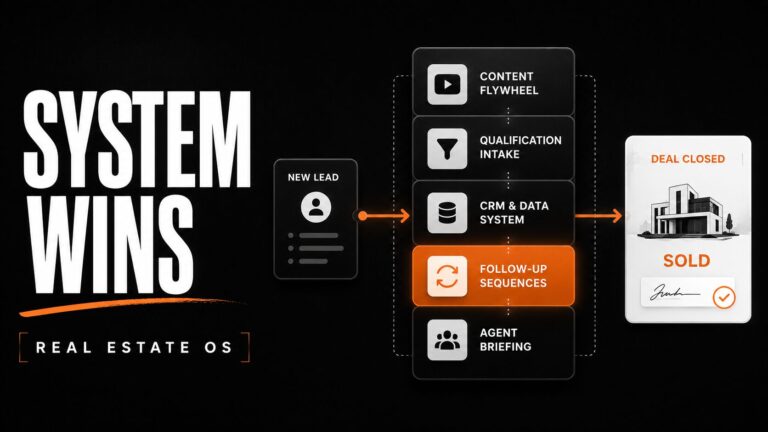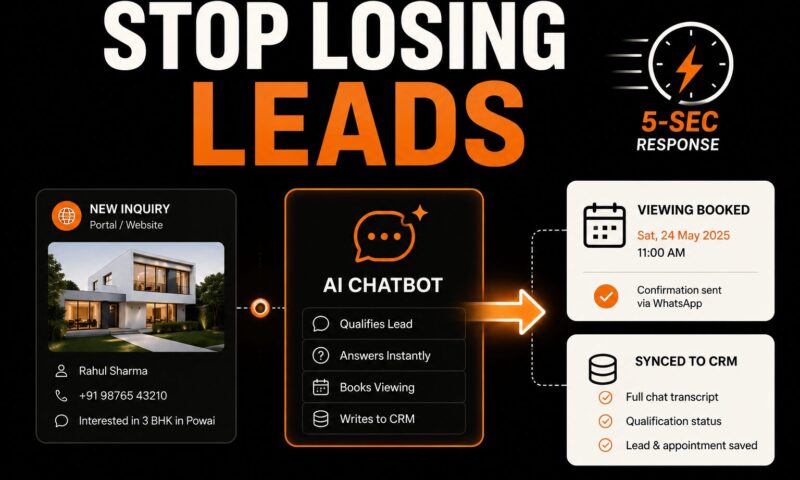
A real estate AI chatbot engages portal and website leads within seconds, qualifies them through a structured conversation, books viewings on the agent’s calendar, and writes the outcome back to the CRM without a human on the line. Brokerages in the US, India, and Dubai use chatbots to cut average lead response time from hours to under 5 seconds.
What a Real Estate AI Chatbot Actually Does
When brokerages say they want a chatbot, they usually mean three different things. Knowing which one fits the operation determines whether the deployment generates appointments or becomes background noise within 60 days. The distinction matters before any platform evaluation begins, because most vendors will sell the brokerage whichever product they happen to offer rather than the one the brokerage actually needs.
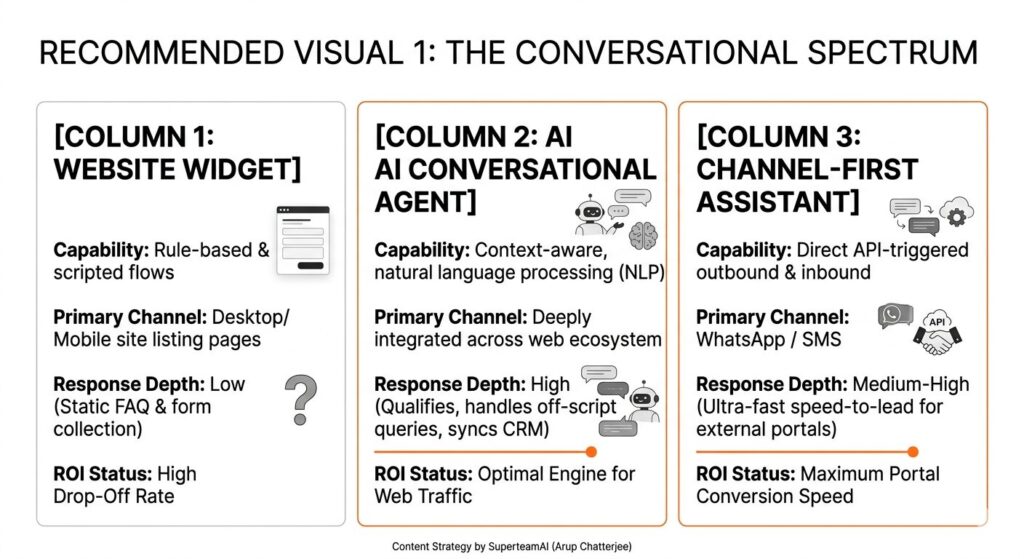
The three types every brokerage needs to know
A website chat widget is the simplest form: a popup on a listing page that captures contact information and answers scripted questions. It works for basic FAQ handling but fails when the lead asks an unexpected question or wants to book a showing at 9pm on a Friday. Most brokerages that report disappointing chatbot results were running a widget and expecting an agent.
An AI agent is a conversational system that handles open-ended exchanges. It tracks what the lead said three messages ago, adjusts its response based on new information, and can still guide the conversation toward a qualified next step even when the lead goes off-script. This is the category where most real estate operators need to be, and it is what most serious chatbot vendors now mean when they use the term AI chatbot for real estate.
An SMS-first or WhatsApp-first assistant works outside the website, reaching leads by text immediately after they submit a portal inquiry. It is the highest-speed option for converting new inbound leads from MagicBricks, Bayut, or Zillow because it meets the lead on the channel they are already using, rather than waiting for them to return to the brokerage website.
Four tasks the chatbot handles without a human on the line
28 percent of real estate businesses have adopted live chat technology, making it the leading AI bot application across all industries, with the primary use cases being initial lead qualification, appointment scheduling, FAQ handling, and automated follow-up for leads who go quiet after the initial inquiry, according to LocalIQ research on chatbot adoption across service industries including residential and commercial real estate.
The four tasks that produce measurable ROI are inbound lead qualification (asking the questions that determine whether the lead is worth an agent’s time), FAQ handling (property availability, pricing, area comparisons, viewing logistics), appointment booking (connecting the lead’s preferred time to the agent’s live calendar and confirming the slot), and automated follow-up (reaching leads who went quiet after the initial inquiry without requiring the agent to remember to call). Everything else a chatbot vendor demonstrates in a sales call is secondary to these four.
The 5 Conversation Flows That Determine ROI
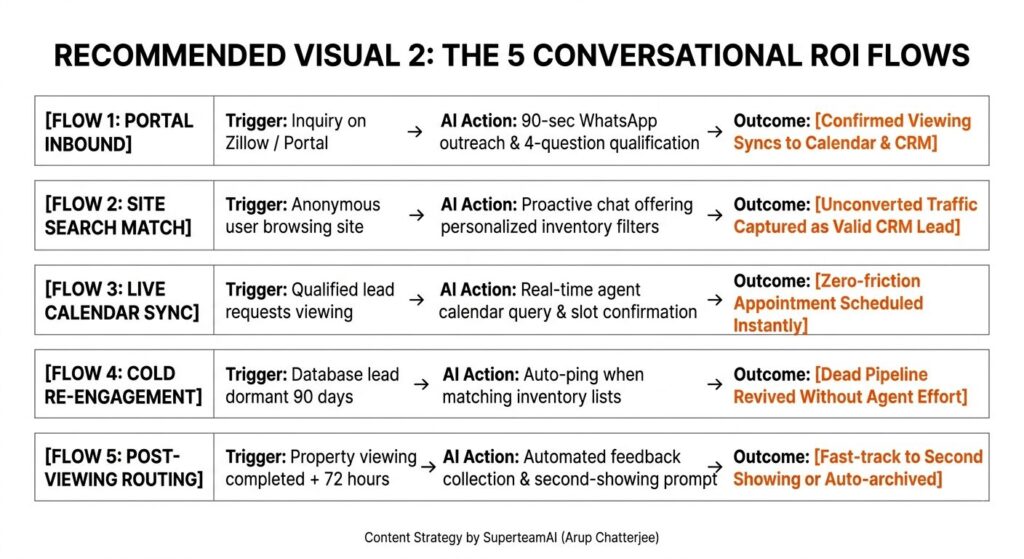
Chatbots that perform well in real estate do not improvise. They run the same five flows reliably, day after day, without a human touching the conversation until the lead has already confirmed a next step. Brokerages that deploy all five flows within 90 days of going live consistently outperform those that run only the first one.
Flow 1 – Inbound qualification from portal leads
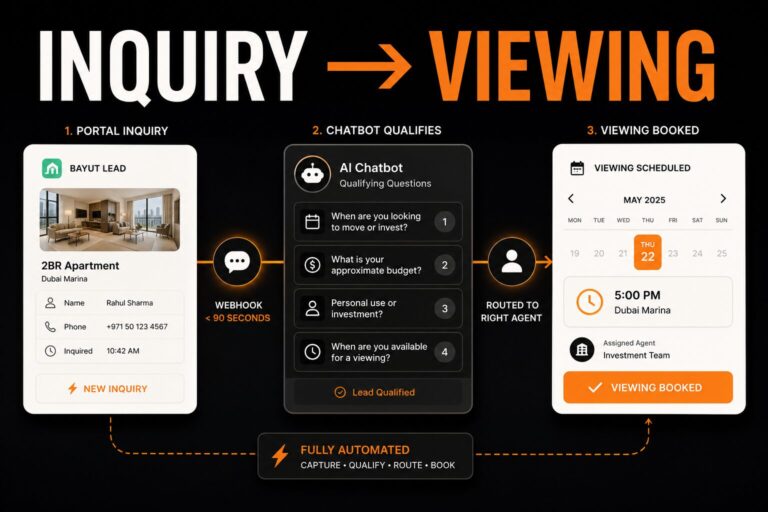
A new lead submits an inquiry on MagicBricks, 99acres, Bayut, PropertyFinder, or Zillow. The chatbot triggers within 90 seconds, introduces the brokerage by name, references the specific property the lead inquired about, and asks four qualifying questions: what is your timeline, what is your budget range, are you buying for personal use or investment, and when are you available to view. If the answers meet the brokerage’s qualification threshold, the chatbot presents three available viewing slots and books the appointment. The CRM receives the full conversation transcript, the qualification status, and the confirmed time. The agent walks into the showing knowing the lead’s budget, use case, and timeline before the first in-person conversation.
78 percent of homebuyers end up working with the first agent or brokerage that contacts them after submitting an inquiry, making response time the single most determinative variable in lead conversion ahead of agent experience level, brokerage brand recognition, and listing inventory, according to NAR and Inman research on buyer-agent selection patterns in residential real estate across the US.
Flow 2 – Property search and matching
A lead arrives on the brokerage website through organic search or a portal referral link and browses listings without submitting an inquiry. The AI agent initiates: it asks whether the lead is looking for something specific and offers to filter by area, budget, and ready date. The lead provides preferences. The chatbot surfaces two or three matching listings from the CRM inventory, asks which one the lead wants to know more about, and moves the conversation toward a viewing booking. This flow captures leads who would otherwise browse for several minutes and leave without converting, contributing nothing to the CRM.
Flow 3 – Appointment booking and calendar sync
A lead who has already qualified sends a message asking to see a specific property. The chatbot queries the agent’s connected calendar in real time, presents two or three available slots, and confirms the booking directly in the conversation. A confirmation message goes to the lead by WhatsApp or SMS within seconds. A 24-hour reminder goes automatically the day before. The agent’s calendar shows the appointment with the lead’s name, the property address, and the qualification summary that came out of the first conversation. No follow-up email needed from the agent, no back-and-forth on availability, no manual calendar entry.
Flow 4 – Cold re-engagement of dormant leads
A lead from 90 days ago inquired about a 3-bedroom apartment in Powai and then stopped responding after the first conversation. A new listing matching that profile comes on. The chatbot sends a message: “A property matching what you were looking for in Powai just listed. Do you want to see it this week?” No agent needed to remember the lead existed, manually search the old inquiry, or find the new listing and connect the two. The re-engagement flow runs against the full CRM database, not just the leads an agent happens to have tagged for follow-up.
Flow 5 – Post-viewing follow-up and next-step routing
A lead completed a viewing three days ago. No second showing has been booked and the agent has not heard back. The chatbot follows up: “How did the Juhu property feel? Ready to see a second option or would you like more detail on financing?” If the lead confirms interest in a second showing, the booking flow initiates immediately. If the lead says they are not interested, the chatbot logs the reason in the CRM and places the contact back into the re-engagement queue for a later trigger. Agents who previously relied on personal memory to manage post-viewing follow-up book significantly more second appointments when this flow runs automatically.
Where the Chatbot Sits in the Brokerage’s Technology Stack
How the chatbot connects to the CRM, calendar, and voice layer
The chatbot is not a standalone tool. It is the front end of a lead qualification stack that includes the CRM, the agent’s calendar, and in a complete deployment, the AI voice layer. A lead who engages with the chatbot and qualifies gets a booked viewing. A lead who does not respond to the chatbot – who submits an inquiry and ignores the first WhatsApp or website message – gets picked up by the AI voice caller, which dials the same lead within 90 seconds on a parallel trigger. The chatbot and the voice agent run on different channels but write to the same CRM record, so the agent sees a complete picture of every touchpoint before the first in-person conversation. For the full architecture of the CRM layer this connects to, see how the CRM-dialer stack connects to the AI calling layer.
The calendar integration is what closes the qualification loop. A chatbot that qualifies a lead but cannot book a real appointment is generating conversation without generating revenue. The connection must be direct: the chatbot queries the agent’s calendar in real time, presents live availability, and writes the confirmed appointment back to both the calendar and the CRM record. Any gap in this integration produces phantom bookings that agents cannot action, which kills team adoption within 30 days of go-live.
SaaS vs Managed vs Custom: Choosing the Right Architecture
The three deployment models are not price tiers for the same product. They are different architectures that require different capabilities to operate. Buying the wrong one based on monthly cost alone is how brokerages end up with a chatbot that nobody uses six months after launch.
When SaaS is the right call and when it breaks down
SaaS platforms work when the brokerage has someone with the technical capacity to configure the agent, write and maintain the qualifying scripts, monitor conversation quality, and update the CRM integration when something changes on the platform. The vendor handles the infrastructure. The brokerage handles the configuration. Monthly cost runs $50 to $1,500 depending on the platform tier and lead volume. Setup can take as little as two days when the brokerage’s CRM is natively supported.
SaaS chatbot platforms for real estate agents are priced at $50 to $1,500 per month depending on tier and monthly lead volume, with the lowest tiers covering website widget functionality and basic scripted qualification, while higher tiers add CRM integration, live calendar booking, and SMS or WhatsApp channel support, and with CRM configuration and script calibration handled by the brokerage rather than the vendor in most self-serve tier deployments.
SaaS breaks down at three consistent points. First, when no one at the brokerage has the time or technical skill to configure and maintain the integration on an ongoing basis. Second, when the brokerage’s CRM is not natively supported and requires custom webhook or API work that the vendor does not provide. Third, when the brokerage needs WhatsApp as the primary channel and the SaaS platform’s WhatsApp support is limited or locked behind a higher-cost enterprise tier.
What the managed deployment includes and who it is for
A managed deployment means the vendor configures the agent, builds the CRM integration, writes and calibrates the qualification scripts, monitors conversation quality, and updates the system when the brokerage changes its qualifying criteria, launches a new development, or expands into a new geography. Monthly cost runs $1,000 to $2,000. The brokerage does not need internal technical staff to manage the chatbot day to day. For brokerages without an in-house AI or technology team handling 100 to 500 portal inquiries per month, the managed model typically produces a lower total cost than a SaaS tool that no one properly maintains. For the pricing structure behind this comparison, see what an AI voice assistant costs compared to an ISA in each market.
Custom development is for enterprise brokerages or franchise networks that need compliance controls built into the conversation architecture, multi-brand management across multiple portals and geographies, or integration with proprietary systems that no SaaS platform supports natively. Build cost runs $5,000 to $150,000 depending on scope, with lead times of 6 to 16 weeks.
See how SuperteamAI deploys the AI chatbot layer for brokerage clients in India, Dubai, and the US
How Real Estate Chatbots Work in India – WhatsApp-First Deployment
Why WhatsApp changes the architecture for MagicBricks and 99acres leads
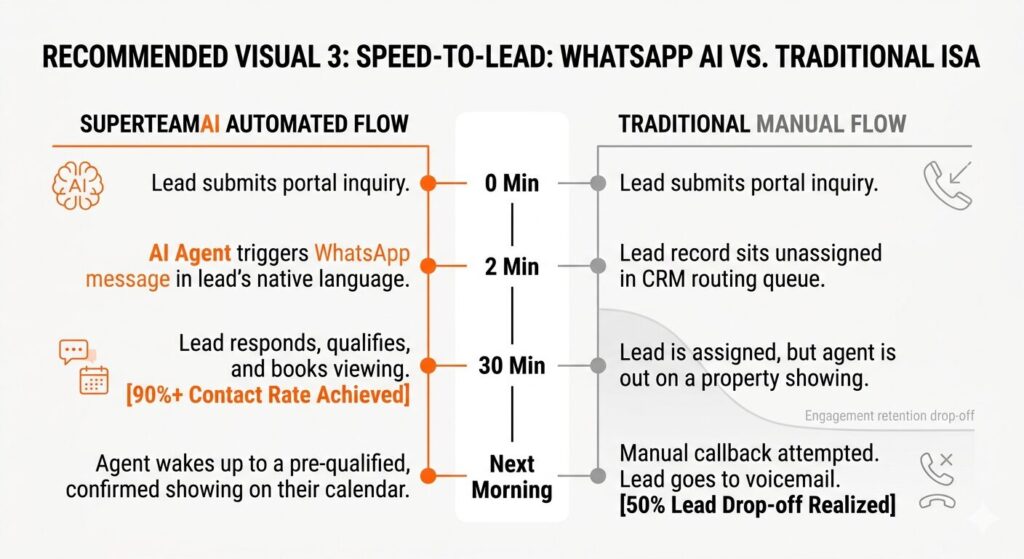
A MagicBricks or 99acres lead submits an inquiry on the portal from their phone and waits. In most brokerages, that wait runs from several hours to the next working morning. The lead did not submit the inquiry expecting to wait. They submitted it from the same device where they conduct most of their conversations, and that device runs WhatsApp. The brokerage that sends a WhatsApp message within 90 seconds of the inquiry arrives in the pipeline gets the conversation. The brokerage that sends an email at 9am the next day does not.
Real estate brokerages in India that deploy WhatsApp-first AI chatbots for portal lead qualification report lead contact rates above 90 percent within the first hour of inquiry submission, compared to contact rates of 50 to 65 percent for teams relying on manual calling or next-morning email follow-up, because WhatsApp message open rates in the Indian market exceed 90 percent compared to 20 to 30 percent for email, making WhatsApp the operationally correct primary channel for portal lead response in India’s residential brokerage market.
This means the chatbot architecture for a brokerage running MagicBricks or 99acres leads is WhatsApp-first, not website-first. The trigger is the portal inquiry. The channel is WhatsApp. The qualification conversation happens in the lead’s preferred app, in English or Hindi depending on the lead’s opening message, with qualifying questions calibrated to the property type and price point the lead originally inquired about. The CRM receives the WhatsApp transcript, the qualification outcome, and the booked viewing slot. The flow is identical to the website qualification flow in structure but delivered through the channel where the lead is actually reachable.
How Real Estate Chatbots Work in Dubai – Arabic, WhatsApp, and RERA
What RERA compliance requires in a chatbot script for off-plan properties
Dubai runs the same WhatsApp-first architecture as India, with two additional requirements that no brokerage can skip. First, the chatbot must detect the language of the lead’s opening message and respond in that language without routing to a separate bot. A GCC investor messaging from Riyadh or Kuwait City in Arabic receives the qualification conversation in Arabic. A European or South Asian buyer messaging in English receives it in English. The language detection and response happen automatically in a properly configured multilingual deployment.
In Dubai’s real estate market, where over 90 percent of property inquiries from GCC-based investors arrive via WhatsApp and a significant share are initiated in Arabic, AI chatbot deployments require automatic language detection and response generation in both Arabic and English to avoid lead drop-off at the first message exchange, with single-language English-only deployments reporting materially lower engagement rates from GCC investors compared to bilingual chatbot configurations in the same brokerage lead pipelines.
Second: the chatbot script for off-plan properties must comply with RERA regulations governing agent-to-client communications. The script cannot state developer completion timelines, projected ROI percentages, unconfirmed payment plan structures, unverified unit availability, or investment return figures unless the developer has formally published that information through official channels. A chatbot that makes an unauthorized representation about an off-plan project creates the same regulatory exposure as a human agent making the same statement in a sales call. The compliance review of every chatbot script template used for Dubai off-plan inventory is not optional – it is a required step before any automated chat campaign goes live.
What a Real Estate AI Chatbot Costs in 2026
Cost comparison across three brokerage sizes
Managed AI chatbot deployments for real estate brokerages handling 100 to 500 portal inquiries per month cost $1,000 to $2,000 per month including CRM integration, script calibration, WhatsApp channel setup, multilingual configuration where required, and ongoing script maintenance and quality monitoring, compared to SaaS platform costs of $50 to $1,500 per month for self-configured deployments where the brokerage manages its own integrations, script updates, and quality reviews without vendor support.
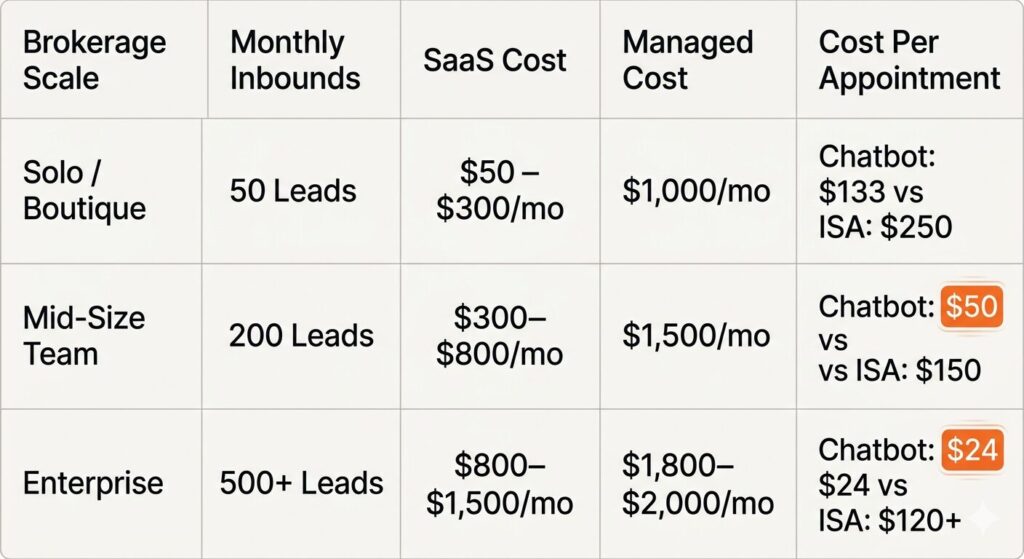
The comparison that produces the correct decision is not monthly platform cost – it is cost per booked appointment from each model. A mid-size brokerage running 200 portal leads per month at a 15 percent connect-to-appointment rate books 30 appointments. At a managed deployment cost of $1,500 per month, that is $50 per booked appointment. At a human ISA cost of $4,500 per month, assuming the ISA contacts all 200 leads on the same day they arrive, which does not happen in practice, the cost per booked appointment runs $150 or higher. The chatbot does not take weekends off, does not have a shift end, and contacts the 11pm inquiry with the same speed it contacts the 10am one.
Real estate brokerages that measure cost per booked appointment as the primary ROI metric for AI chatbot deployments consistently report positive returns within 60 to 90 days of go-live, with the cost advantage over human ISA-produced appointments widening as monthly lead volume rises above 150 portal inquiries per month, because the managed chatbot monthly cost remains largely fixed while ISA costs scale linearly with the volume of leads requiring follow-up.
Book a call to see the SuperteamAI chatbot OS running on a live brokerage lead pipeline
What to Ask Before Committing to a Platform
Six questions that surface the real cost and capability before you sign
85 percent of real estate technology decision-makers report plans to increase investment in chatbot and conversational AI tools within the next 12 months, and 92 percent believe AI chatbot integration provides a measurable competitive edge over brokerages that rely on manual follow-up for portal leads, according to JLL Research on technology adoption in commercial and residential real estate operations globally.
Most chatbot evaluation conversations focus on the demo. The demo shows a clean qualification flow with a cooperative lead who answers every question exactly as scripted. It does not show what happens when the lead writes in Hindi, asks about a property that was sold three weeks ago, or sends a message at 1am on a Saturday with two words and a question mark. These six questions surface the gaps before the contract is signed.
Is WhatsApp included in the base monthly price or is it a separate channel add-on with its own setup fee and ongoing cost? Is CRM integration native to the platform or does it run through a third-party connector that the brokerage configures and maintains independently? What happens when the lead asks a question outside the script – does the chatbot fail gracefully with a handoff, or does it loop in a way that ends the conversation? Can the qualification script be updated by the brokerage team without a developer when criteria or property types change? For Dubai off-plan deployments: has the vendor completed a RERA compliance review of the specific script template they plan to use, and can they show it in writing? What is the minimum contract term and what triggers an early termination fee if the deployment underperforms?The vendor who answers all six clearly in the first meeting, without requiring a follow-up demo, is the one who has deployed this before in a real brokerage environment. For how the same due-diligence discipline applies to the AI voice calling layer that runs parallel to the chatbot, see how AI cold calling for real estate handles leads who do not respond to chat.