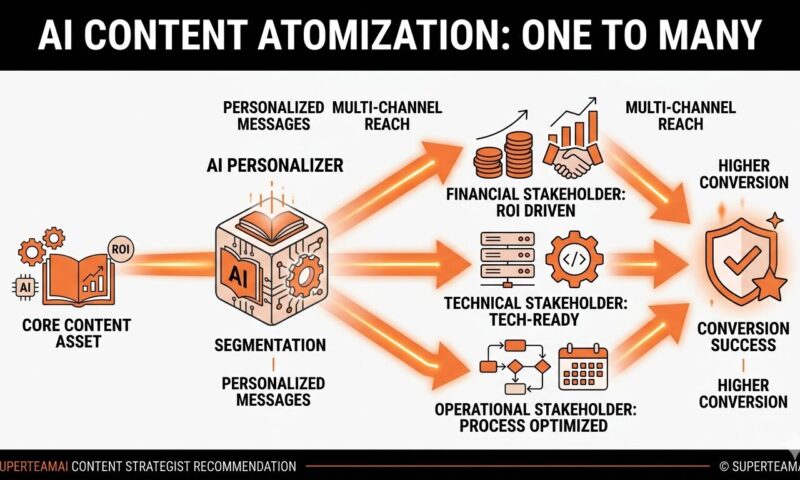
AI B2B lead generation applies machine learning and behavioral data to identify and engage potential business buyers across longer sales cycles and multi-stakeholder buying committees. Unlike consumer lead generation, the B2B model scores accounts as well as individual contacts, aggregates intent signals across buying committees, and sequences outreach to reach multiple decision-makers simultaneously rather than converting a single buyer.
Most AI lead generation frameworks are built for single-buyer conversion. A contact shows intent, scores above threshold, and receives outreach. The logic is clean and works well when one person makes the purchase decision.
B2B deals rarely work that way. The buying committee is a structural feature of complex sales, not an edge case. Understanding how that structure changes the pipeline architecture is what separates AI B2B lead generation that produces qualified pipeline from AI lead generation applied to a B2B context without adjustment.
What Makes AI B2B Lead Generation Different From Generic Approaches
The Buying Committee Problem: Why Contact-Level Scoring Misses the Deal
In a B2B purchase, multiple stakeholders evaluate the solution from different angles. The economic buyer assesses budget and ROI. The technical evaluator assesses integration and risk. The end-user champion assesses workflow fit. Each stakeholder has a different set of signals that indicate intent, and none of them alone represents the account’s readiness to buy.
A contact-level scoring model that flags the champion as high-priority will route that contact into outreach while the economic buyer and technical evaluator are still in early-stage research. The outreach arrives before the buying committee has aligned internally, and the timing produces low conversion regardless of how well the message is personalized.
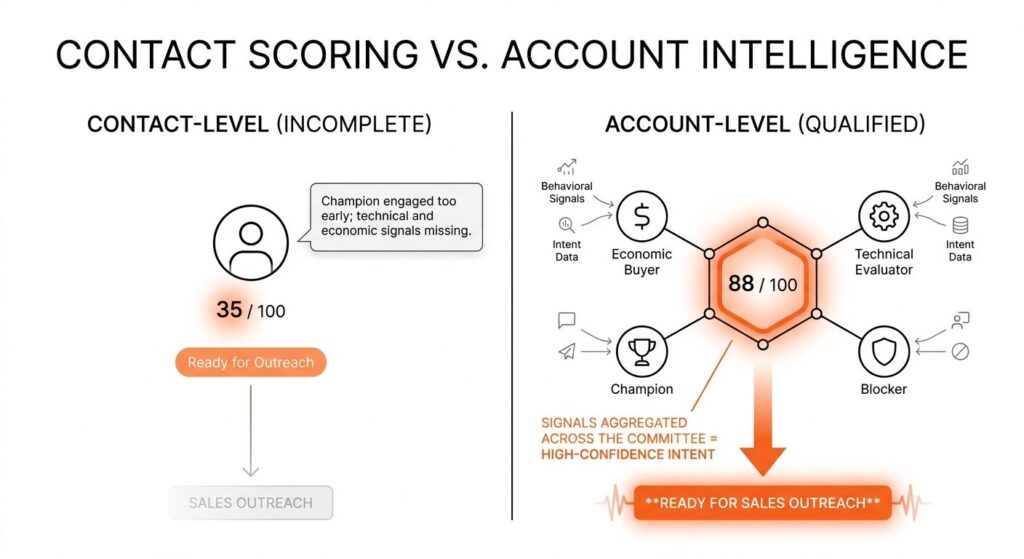
Account-level scoring aggregates signals across all identified committee members and produces an account readiness score that reflects where the buying group as a whole sits in the evaluation process. This is the foundational architectural difference that B2B lead generation requires. [VERIFY: average B2B deal involves 6 to 10 stakeholders and takes 3 to 9 months from first intent signal to close depending on deal size, per Gartner and CEB research]
How Sales Cycle Length Changes Signal Interpretation
A B2B intent signal that fires today may reflect a buying process that will not reach a decision for 60 to 90 days. In consumer lead generation, a pricing page visit is a strong near-term conversion signal. In B2B, the same visit may be the first research action in a multi-month evaluation. Acting on it as a late-stage signal produces premature outreach and conditions the prospect to ignore future contact.
B2B signal interpretation requires a time-weighted model that distinguishes early-stage research signals from late-stage evaluation signals. A contact visiting your blog for the first time is at a different stage than one who has returned to your pricing page three times, requested a case study, and whose company has three other employees engaging with your content simultaneously. [VERIFY: B2B intent signals typically indicate active evaluation 30 to 90 days before a purchase decision, compared to hours or days in B2C contexts] On average, converting a B2B prospect to a sales-qualified lead requires approximately 12 distinct touch points across multiple channels and stakeholders. [VERIFY: average of 12 touch points required to convert a B2B prospect to a sales-qualified lead, per Salesforce and SiriusDecisions research]
Account-Based vs. Contact-Based: The Foundational Architecture Decision
What Account-Based AI Lead Generation Requires at the Data Layer
Account-based AI lead generation tracks and scores activity at the company level, then identifies the individuals within that company who are showing engagement signals and maps them to their likely buying committee role.
This requires a richer data layer than contact-based approaches. The system needs firmographic data to identify which accounts fit the ICP, technographic data to assess fit and urgency, and the ability to associate individual contact signals with their parent account record. Most CRM configurations are not set up for this by default. Contacts exist as individual records without consistent account linkage, which means the account-level aggregation logic has to be built or configured before the scoring model can operate correctly.
When Contact-Based Approaches Still Make Sense in B2B
Contact-based approaches remain appropriate in B2B contexts where the deal involves a single decision-maker: small business sales, individual practitioner services, or product-led growth motions where a single user can sign up and expand the account independently.
The decision between account-based and contact-based architecture should be made before any other configuration choice. It determines the data model, the scoring logic, and the outreach sequencing design. Applying the wrong architecture to your deal type produces a pipeline that generates activity but not qualified opportunities. The implementation sequence covers how to map this decision to your specific pipeline characteristics before building.
Buying Committee Signal Aggregation: Scoring Accounts, Not Just Contacts
How Account-Level Scoring Works Across Multiple Stakeholders
Account-level scoring treats the sum of signals across all identified contacts at a target company as a single composite readiness indicator. A company where three employees have visited your site in the past two weeks, two have opened sequence emails, and one has downloaded a technical evaluation guide is further along in the buying process than a company where only the champion has engaged.
The scoring model weights signals by their position in the buying journey and by the seniority and role of the contact generating them. An engagement from someone in a VP or C-level role carries more weight than the same engagement from an individual contributor. An engagement from a finance stakeholder adds a dimension that suggests budget awareness has entered the process. [VERIFY: account-based AI approaches report 30 to 40 percent higher pipeline conversion rates than contact-only scoring in B2B contexts, based on vendor case studies from Demandbase and 6sense]
The Champion and Blocker Problem: Weighting Signals by Stakeholder Role
Not all buying committee members contribute equally to the purchase decision, and their engagement signals should not be weighted equally in the scoring model. The economic buyer’s engagement is a stronger purchase signal than the technical evaluator’s, because economic approval is the final gate. [VERIFY: buying committee size scales significantly by deal tier: SMB deals typically involve 1 to 3 stakeholders, mid-market deals 4 to 7, and enterprise deals 10 or more active evaluators, per Gartner and CEB buyer research]
Role-based signal weighting requires that your enrichment layer identifies stakeholder roles accurately. A scoring model that cannot distinguish a CFO’s pricing page visit from an intern’s will weight them identically, producing a composite score that does not reflect actual buying committee readiness. This is one reason why enrichment quality is more consequential in B2B than in consumer lead generation: the role data that informs weighting is a B2B-specific requirement with no equivalent in single-buyer contexts.
The B2B Data Layer: Firmographic, Technographic, and Intent Inputs
Firmographic Data: What the Scoring Model Needs Beyond Company Size
Firmographic data in a B2B scoring model extends significantly beyond company size and industry. The fields that produce meaningful predictive lift are those that reflect structural fit with your existing customer base: revenue range, growth rate, headcount by department, funding stage and recency, geographic market, and organizational structure. [VERIFY: fewer than 50 percent of B2B CRM records have complete firmographic data across all ICP criteria fields at the time scoring is configured, based on data quality audits from Salesforce and HubSpot research]
Incomplete firmographic data is one of the most common reasons B2B scoring models underperform at launch. If critical ICP fields are missing for a significant portion of the contact universe, the model cannot apply its weighting logic to those records and either defaults to a lower-confidence score or excludes them entirely.
Technographic Signals and Why They Matter in B2B Qualification
Technographic data identifies which software and infrastructure a target company currently uses. In B2B sales, this serves two distinct purposes. First, it surfaces companies that are already operating the adjacent tools your product integrates with, which significantly lowers evaluation friction. Second, it identifies companies using a competitor’s product that has known limitations relative to your offering, creating an urgency signal that firmographic data alone cannot produce.
Companies that use tools with verified overlap with your existing customer base show materially higher conversion rates than firmographic-match companies without technographic alignment. [VERIFY: B2B leads with verified technographic overlap with existing customers show 2 to 3 times higher conversion rates than firmographic-only matched leads, per Clay and Clearbit case study data] Adding technographic signals to the scoring model is one of the highest-ROI data layer investments available in B2B pipeline configuration.
SuperteamAI builds B2B lead generation pipelines configured for account-level scoring and multi-stakeholder outreach, not repurposed consumer lead generation tools applied to complex deals.Talk to the team
Signal Timing in B2B: How Longer Sales Cycles Change the Intent Window
Early-Stage vs. Late-Stage Intent Signals in a 90-Day Buying Process
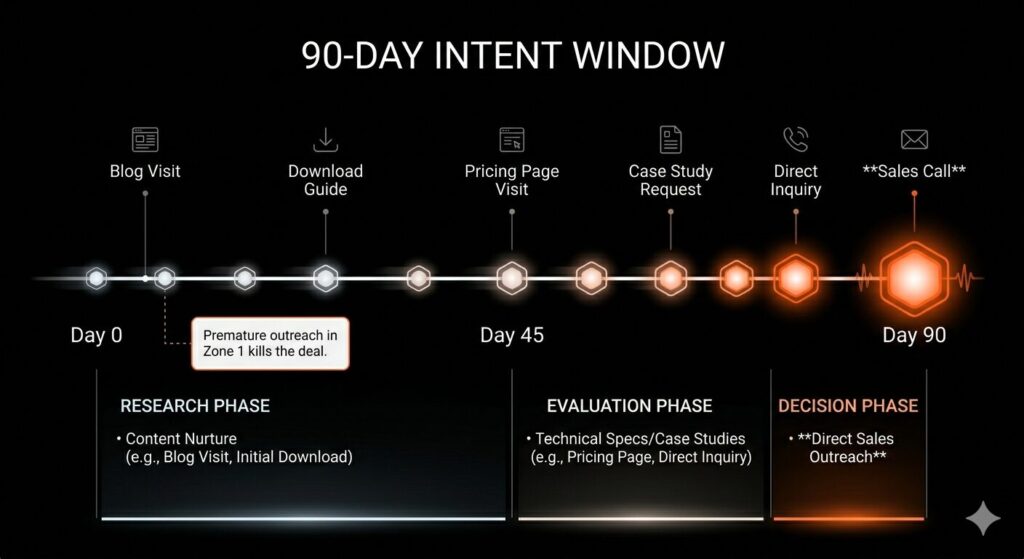
B2B buying processes contain distinct signal phases that require different responses. Early-stage signals, typically 60 to 90 days before a decision, indicate that a company has begun researching a category. These include first visits to educational content, initial email opens, and broad-topic intent data from third-party publisher networks. Responding to early-stage signals with late-stage sales outreach produces negative engagement that removes the prospect from the pipeline prematurely.
Late-stage signals indicate that the evaluation is narrowing and a decision is approaching: repeated visits to pricing and comparison content, requests for technical documentation, multi-stakeholder engagement within a short window, and direct product inquiry. These are the signals that should trigger direct sales outreach rather than nurture content.
Configuring the scoring model to distinguish between early and late-stage signals requires setting up a signal taxonomy that maps specific behavioral events to buying process stages, not just converting them directly to score points. The AI lead generation tools guide covers how specific platforms handle this tiered signal architecture.
Recalibration Cadence for B2B Pipelines
B2B scoring models require more frequent recalibration than their consumer counterparts because the longer sales cycles produce outcome data more slowly. A consumer-facing model can accumulate hundreds of conversion events in a month. A B2B model working with a 90-day average sales cycle may produce only a handful of closed-won records in the same period.
This means the scoring model is operating with lower statistical confidence for longer. Quarterly recalibration is the minimum cadence. Each review should assess whether the accounts the model rated highest in the prior quarter are progressing through the pipeline as expected, and whether new closed-won records reveal attributes the current model is not weighting correctly.
Multi-Stakeholder Outreach Sequencing: Coordinating Across Buying Committees
Parallel vs. Sequential Outreach to Multiple Decision-Makers
Contact-based sequencing sends a series of messages to one person and advances based on that person’s response. Multi-stakeholder sequencing sends coordinated but distinct tracks to multiple committee members simultaneously, so the account experiences a coherent set of touchpoints rather than receiving the same message through multiple inboxes.
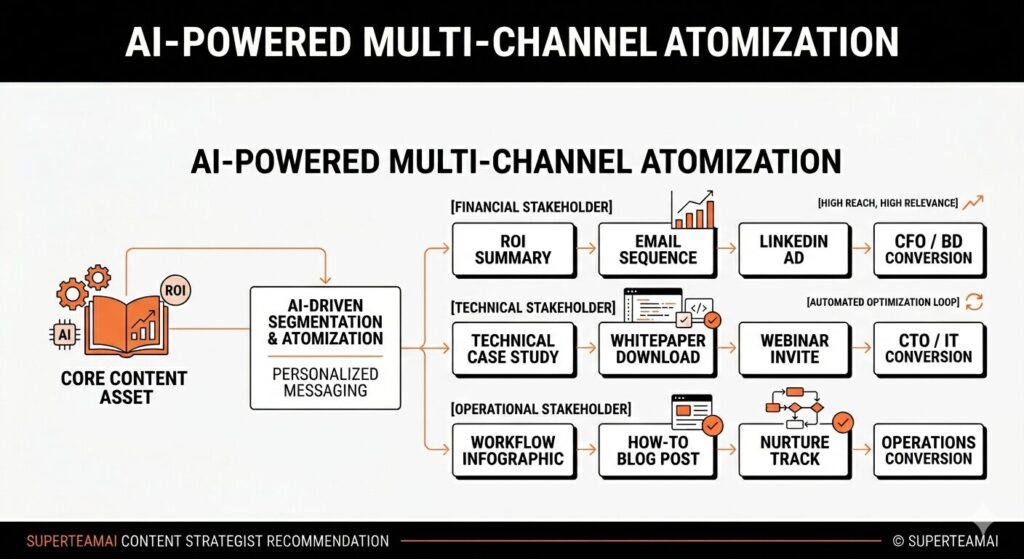
Parallel outreach requires that each track is differentiated by stakeholder role. Sending identical content to the CFO and the technical evaluator signals that the outreach is automated and generic, which reduces credibility at precisely the stage where it matters most. Each track should address the specific concerns and evaluation criteria relevant to that stakeholder’s role in the buying process. [VERIFY: role-personalized outreach to buying committee members reports 20 to 40 percent higher engagement rates than generic outreach to the same accounts, based on vendor data from Outreach and Salesloft]
Message Differentiation by Stakeholder Role and Buying Stage
The CFO track should address business impact, cost of status quo, and ROI evidence. The technical evaluator track should address integration complexity, security requirements, and implementation timeline. The end-user champion track should address workflow impact and day-to-day efficiency gains. Each message pulls from the enriched contact record to confirm role and seniority before the personalization logic fires.
Building differentiated tracks requires that your enrichment layer has correctly identified each stakeholder’s role and that your outreach platform supports parallel sequencing with role-based branching logic. Most entry-level outreach tools do not support this natively. The cost implications of building or buying this capability are covered in the AI agent development cost breakdown.
What AI B2B Lead Generation Looks Like for Marketing Agencies and Professional Services
Marketing Agencies: Building the B2B Sequence for Client Acquisition
Marketing agencies selling to B2B clients face the same multi-stakeholder dynamic their clients face: a typical agency deal involves a marketing director, a CMO or VP, and often a finance stakeholder for any contract above a threshold. An AI lead generation system configured for single-contact outreach will surface one name per target company and miss the committee.
For agency client acquisition, account-level scoring should aggregate signals from the target company’s marketing, finance, and executive contacts. Outreach tracks should differentiate between the marketing decision-maker (who evaluates capability) and the economic decision-maker (who evaluates cost and contract risk). Agencies that have configured this architecture for their own pipeline are better positioned to build it for clients as a service offering, with direct experience of where each configuration step can fail.
Professional Services Firms: Adapting Account Scoring for Relationship-Driven Pipelines
Professional services firms, including management consultants, law firms, and specialized advisors, operate in markets where relationship signals carry more weight than behavioral intent signals. A contact who has attended a webinar, downloaded two reports, and connected with a partner on LinkedIn is showing a different kind of intent than a contact who visited a pricing page three times.
For relationship-driven pipelines, the scoring model needs to incorporate engagement quality signals alongside engagement volume signals. A single high-quality interaction with a senior partner is a stronger buying signal than five low-engagement touchpoints with a junior researcher. Configuring the model to reflect this requires either platform-level customization or a custom scoring build. The AI lead generation pillar covers the decision framework for when platform-level configuration is sufficient and when a custom model produces meaningfully better B2B pipeline results.
SuperteamAI deploys AI B2B lead generation systems for marketing agencies and professional services firms with deal cycles that require committee-level coordination, not contact-level spray.See how the system works for your pipeline
Frequently Asked Questions
What is the difference between AI B2B lead generation and AI lead generation generally?
AI lead generation generally is optimized for single-buyer conversion: one contact scores high, receives outreach, and either converts or does not. AI B2B lead generation accounts for the buying committee: multiple stakeholders at the same account are tracked, scored together, and receive coordinated but differentiated outreach. The architecture, data requirements, and outreach logic are all meaningfully different.
How many stakeholders should a B2B scoring model track per account?
The number depends on deal size. SMB deals typically involve one to three stakeholders. Mid-market deals involve four to seven. Enterprise deals frequently involve ten or more, and tracking all of them simultaneously requires a data infrastructure that most SMB-tier platforms do not support natively. Start by identifying the three to four roles that most commonly appear in your closed-won deals and build the committee model from there.
Does AI B2B lead generation work for short-cycle B2B sales?
Yes, with a simplified architecture. Short-cycle B2B deals with low contract values often involve a single decision-maker and a buying process that resembles a consumer purchase. In those cases, contact-level scoring is appropriate and the full account-based architecture is unnecessary overhead. The architecture decision should be driven by your actual deal structure, not by a generic recommendation to go account-based.
What data is most important for B2B lead scoring accuracy?
In order of predictive value: technographic overlap with your existing customer base, firmographic fit across ICP criteria, behavioral intent signals from first-party and third-party sources, and engagement quality from previous outreach interactions. Firmographic data alone produces a lower-accuracy model than one that incorporates technographic and behavioral signals alongside it.
How do you handle accounts where only one stakeholder is showing intent signals?
Single-stakeholder intent at an otherwise strong-fit account is an early-stage signal. The appropriate response is nurture content targeted at the engaged stakeholder rather than direct sales outreach. As additional committee members begin showing engagement, the account score rises toward the threshold that triggers outreach. Contacting the single engaged stakeholder with a sales sequence before the broader committee is engaged typically produces a stalled deal rather than a progressed one.


